English
 Español
 Français
 Deutsch
 Italiano
 Português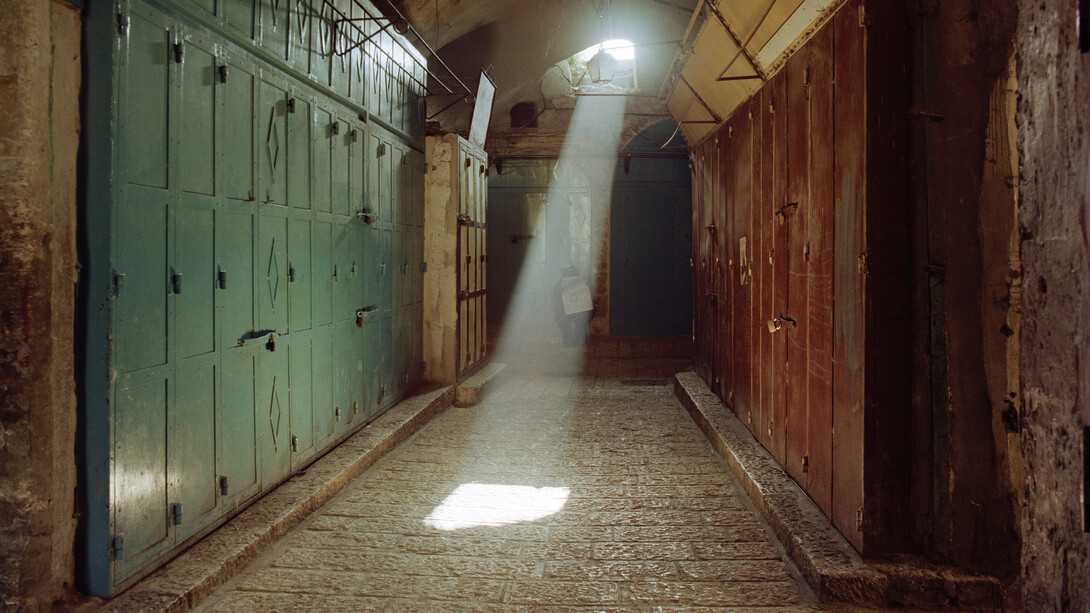
One evening, on my way home after a rainy day spent working on an image of a cat poised on the final step of a stone staircase—about to leap from the deep shadow of a baobab tree into the brilliant light of the Mediterranean midday sun—I suddenly caught sight of an enormous neon palm tree. Through the rain-streaked bus window, directly at eye level, its shimmering, surreal glow appeared before me like an unsettling vision. This encounter marked the beginning of a new series entitled La Creazione (The Creation), in which neon signs resembling natural forms and human-made objects were isolated against the city’s night sky. It also signalled the beginning of a profound crisis: a creative hiatus that lasted more than three years—a period of silence and of wandering through the compelling mystery of existence—from which a decisive transformation in both my life and my photography ultimately emerged.
(Giovanni Chiaramonte, Terra del ritorno. Jaca Book, 1989)
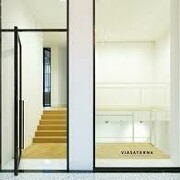
Viasaterna is pleased to present Alight, a monographic exhibition dedicated to Giovanni Chiaramonte (Varese, 1948–Milan, 2023), curated by Luca Fiore in collaboration with the Giovanni Chiaramonte Archives. Bringing together 75 photographic works, the exhibition explores light as both its central theme and the subject of each individual image. It features some of the artist’s best-known photographs alongside previously unseen works. For the first time, the complete 1975 series La creazione/Neon will be presented in its entirety.
The series comprises details of colourful neon signs photographed with a telephoto lens and printed using an inkjet process. The exhibition also revisits Di-Stanze, an important series from 2001 exploring Villa Panza in Varese and its collection. In 1970, Chiaramonte first discovered the fluorescent-light installations of American artist Dan Flavin, whose work played a key role in the development of Minimalism. Years later, he encountered them again at Villa Panza. During his visit to the villa, Chiaramonte realised that Panza had arranged the rooms housing Flavin’s works as camera obscuras.
This renewed encounter with fluorescent light and its transformation of spatial perception brought Chiaramonte, twenty-seven years after La creazione/Neon, back to the central themes of that earlier series: light and shadow, darkness and projection, and the creation of the image itself—the fundamental principles of photography.
All the works in the exhibition are drawn from Chiaramonte’s personal photographic archive and from materials preserved by the artist during his lifetime. Alight marks the first in a series of initiatives devoted to the study and promotion of Giovanni Chiaramonte’s artistic legacy.
The exhibition Alight traces Chiaramonte’s career through the relationship between light and shadow, a recurring theme throughout his work. His approach is rooted in a theological understanding: just as evil is the absence of good, darkness is the absence of light. Light as a metaphor for the act of creation is fundamental to Western culture; in the opening verses of Genesis, light is God’s first creation.
Chiaramonte’s originality lies in his ability to translate this fundamental idea into images. He developed this approach in the 1970s, when the influence of Conceptual Art was moving photography away from the direct representation of the world. During this period, he maintained close relationships with Paolo Monti, Luigi Ghirri and Arturo Carlo Quintavall. He also engaged with Adriano Altamira, Gianfranco Pardi and Emilio Tadini, as well as with Giuseppe Panza di Biumo and the works in his collection, particularly those of Robert Ryman and Dan Flavin. One of Chiaramonte’s earliest photographic sequences, La creazione/Neon, takes its inspiration from the opening verses of Genesis.
The series was presented at the Galleria d’Arte Moderna in Modena in 1975. Its subjects are details of colourful neon signs photographed with a telephoto lens. By setting the exposure according to the light emitted by the neon, Chiaramonte rendered the background entirely black, isolating the individual forms. At the time, the photographs were produced as Cibachrome prints from 35mm slides. The sequence reappeared a few years later in the Enciclopedia pratica per fotografare (Fabbri, 1979), where Arturo Carlo Quintavalle drew a parallel between the neon imagery of La creazione/Neon and the works of Dan Flavin.
In 2016, Chiaramonte revisited the original slides in collaboration with printer Mario Govino. Together, they digitised each image and produced a new series of inkjet prints. Compared with the original Cibachrome process, digital printing offered a wider range of tones in the shadow areas and more precise control over contrast. Chiaramonte felt that these new prints reflected his original vision more closely than those produced at the time. The complete series of prints is presented in the exhibition.
In a biographical and programmatic text published in Terra del ritorno (Jaca Book, 1989), the artist reflected on the meaning of the series more than a decade after its creation. He recalled the profound impression made by his encounter with an enormous neon palm tree, alongside a number of other images—including arrows, aeroplanes, a house, the silhouette of a cat, a clock, and the faces of a man and a woman brought close together. For Chiaramonte, these images were signs of a civilisation that had lost touch with the mystery of life and was no longer able to represent the world.
The photographs in the central section of Alight date from the 1980s to the early 2000s. They are drawn from Paesaggio italiano, a series that remains partly unpublished, and from the books Terra del ritorno, Penisola delle figure, Westwards and Dolce è la luce. Chiaramonte often compared his use of light to that of Tarkovskij, whose work was shaped by the Byzantine idea of divine radiance. However, Chiaramonte interpreted this idea through his own Western Christian perspective, exploring the balance between pure light and the shadows it creates. For him, these two elements were inseparable and fundamental to both everyday life and photography.
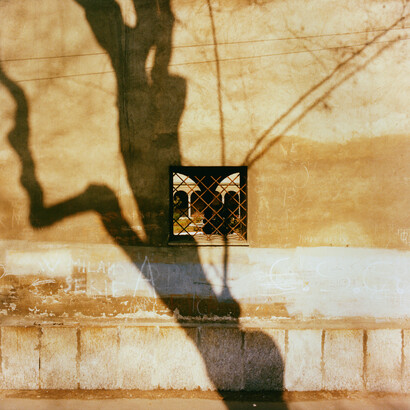
The photographs in the exhibition are arranged in diptychs and triptychs according to a curatorial approach that highlights recurring themes both in Chiaramonte’s work and throughout the history of photography. These include the topos of the cast shadow—whether of a tree or a building—and the beam of light that pierces the darkness. Particularly significant is the photograph taken from inside the Ogre in the Park of the monsters at Bomarzo. Within this darkness, the photographer evokes a mind illuminated from outside and the first glimpse of Plato’s cave entrance. Curator Luca Fiore explains, “The juxtaposition with the previously unseen self-portrait, in which Chiaramonte photographs his own shadow, reveals his outlook, both as a person and as an artist: the photographer works in the shadows, watching the forms of the world emerge as projections of light or as sudden illuminations of Grace. The photograph taken at Bomarzo is a powerful expression of the artist’s vision. Chiaramonte places himself at the threshold of discovering the reality of the world—a discovery made possible by the mysterious action of light, which can both conceal and reveal.”
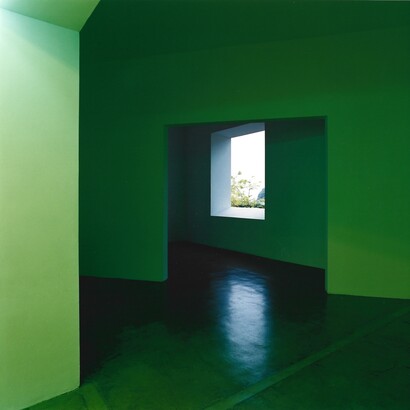
The final section of the exhibition presents thirteen photographs from Di-stanze, a sequence created by Chiaramonte at Villa Panza di Biumo in 2001 and exhibited the following year at Galleria San Fedele in Milan. The series was not intended as a documentary record. Instead, Chiaramonte sought to use the camera as an instrument of critical reflection, creating a work of art that would also offer a critical interpretation of its subject: the villa and the collection it houses, its architecture and park, and the artworks conceived for these spaces, particularly those of Dan Flavin. At Villa Panza, Chiaramonte encountered Flavin’s work again, twenty-seven years after photographing the neon lights of La creazione. In the former stables, he noticed small openings in the walls of the rooms containing Flavin’s installations and asked Panza about their purpose. Panza jokingly replied that anyone who felt confined by the space could look through them and see outside. Unconvinced, Chiaramonte stepped outside and discovered that the windows had been covered with mirrors. He then realised that each room, illuminated through a single pinhole, functioned as a camera obscura, and asked for the neon lights to be switched off. In the darkness, an inverted image of the landscape outside the villa appeared on the wall opposite the opening: light, pinhole, projection, image. The fundamental principles of photography were thus revealed within a Minimalist installation that had appeared to move beyond the photographic medium.
In Chiaramonte’s photographs of the spaces created by Robert Irwin and James Turrell, the same visual topoi encountered in the previous rooms reappear: cast shadows and beams of light cutting through darkness. Chiaramonte recognised a shared approach to light. This affinity is particularly evident in his photograph of Maria Nordman’s Varese room (1976), where a narrow blade of light opens up the darkened space. The same line of light reappears in the opening image of La creazione.