English
 Español
 Français
 Deutsch
 Italiano
 Português
Since the advent of agriculture some 12,000 years ago 1, food has been available in a larger volume than during the hunting and gathering period or, for that matter, in any other time in recorded human history. More people were fed, food security increased, produce was available for sale in the marketplace, and as a result, prosperity among many more people increased.
The premise here is simple: when people have enough food for their family and are food secure, when they have a surplus to sell, they stabilize their food and economic security. They then naturally want to protect and preserve what they have, which is to say, live at peace with their neighbors and community.
When a certain approach to farming is utilized—which is the most natural, organic approach, now called regenerative agriculture or farming—a handsome crop yield is pretty well assured absent any unseen catastrophe.
With this very natural, cost-effective approach to farming, the solution to challenges that have been plaguing humanity for so long—hunger, poverty & sustaining peace—is really at our fingertips.
What is regenerative farming?
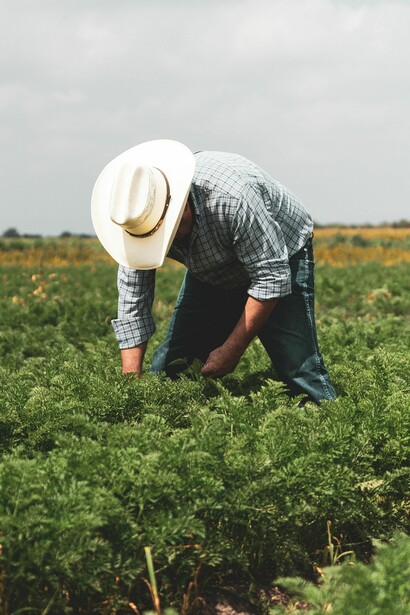
It is an approach to farming and agriculture that aligns with Nature. That is, the focus is on cultivating healthy soil flourishing with bacteria, fungi, and microbes, each of which plays a vital role in nourishing it. Soil degraded by chemical fertilizers, pesticides, and insecticides has proven to be the main obstacle to a flourishing farm, despite advertising and virtual market control.
Without their use, soil is able to be restored to its natural condition.
With regenerative farming, soil is no longer tilled, and animal grazing is encouraged. Natural principles such as these are core to the regenerative farmer. It is largely aligned with organic farming as well, without attention to certification. Soil, pretty much no matter how damaged, can be rehabilitated over time due to natural processes.
Attention is put largely on cultivating healthy soil, and that is done by supporting Nature’s own processes occurring among the bacteria, fungi, worms, and the like. This rich life in the soil has been highlighted in numerous books and documentaries. One of note is the beautiful film Symphony of the Soil2 by Deborah Koons-Garcia.
Regenerative farming is simple, and vastly less expensive than using chemical weed-killers, pesticides, or fertilizers. It respects that Nature’s intelligence, honed over millions of years, knows better than commercially based chemical companies how to nurture soil and crops, when it appears that these companies, at our and anyone’s expense, are most interested in nurturing massive profits.
There are several dimensions of going “au naturel” in farming. Bringing toxic chemicals into one of Nature’s most beautiful gifts to us—her bountiful harvest, which supports our health and longevity—seems like one of the worst ideas one could conceive.
One of the dimensions less known but no less important is the use of sound—natural sounds, of course, such as bird songs, though fine music also has a productive effect. A company named Sonic Bloom3 has been exploring and promoting this dimension since the early 1980s.
Because regenerative farming costs less and is far easier to implement, its principles can be applied by the vast majority of farmers across the world.
Because it is based on common sense and sensible economics toward achieving long-term benefits, regenerative farming of crops and cattle is also referred to as “sustainable farming.”
The dangers of chemical farming
There was an idea promulgated by chemical companies going back to the late 19th and early 20th centuries that by synthesizing ammonia, nitrogen-based fertilizers could be made cheaply and abundantly. Clever perhaps, but out of balance with the health and homeostasis of the soil, yielding devastating effects on humans, animals, and the ecosystem.
By the 1940s during WWII, the idea of using chemical fertilizers and pesticides took hold, took over a good part of U.S. agriculture, and gradually spread to the rest of the world4.
The damage it caused was not made public by the offending corporations5 because the profit was so great and the market so large. But the damage was no less considerable.
Due to the appearance of short-term benefits, the long-term destruction of the soil and the depleted nutrition of the produced food were covered up or just flatly denied.
The damage, however, has been and continues to be massive. People have become seriously ill, and the toxic chemicals are often held to be carcinogenic. Many were chemicals used during WWII. Lawsuits 6 have been voluminous, reaching into the billions over the past few decades.
The truth of the damage these toxic chemicals do to crops, soil, and humans has become much more public. As mentioned, litigation amounting not just to millions but billions of dollars against Monsanto and other chemical ag giants began to populate the courts 7.
Soil across the world that was chemicalized was so degraded that it wasn’t able to generate enough crops to feed the farmers’ families, let alone generate a surplus to be sold at market. This led to the deplorable reality in India of “suicide circles,” in which farmers whose land had been chemicalized (i.e., rendered infertile) gathered in circles, unable to feed their families, and passed around cups of chemical fertilizer to drink, leading to their own demise.
Big Ag’s stranglehold, quite literally, over Congress, the White House, and the USDA over decades, with a revolving-door policy, has led to the decline in health of Americans and people all over the world. It has led to poverty instead of prosperity and to hunger instead of food security.
Coming full circle
As time goes on, an increasing number of farmers around the world have stopped believing the advertising of the agricultural chemical industry and started to trust their own common sense as well as Nature’s extraordinary intelligence.
Simply by seeking to save money spent on chemicals, some stumbled upon what we now call regenerative farming.
Educational channels emerge
The ECOSOC-level NGO, Institute of Global Education8 is developing an online educational program that is being designed to educate farmers around the world in these natural, cost-effective practices through which they can cultivate healthy soil—which of course leads to healthy food and then to healthy people. With a greater crop yield, farmers have produce to sell at market, which enriches their families. With this increase in revenue, they can live more peacefully, as can their neighbors who are practicing the same methods.
The World Food Bank9, founded by Richard Lackey, CEO, has been educating farmers about regenerative farming practices across Africa for years through a weekly television program which has attracted millions of viewers. As a result of the application of this education, a “farmer middle class” is now emerging across the continent. Lives, family economies, and health are all turning around. Well-being is emerging where before there was poverty and hunger.
The economics of regenerative farming
For the farmer, the economics of going “au naturel” work much better than “going chemical.” For the consumer and society, the economics work much better as well. Greater health, fewer medical expenses, less detoxification, healthier soil, no need to continually buy chemicals—the value of this choice that farmers are making across the world is staring us in the face.
The CEO of the World Food Bank, Richard Lackey, who also has an extensive background in trading and securities, has authored a book on the economics of regenerative farming and, again, the verdict is in: this approach to farming is significantly more economical and profitable for the farmer and downstream.
Energized water nourishes soil too
There are ways to enhance the soil naturally, and hence the crops, by using a form of energized water. The results over the years have been significant.
Former NASA scientist on the Apollo Mission, physicist Jim Osugi, has developed a technology utilizing the frequency of hydrogen in a particular way so that, when it is applied to water, it activates the microbes dormant in the water. According to Jim, this activation “changes everything.”
The water is effectively restored to its natural condition prior to suffering pollution and contamination through commercial corruption of the water when it is used as a “dump.” This hydrogen-based technology restores the entire marine ecosystem because it activates the microbes, which Jim says “do all the work.”
Bodies of water that have excess algae or a red tide clear up rather rapidly with the presence of the Kiko technology.
When applied to farming, water treated with Kiko technology enhances the soil to such an extent that it has increased crop yields by a remarkable 30–60%. This enhancement can change the economics of any family farm significantly, as well as the health of the family.
Impaired watersheds, lakes, and any bodies of water can be brought back into harmony and balance.
Osugi encourages looking at the subject of water through the lens of physics, not chemistry, and says that if we do, we’ll be a lot healthier and bodies of water will be too. After all, we are bodies of water.
Again, Nature provides the solution.
Men confuse the important things in life and hurt people & planet
In the human realm, hubris is rampant. Men seek to outsmart Nature so they can “patent and profit,” with little to no regard for the Earth or people. Too many knowingly produce products that harm people, which includes not just women and men, but children and animals, including pets. “Poisoning the people for profit,” whether it’s in the chemical ag industry or the household product or food industry, as sick as this is, has become accepted as the norm, distasteful and repugnant as these are to a thoughtful, adult seeking to responsibly care for one’s own family and community.
People need to challenge this insanity, or it will persist, and the same goes for war.
Too many people think that if one is making a profit, there’s a problem. No! Profit is fine as long as people are helped, not harmed, but that’s the opposite of how altogether too many commercial enterprises operate. It doesn’t have to be this way—not at all.
A Better World and so many organizations across the world-, the Evolutionary Leaders Circle, Unity Earth, and so many others are aligned with the idea and principle of social impact that states: “People and planet before profit.” It does not say not to profit, not at all. It does imply the wisdom of Hippocrates, who said, Do no harm. That applies to medicine, of course, but every bit as much to all fields of endeavor, from government to business.
Nature provides wonders
The regenerative farming evolution is bearing witness to the power of harnessing Nature Herself in order to provide healthy, nutrient-dense food as it takes hold across the world.
As you can see, the application of sound, natural principles leads to a family’s ability to feed itself, produce enough to sell at market, and thereby be at peace with one’s own family and neighbors—that is, one’s community.
If this were repeated the world over, do the math: we would have a well-fed, prosperous, and peaceful world almost for the cost of seeds, a little biochar, a hoe or two, and some energized water.
Even though it’s simple, it doesn’t mean that it is easy. There are many powerful forces fighting against what’s natural and what makes common sense, and it almost always has to do with “who is profiting and who is controlling the narrative.” But that is a short-lived game plan.
Being aligned with Nature ultimately wins.
With this simple, cost-effective, and natural approach to farming, the issues of global hunger, poverty, and peace can be and are ultimately solved, addressing these long-standing challenges to our world and survival.
Notes
1 Science Insights. (n.d.). When did agrarian society begin? Origins explained.
2 Koons-Garcia, D. (Director). (2012). Symphony of the soil [Film]. Lily Films.
3 Dan Carlson’s Sonic Bloom. (n.d.). Sonic Bloom: Organic sonic agriculture.
4 Barrett, L., Macfadyen, S., Williams, S., & Parry, H. (2021, May 12). A short history of agricultural chemical usage and development. Commonwealth Scientific and Industrial Research Organisation (CSIRO).
5 Global Agriculture. (2020, February 20). Pesticide giants making billions from highly hazardous products: Report.
6 Lawyer Inc. (n.d.). The biggest Monsanto lawsuits in history.
7 Center for Food and Agricultural Law. (n.d.). Review of litigation against Monsanto regarding the safety of glyphosate. Penn State Law, Pennsylvania State University.
8 Institute of Global Education. (n.d.). Institute of Global Education: Sustainable education and planetary healing.
9 World Food Bank. (n.d.). Ending hunger through sustainable agricultural solutions.