English
 Español
 Français
 Deutsch
 Italiano
 Português
For more than half a century, the humanoid robot existed primarily as a cultural icon—a creature of science fiction, trade show theatre, and academic curiosity. That era is ending. In the span of eighteen months, a confluence of advances in actuator design, lightweight composite engineering, large language models, and embodied AI has pushed humanoid robotics across a threshold that industry veterans once doubted they would witness in their careers. The machines are no longer prototypes. They are products.
The most concrete signal of this transition arrived this month with Unitree Robotics' commercial launch of the GD01, a full-size humanoid platform priced and positioned not as a research curiosity but as a production-grade industrial unit. Coupled with parallel announcements from Figure AI, Tesla's Optimus programme, Agility Robotics, UBTech, Fourier Intelligence, and XPENG's IRON, the GD01 release marks what analysts are calling the genuine beginning of humanoid robotics' commercialisation phase — a phase characterised less by spectacle and more by purchase orders, factory deployments, and the unglamorous metrics of mean time between failures.
"What we are seeing in 2026 is the equivalent of the personal computer's transition from the Altair to the Apple II," said one Shenzhen-based hardware analyst who has tracked the sector for over a decade. "The hobbyist phase is over. Procurement officers are now writing the requisitions."
The Unitree GD01: a production statement
Unitree Robotics, the Hangzhou-headquartered company that first earned global attention with its agile quadruped robots, has used the GD01 launch to stake an unambiguous claim on the humanoid market. Unlike earlier humanoid platforms positioned as research kits — sold in low volumes to universities at six- or seven-figure prices — the GD01 is engineered for series production and aggressive cost reduction.
The unit reportedly stands roughly 1.3 to 1.7 metres tall depending on configuration, integrates more than 30 degrees of freedom across its joints, and is built around Unitree's in-house high-torque-density actuators — the same lineage of components that gave the company a structural cost advantage in the quadruped market. The pricing strategy, which industry observers describe as a deliberate disruption of the segment, places the GD01 at a fraction of the cost of comparable Western platforms, mirroring the playbook that turned Chinese drone and electric-vehicle makers into global category leaders.
Crucially, the GD01 is not being marketed primarily on its mechanical specifications. Unitree's launch materials emphasise the platform's openness to third-party AI stacks, its ROS-compatible software development kit, and its readiness for what the company calls "agentic operation" — autonomous task execution driven by large multimodal models rather than scripted motion sequences.
"The hardware is no longer the bottleneck," said a robotics researcher at a leading European technical university, speaking on background. "Five years ago, building a stable bipedal walker was a doctoral thesis. Today it is a bill of materials. The competition has moved entirely upstream — to perception, planning, and policy learning."
From mecha theatre to mass production
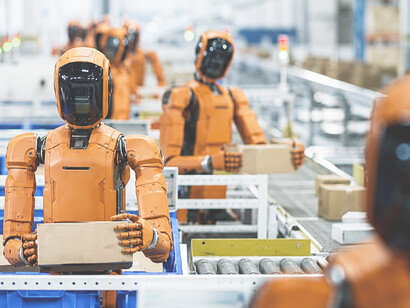
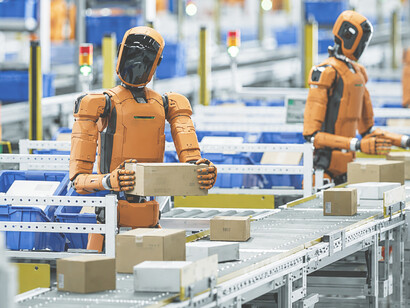
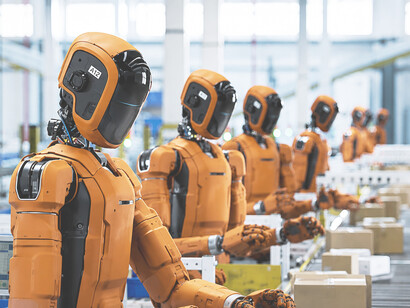
The phrase "mecha mass production" — invoked across the Chinese trade press in recent weeks — captures the cultural shift as much as the industrial one. Where humanoid robots were once unveiled in carefully choreographed stage demos with cables visible just out of frame, manufacturers are now releasing footage of identical units rolling off assembly lines in batches of dozens, then hundreds.
UBTech has publicly confirmed orders for hundreds of Walker S2 units destined for automotive assembly lines at Geely, BYD, FAW, and Foxconn. Figure AI's commercial agreement with BMW has moved from pilot to expanded deployment at the Spartanburg plant in South Carolina. Agility Robotics' Digit is now operating in multiple GXO Logistics distribution centres under a formal robotics-as-a-service contract — a financial structure that, more than any technical milestone, signals true commercial maturity.
The numbers are beginning to compound. Goldman Sachs' most recent humanoid robotics forecast projects a global total addressable market of roughly \$38 billion by 2035, with annual shipments potentially reaching 1.4 million units by the same year. Morgan Stanley's more aggressive scenario, which assumes faster cost-down curves and broader service-sector adoption, places cumulative global humanoid deployments at over one billion units by 2050. Even discounting the headline figures by half, the implied growth rate places humanoid robotics among the most consequential hardware categories of the coming two decades.
The supply chain is responding accordingly. Harmonic drive and planetary roller screw manufacturers in Japan, Germany, and increasingly China are reporting order backlogs measured in quarters rather than months. Speciality motor producers, dexterous-hand component vendors, and tactile-sensor suppliers — long-sleepy corners of the industrial-automation ecosystem — are seeing valuations and capital expenditures climb in a pattern reminiscent of the early electric-vehicle battery boom.
The AI adaptation inflection
If improved hardware made the current generation of humanoids physically possible, it is the rapid maturation of embodied AI that has made them economically viable. The integration of vision-language-action (VLA) models — descended from foundation models such as Google DeepMind's RT-2, Figure's Helix, and the open-source OpenVLA lineage — has collapsed the development cycle for new tasks from months of engineering work to, in the best cases, hours of demonstration learning.
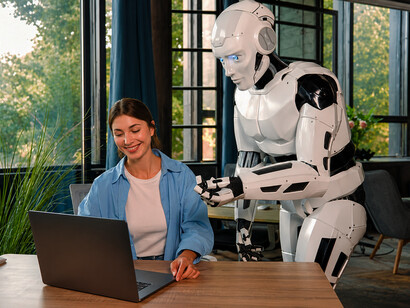
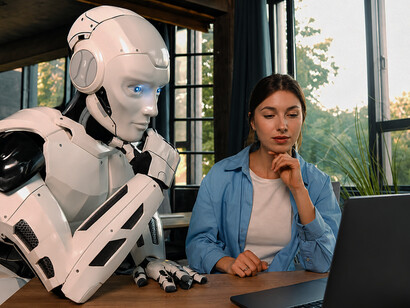
This is what industry insiders mean when they speak of "AI adaptation". A humanoid robot in 2022 had to be programmed for each task; a humanoid robot in 2026 is, increasingly, instructed. The shift is more than semantic. It is the difference between a fixed industrial automation cell, capable only of what it was designed for, and a general-purpose worker that can be redirected to new duties by a supervisor speaking plain English or Mandarin.
"The intelligent-agent layer is where the real differentiation will happen over the next thirty-six months," argued a managing director at a Hong Kong–based technology investment firm. "Hardware specifications will converge. Whoever owns the policy models, the data flywheel, and the developer ecosystem will own the margin."
Several architectural patterns are emerging. Tesla and Figure have pursued vertically integrated stacks, building proprietary foundation models trained on enormous volumes of teleoperation and simulation data. Unitree and a growing cohort of Chinese platform vendors have adopted what might be called the "Android strategy" — releasing relatively open hardware and inviting third-party AI developers, system integrators, and enterprise customers to layer their own intelligence on top. NVIDIA's Project GR00T, alongside its Isaac simulation environment and Jetson Thor compute module, increasingly functions as the connective tissue between these camps, positioning the company as the de facto silicon and tooling supplier for the sector — a role analogous to its position in generative AI more broadly.
The strategic implications are significant. If the open platform approach succeeds, humanoid robotics will resemble the smartphone market: a small number of dominant hardware vendors, a vibrant ecosystem of application developers, and a long tail of enterprise customisation. If the vertically integrated approach prevails, the industry will look more like commercial aviation — concentrated, capital-intensive, and dominated by a handful of full-stack giants.
Industry trends reshaping the landscape
Several broader trends are accelerating the commercialisation curve and are worth examining individually.
First, the labour arithmetic is becoming undeniable. Ageing populations across Northeast Asia, Europe, and increasingly North America are colliding with persistent shortages in logistics, manufacturing, elder care, and skilled trades. A humanoid platform priced between \20,000 and \50,000 — the trajectory most major manufacturers are publicly targeting — competes favourably with annual fully loaded labour costs in developed markets, particularly for two- and three-shift operations. The unit economics, once theoretical, are now beginning to pencil out.
Second, the regulatory environment is shifting from cautious observation to active engagement. China's Ministry of Industry and Information Technology released its humanoid robotics development guidelines in late 2023, setting ambitious targets for 2027 that the sector is now ahead of schedule to meet. The European Union's AI Act and forthcoming machinery regulations include specific provisions for autonomous mobile robots operating alongside humans. The U.S. has, more quietly, begun integrating humanoid platforms into defence logistics and disaster-response pilot programmes.
Third, geopolitical competition is unmistakably driving investment. The humanoid robot has joined semiconductors, electric vehicles, and artificial intelligence in the small set of technologies treated by major governments as matters of strategic concern. State-backed funds, industrial subsidies, and procurement preferences are flowing into the sector at a scale that purely market-driven analysis cannot fully explain.
Fourth, the developer story is finally arriving. Open-source robot learning frameworks — LeRobot from Hugging Face, the broader Isaac and ROS 2 ecosystems, and a growing number of teleoperation and data-collection toolchains — are lowering the barrier for application developers to build on humanoid platforms without first becoming roboticists. This is the same democratising pattern that turned mobile phones from communication devices into the world's largest software platform.
Implications for industries and society
The near-term industrial impact will be most visible in three sectors: automotive manufacturing, where humanoids are being deployed for tasks that resist conventional automation – flexible assembly, parts kitting, and quality inspection in confined cells; logistics and warehousing, where they handle the unstructured edges of fulfilment that fixed automation cannot economically address; and electronics assembly, where the dexterity requirements have long defeated traditional robotic arms.
Within three to five years, plausible expansion targets include hospitality, retail restocking, light construction, agricultural picking, and — perhaps most consequentially — eldercare and household assistance. The latter category, while technically the most demanding, is also the largest single market by potential unit volume, and it is the application most likely to bring humanoid robots into direct, sustained contact with the general public.
The societal consequences deserve serious consideration. Labour displacement, while a legitimate concern, is unlikely to manifest as a sudden shock; the more probable scenario is a multi-decade rebalancing in which humanoid robots fill roles that current demographics cannot staff, while simultaneously reshaping wages and working conditions in adjacent occupations. Policy responses — retraining programmes, portable benefits, and productivity-sharing mechanisms — will need to be designed with more sophistication than the debate has so far displayed.