English
 Español
 Français
 Deutsch
 Italiano
 Português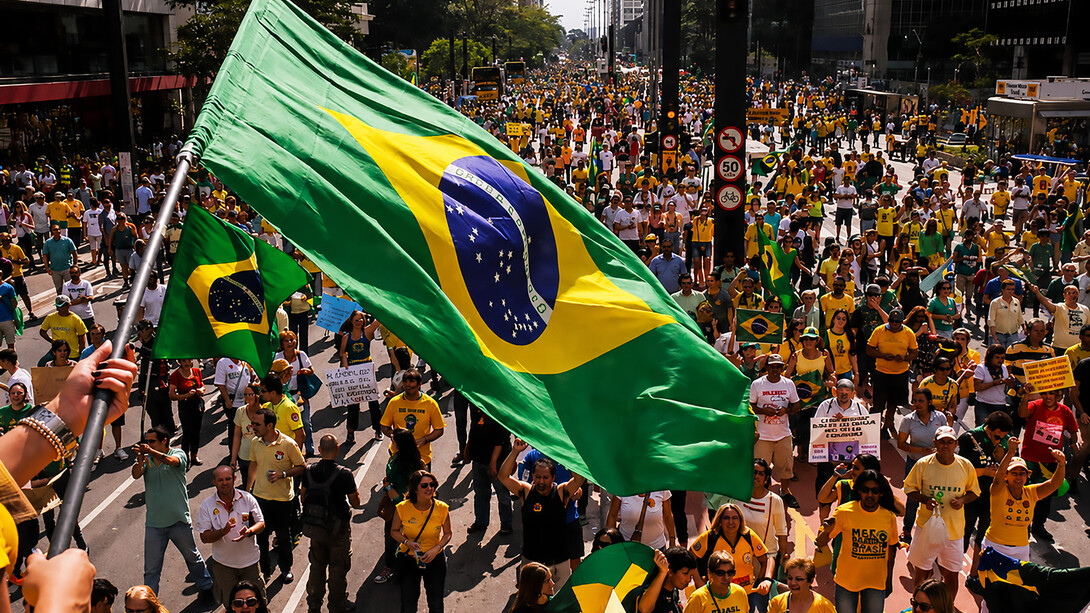
The presidential elections this coming October in Brazil (currently in the eye of the storm) are an internal matter for the country, and it is up to Brazilians alone to decide who will be the next president. In theory, that is how it should be, and practice should reflect it, but unfortunately it does not. This could have dramatic consequences for the future of democracy in Brazil and around the world.
The strength and weakness of democracy in Brazil
Forty years ago, Brazil overthrew one of the three longest and bloodiest military dictatorships of the past hundred years in South America. The other two were in Chile and Argentina. The transition to democracy was negotiated with the dictators—a sign of weakness that continues to haunt Brazilian democracy to this day. Furthermore, redemocratization took place against an international backdrop of the global imposition of neoliberalism, a weapon of mass destruction against social justice and the democratization of society and the state. But thanks to social movements and a vibrant labor movement (in which current President Lula da Silva distinguished himself), Brazil was able to turn weakness into strength.
Democracy was consolidated and deepened through local experiments in participatory democracy (such as participatory budgeting), which caught the attention of the democratic world. In 2001, Brazil became a global model of the power of social movements in the pursuit of social justice by organizing the first World Social Forum, and in 2002, the tenacious labor leader Lula da Silva—hailing from the impoverished regions of the country’s Northeast, a world apart from the São Paulo elites who had always governed Brazil—was elected president.
What followed was a glorious decade of economic development; improvements in the living conditions of the working classes (who were finally able to fly to visit family or enjoy vacations, much to the chagrin of the classes accustomed to that privilege of mobility); and transformative investment in public education, especially at the university level (another source of annoyance for the privileged classes, who until then “were convinced” that there was no structural racism in Brazilian society and that, therefore, compensatory policies, affirmative action, and quota systems were unnecessary). Brazil became one of the “emerging countries” in the Global South, ranking among the world’s ten largest economies, and in 2006 it formally became a founding member of BRIC, the precursor to BRICS. In short, a world power that, moreover, seemed to demonstrate that there is no contradiction between capitalist development and democratic development.
Tragically, however, appearances can be deceiving. The 2008 financial crisis and the changes that followed (the financial capital responsible for the crisis was the very same force tasked with resolving it, with the usual consequences: those at the bottom—whether social classes or countries—are the ones who pay for the crisis), combined with the “need” for the U.S. to return to “tending” to its Latin American “backyard” after the disaster in Iraq—and alarmed by China’s growing influence on the subcontinent—(easily?) destabilized Brazilian capitalism and Brazilian democracy, primarily through Operation Car Wash. After all, strength was also a weakness. The “soft coup” of 2016 against President Dilma Rousseff was followed by the “fabrication” of grounds to disqualify the strongest candidate in the 2018 elections, Lula da Silva, his 580-day imprisonment, and the election of an obscure and mediocre far-right radical.
But the strength of democracy was not entirely exhausted. This time, weakness turned into strength. Faced with pressure from Brazilians and democrats around the world denouncing these legal abuses, the very same judicial system that had fabricated Lula da Silva’s disqualification and his imprisonment redeemed itself, from a democratic standpoint, by restoring the rule of law and allowing Lula da Silva to run again and win the presidential election, which took place in 2022.
President Lula da Silva returned, but Brazil’s democratic vitality and the richness and diversity of its social movements did not. Nor has the Afro-Catholic-pagan joy of rebellion returned—that joy which disarms self-righteous orthodoxy, offers hope in the struggle amid the harshest adversity, and disguises itself as outward reverence to better conceal the clenched teeth of nonconformity. The rebellious rappers continued to revolt, but increasingly on their own.
The fact is that, in the meantime, Brazilian society had undergone a new form of recolonization based on two types of extractivism: the extractivism of belief and the extractivism of deliberation. As in the realm of other raw materials, extractivism is unequal exchange, expropriation, and physical, psychological, or symbolic violence used to extract natural or human resources. What is new about this recolonization is that it presents itself as an exhilarating decolonization in relation to the old world of the old religion and the old politics. It is an expropriation disguised as reappropriation, a servitude disguised as autonomy, a super-objectification of consciousnesses disguised as exhilarating super-subjectivation. In short, dispossession as a new form of empowerment.
The intensity of the recolonization that has already taken place was evident in the way the far right reacted to the election results. Having failed to “peacefully” take control of the elections, it reacted violently, vandalizing the buildings at Brasília’s Praça dos Três Poderes, brilliantly designed by Lúcio Costa and Oscar Niemeyer to celebrate democracy. On January 8, 2023, the world watched in astonishment and disbelief as shocking images of vandalism unfolded at the heart of the institutions of political power. The strength of Brazilian democracy revealed that it had feet of clay.
But once again—and this time on the brink of the abyss—Brazilian democracy gathered the shards and pulled itself together. Once more, weakness turned into strength, but that strength was no longer the strength of the previous era. It was not the strength of flourishing; it was the strength of survival because, in the meantime, the operations of extractivism had advanced significantly.
The extractivism of belief
To avoid any misunderstanding, I begin by reiterating my full respect for people’s religious feelings and beliefs, while affirming at the same time that I am totally opposed to any political use of religion other than following the example of the Nazarene: to fight in this world for the well-being and dignity of the working classes—the impoverished, the excluded, and the victims of racial and sexual discrimination—against the temple merchants, the architects of inequality and discrimination, and to take the risks that this entails in the capitalist, colonialist, and patriarchal societies in which we live.
The extractivism of belief drains the religious energies of the earth’s downtrodden—energies meant to critique and transform this unjust world—and redirects them toward zealously ensuring that the justice of a better life is safeguarded in the other world, the world of eternal salvation. The conduits of these energies are the pastors, especially the evangelicals of the neo-Pentecostal denomination, who—with the proliferation of their churches and the millions of followers on social media and in their daily videos—ensure the greatest yield of these energies in the next world.
The spiritual energy expended in trances within the churches does not spill out onto the streets. On the contrary, the believer steps out onto the street relaxed, resigned to this world, and content with the prosperity they are accumulating in the next world. That the conveyors become increasingly prosperous in this world is the just reward for their effort to carry the flock’s energies so far. The believer’s nonconformity now takes on a narrow focus: changing one’s family and convincing one’s neighbors.
The extractivism of deliberation
This extractivism consists of getting people hooked on outsourcing—to accredited and readily available intermediaries—the thought, information, and emotions necessary for deliberation. This leaves free time to look for work, help feed the family, and distract oneself with television, social media, and soccer—and, until recently, Carnival (the extractivism of belief is eliminating Carnival).
The extractivism of deliberation is particularly intense when linked to the extractivism of belief. For if politics is important for governing this world, those who govern it best are those who most closely resemble the One who governs the Other World—the world of eternal salvation. Now, if God is not democratic, why must the one who manages this world be so? What matters is that he be one of “ours” – that is, trusted by “our” agents of deliberative energy and by “our” conveyors of religious energy to a safe place in the world of salvation. Tomorrow, if the mediators and conveyors so desire, artificial intelligence may be the one to choose candidates to vote for and turn them into rulers. If it ensures that “the one elected is one of us,” the addicted believer sleeps soundly, having fulfilled his duty and earned a few points toward eternal life.
Extractivism stems from the massive transfer of individual democratic deliberation to opinion-makers and agents of deliberative energy. The world of uncertainties surrounding election candidates – and the fear of choosing wrongly and suffering the consequences – is left at the doorstep of churches and screens. What one gains by following the opinion of “our own” and by joining millions like us is worth far more than individual deliberation and the solitary vote—which, incidentally, is of little value because politicians, “except for our own,” are all the same and never deliver on what they promise during election campaigns.
As Claude Lévi-Strauss taught us, myths are the great stabilizers of hierarchies. Thus is the anti-democratic myth consolidated. What is new is that the combined effect of today’s two myths stabilizes the hierarchy, not only between this vale of tears and the other world of eternal happiness, but also within each of them.
Stabilizing hierarchies in a socially, racially, and sexually unjust society means freezing conformity in place. This is not the passive conformism of resignation and abstention; rather, it is militant conformism, intolerant of anyone who challenges it. And those who challenge it are the devil or the communist—whether it be a candidate who “is not one of us" or opinions that disagree with “ours,” that is, with the agents of “our” thought, “our” preferences, and “our” deliberative energies. One does not make deals with or discuss matters with the devil or the communist. The devil and the communist must be fought, and all weapons are legitimate if they are effective.
The origin of these forms of extractivism
The super-agents and super-carriers of these forms of extractivism have a well-known origin: the United States. They come from afar, from U.S. imperialism on the subcontinent dating back to the Monroe Doctrine of 1823, according to which the subcontinent is a U.S. sphere of influence that no one can challenge—whether Europe in the 19th and 20th centuries or China in the 21st century. More recently, these two forms of extractivism intensified at two different but converging moments.
Faced with the failure of the Alliance for Progress to contain the Cuban Revolution, Nelson Rockefeller proposed to President Richard Nixon, in his 1969 Report on Latin America, that the solution lay in exporting en masse to the subcontinent the most conservative theologies of Protestantism (especially Neo-Pentecostal evangelism) that would effectively counter the danger of the subcontinent’s communist drift, whose main agent was the liberation theology of Catholic priests and bishops energized by the Second Vatican Council. It was they – and not secular politicians, communists, or anti-religious leftists – who lived side by side, on the ground, with the poor, amid the misery, discontent, and revolt of the subcontinent against the status quo, promising redemption in this world and not in the next.
From then on, an avalanche of Protestant pastors poured into the continent. I witnessed this firsthand when, in Cuernavaca, Mexico, I observed them between 1970 and 1973 voraciously learning Spanish to head south. For those who had to learn Portuguese, there were other linguistic stopovers. Perhaps most were unaware of the grand imperial design they were carrying out. They sought only the “salvation of souls” and the spread of their religious denomination. Many of the pastors weren’t even conservative. But the project was imperial, and it worked perfectly.
Protestant churches, especially evangelical ones, are scattered across the entire continent and have no qualms about turning their religious proselytism into political proselytism in favor of “our” candidates, that is, those who serve the interests of the ruling class and U.S. imperialism—not because they are virtuous in and of themselves, but because they are the ones who defend “our” family and “our” traditional values and effectively ward off Satan from the left, which is entirely communist—the embodiment of the Devil. The two dimensions of extractivism share a valuable characteristic: they spare citizens the time of listening to communists and the time of resisting the Devil’s temptation.
This was the origin of the religious dimension of extractivism (the extractivism of belief). The secular dimension of extractivism (the extractivism of deliberation) has intensified more recently with Donald Trump’s rise to power in the U.S. and his aim to recolonize Latin America as the most effective means of making up for lost time and definitively preventing China from entering or remaining in its backyard. The agents of deliberative extractivism are digital platforms, social media, communicators, influencers, and, above all, the purveyors of fake news. The two forms of extractivism have not only become more violent but have also acquired the ability to spread virally. In fact, the two forms of extractivism have become two viruses—two viruses disguised as vaccines against the Devil and communism.
The dissolvers of democracy
These two forms of extractivism were designed to operate within democratic regimes, distorting democracy and eroding its potential to exercise popular sovereignty until it is transformed into proud subservience to the geopolitical interests and designs of U.S. imperialism – paradoxically justified in the name of the “higher interests of the homeland.” Historically, they correspond to the third major strategy of interventionism. Each employs a preferred instrument of intervention. But once used, no instrument is entirely discarded; it remains in reserve to be deployed should the new instruments fail.
The first strategy
The first major strategy was the imposition of civilian or military dictatorships. In this phase, the preferred local instrument for carrying out the intervention was the armed forces of the target country. To this end, they were trained at the School of the Americas, headquartered in the U.S. and specializing in teaching techniques of torture, extortion, blackmail, and summary executions. For this reason, it became known as the “School of Assassins” or the “School of Dictators.” It is estimated that more than 60,000 Latin American military personnel were trained there. With regard to Brazil, the National Truth Commission states in its final report that more than 300 Brazilian military personnel were trained at the School of the Americas between 1954 and 1996.
The second strategy
In light of the failure of this strategy—due to Latin Americans’ resistance to dictatorships and the return of democracies—the second strategy consisted of “soft coups,” or the manipulation of democratic institutions to favor the election of candidates subservient to the interests of imperialism. The primary local tool was the judicial system. Especially beginning in the 1990s, hundreds of prosecutors and judges (some of whom were already known for their conservative views) were invited to take specialized courses in the U.S. or at U.S. embassies in their home countries under the guise of “training, exchange, and international cooperation programs,” where, under the pretext of training, they were indoctrinated with an anti-communist, anti-socialist, anti-left, and anti-social-democratic ideology, whose main pillars are as follows: an inquisitorial conception of the public prosecutor's office (in the U.S. tradition) based on the priority given to institutional security and criminal investigation policies; the defense of private property and freedom of expression without regard for dignity or truth; and the fight against corruption and terrorism—with the implication that these evils are more widespread among politicians considered progressive.
The third strategy
As the cases of Brazil, Chile, and Colombia clearly demonstrate, this second strategy has not always been effective. In light of this, a third strategy has come to be favored: the manipulation of consciences and subjectivities through “extractivism of belief” and “extractivism of deliberation,” which I have been analyzing. In this strategy, the local instruments of intervention are pastors (especially evangelicals); corporate media; and journalists, communicators, and influencers considered to be on the right and far right who, like the judges before them, are invited to training courses, retreats or reflection weekends in their own countries, and visits or stays in the U.S.
Religious indoctrination is dominated by the prosperity gospel—that is, the celebration of wealth as a blessing from God. The significance of this celebration is that, through it, wealth and poverty are no longer linked by a causal relationship. The enrichment of minorities is no longer tied to the impoverishment of the vast majority. If they obey the pastors’ teachings, the poor of this world will be the rich of the next.
Secular indoctrination is openly reactionary in the technical sense of the word. High-tech methods of extracting deliberation are put at the service of ideas from the Ancien Régime, that is, the political ideas that prevailed before the individualistic liberalism of the seventeenth century and the bourgeois revolutions of the eighteenth century (the American Revolution and the French Revolution) and, in the nineteenth century, the revolutionary wave in post-1848 Europe: the Church’s dominion over consciences and the King’s absolute power over secular life. The crucial difference from the pre-Enlightenment period is that today’s reactionary ideology includes the unconditional defense of private property, something that was unthinkable in the pre-revolutionary 17th and 18th centuries.
The interplay between the strategies
The sequence among the three strategies is not linear. It has been a cumulative process of instruments of interference in which only trends and emphases are visible. It is possible that, at any given moment, the three strategies are being adopted in different countries or even within the same country as a toolkit of anti-democratic measures to be used according to specific circumstances.
Intervention differs depending on whether (1) it aims to prepare in advance for a political change through elections, (2) it takes place during an electoral process, or, finally, (3) it takes place outside of an electoral process. In case (2), the intervention aims to influence voters’ voting intentions as much as possible; thus, election fraud occurs before the vote and, therefore, does not involve the counting of votes. It sometimes includes accusations of electoral fraud against the “enemy” with the aim of delegitimizing the election results and paving the way for other, more violent and overtly coup-oriented strategies, as happened in Brazil on January 8, 2023.
It is important to note that U.S. interference in Latin American countries has been intensifying and diversifying its methods. In the past year, we can cite three paradigmatic cases.
In Honduras, U.S. interference in the November 2025 elections combined the second strategy with the third. Faced with the likely failure of the latter, a form of “soft coup"—typical of the second strategy—was employed. Donald Trump intervened personally. By publicly expressing his support for the far-right candidate, Nasry Asfura, he accused the National Electoral Council of fraud in the vote count and threatened the country with economic sanctions if the other candidate – also on the right but more moderate – were to win. The interference was so blatant that the outgoing president, Xiomara Castro, accused Donald Trump of orchestrating an “electoral coup” through blackmail, coercion, and direct interference in the country’s sovereignty.
In Venezuela, the U.S. resorted to a combination of the first and second strategies: a full-blown coup d’état disguised as a “soft coup” within the framework of democratic normality, because it was “tolerated” by the legitimately elected authorities. After committing war crimes by killing some two hundred fishermen in the Caribbean Sea, the U.S. launched a military invasion of Venezuela on January 3 of this year, in an operation whose name makes its purpose clear: “Operation Absolute Resolution.” They killed more than twenty members of the presidential guard—most of them Cuban—captured President Nicolás Maduro and the First Lady while they slept, and took them prisoner to the U.S.
The top leader of the far right, María Corina Machado, had repeatedly called for U.S. military intervention. This is what happened, but not with the outcome she intended: power was not handed over to her; instead, the current government, led by Vice President Delcy Rodríguez, was left pathetically powerless. The expropriation (theft?) of oil operations—the main objective of the intervention—was handed over to U.S. Secretary of State Marco Rubio, the new viceroy of Venezuela. Not only has China lost its privileged access to Venezuela’s oil, but the oil revenues—recently estimated by the Financial Times at twelve billion dollars—are deposited in the U.S. Treasury and are made available at the Viceroy’s discretion.
In Colombia, the third strategy was employed with unprecedented intensity in the May and June elections of this year. The platforms and agents of deliberative extractivism utilized the most sophisticated technologies in the digital realm—with the active participation of Israeli technology—to rob Colombians of their autonomy to inform themselves and choose for themselves the candidate for whom to vote. In turn, “belief-based extractivism” dealt the final blow to the electoral prospects of left-wing candidate Iván Cepeda, particularly during the final week of the election campaign.
The pulpits, prayers, worship services, “spontaneous prayers,” videos, and social media posts from evangelical churches flooded the public sphere with urgent appeals for the sacred defense of the family against the threat of the red devil. This strategy was reinforced by Donald Trump’s now-familiar statements of support for far-right candidate Abelardo de la Espriella, combined with warnings from the U.S. Embassy in Bogotá about potential outbreaks of violence and protest. The election’s outcome was set in stone—or rather, in the transparent stone of fake news.
Brazil in the eye of the storm and the global significance of the outcome
Everything suggests that Brazil will be the next target of U.S. interference, and it is likely to surpass in intensity and scope everything we have observed so far.
Brazil is the largest and most populous country in Latin America, the region’s most important economy, and China’s largest trading partner. It is, moreover, one of the founding members of the BRICS, and former President Dilma Rousseff is the current president of the BRICS bank, the New Development Bank. And above all, it is a democracy weakened by its recent past and the country where “extractivism of belief” and “extractivism of deliberation” have been at work for the longest time and with the greatest intensity. Furthermore, the Brazilian far right is the most internationalized and displays an arrogance that puzzles the democratic world, especially in light of the far-right president’s disastrous handling of the pandemic, which resulted in between 120,000 and 400,000 preventable deaths, according to World Health Organization estimates.
What happens in Brazil in the coming months concerns Brazilians and should be their sole responsibility, but whatever happens will have significance that far exceeds Brazil’s borders.
It will certainly be significant for the entire subcontinent because it will signal the extent of U.S. interference in the destruction of the region’s democratic regimes. The far right uses democracy to seize power, but once it has seized it, it neither exercises it nor remains in power democratically. It is the foretold death of democracy.
The significance of what is about to happen in Brazil is, however, global in scope, because the technologies characteristic of the third generation of interference are already being used in Africa and Europe as well. It is therefore worth highlighting their main characteristics.
The two forms of extractivism are being used worldwide wherever U.S. imperialism seeks to establish or maintain influence. They are a fundamental part of the global far-right movement operating in a wide variety of countries, adapting the basic playbook to local conditions but resorting to U.S. intervention as a last resort whenever deemed useful.
There are global linkages between the two forms of extractivism. Far-right parties in various countries now have a vast and diverse global network (sometimes extending to the most conservative right-wing parties): the Conservative Political Action Conference, founded in the U.S. and now with a global reach; the summits and groups within the European Parliament (Patriots for Europe, Europe of Sovereign Nations, European Conservatives and Reformists); the Madrid Forum; and the Madrid Charter.
The issues they debate are, unsurprisingly, the following: anti-immigration (advocating for closed borders and criticizing multiculturalism); sovereignty (opposition to supranational bodies, such as the European Union or the UN); culture war (rhetoric focused on defending the “traditional family” and opposing progressive and gender identity agendas); digital tactics (sharing methodologies on the use of algorithms, social media, and structured disinformation to attract the young electorate).
Nonpartisan far-right organizations also have their own global meetings and networks, and the topics under discussion only partially overlap with those of far-right parties: coordination of narratives (alignment of discourses against immigration, minorities, and the liberal order); export of strategies (local adaptation of digital communication tactics and grassroots activism that have worked in other countries); transnational financing (links between private international donors, wealthy foundations, and political pressure groups); cultural warfare (focus on the profound transformation of social norms, academic institutions, and cultural values prior to actually winning electoral power).
In turn, major global conferences of evangelical churches are held regularly, focusing on missionary cooperation, leadership, and theological alignment. There is a World Evangelical Alliance, which held its fourteenth General Assembly in 2025. Obviously, part of this global movement does not serve imperial designs, nor does it subscribe to far-right ideologies, although it is anti-communist – just as the Catholic Church has always been, with the exception of the brief period of liberation theology.
When “extractivism of deliberation” is present, “extractivism of belief” tends to ally itself with it at decisive moments – that is, during election campaigns. As has happened in other countries, the explicitly political intervention of pastors and their churches occurs at the very end of campaigns, when nothing can be done to counteract it.
Digital capital: in recent decades, the U.S.-led phase of capitalist globalization has been characterized by the central role of financial capital in controlling political choices—both domestically and internationally—in peripheral and semiperipheral countries (austerity policies, sanctions, tariffs, and the freezing of dollar-denominated assets deposited abroad). Today, this central role is increasingly being shared by digital capital, which has the distinct feature of being directly used to control minds—whether through the “extraction” of beliefs or the “extraction” of deliberation.
Far-right parties and organizations are increasingly relying on digital capital, as it allows them to personalize political indoctrination to the utmost degree. The more personalized the indoctrination, the more easily it becomes credible information for the recipient. Citizens choose only after having been selected by the algorithm to favor the choice they ultimately make of their “own free will.” The algorithm is the great anti-democratic decision-maker of our time.
The U.S.-led far right is staking everything on the use of artificial intelligence (AI) to disseminate its messages, to shape and condition minds and consciences, and to turn it into a privileged tool for accessing and exercising power—economically, socially, politically, and culturally. For the most extreme figures, such as the philosopher Nick Land, AI is the God of our time. The techno-optimism movement, entirely centered on the hubris of AI, is becoming increasingly popular within the far right.
Israel’s involvement: U.S. imperialism is today a joint endeavor of the U.S. and Israel. Without profound political changes in either of these countries, neither can survive without the other. The importance of digital capital in systems of information, disinformation, surveillance, intelligence, security, and cyberwarfare grants Israeli companies and the State of Israel a strategic position that often supersedes that of the U.S. AI-based warfare technologies have found in the Middle East—and especially in Palestine—a testing ground so sophisticatedly barbaric that it far surpasses that of the Nazi concentration camps.
The far right as civil society: when discussing undemocratic interference or U.S. imperialism, one might be misled into thinking that we are dealing exclusively with actions by the U.S. government. Far from it. The global far-right movement, committed to the “extractivism of belief” and the “extractivism of deliberation,” is a movement within what liberalism has termed “civil society.” It comprises churches, nongovernmental organizations, foundations, newspapers, digital platforms, radio stations, social media, fake news factories, communicators, influencers, left-wing intellectuals who act as useful idiots to gain notoriety, and activists for supposedly progressive causes whose main objective (of which the activists are not always aware) is to foster public opinion favorable to activism originating in the North and to U.S. imperialism.
Holding political power without ever having held public office: one of the major innovations of the current model of anti-democratic interference in the political processes of countries within the U.S. sphere of influence is the political power wielded by figures who have never held any public office and who, when they are not influencers, are unknown to the public, operating behind the scenes and, at times, in the underbelly of disinformation campaigns in favor of far-right candidates, as managers of multinational “digital trash” factories, thanks to their mastery of algorithms and AI in general. They are sinister figures, powerful eroders of the democratic spirit and of respect for the truth and the dignity of people. They often combine legal activities with illegal ones: mercenaries of false ideas and fascist causes—as long as they are paid—operating in various countries. They represent a dimension of the underground globalization of fascism that has received little attention.
They only come to the attention of the general public under exceptional circumstances, as in the recent case of Fernando Cerimedo, an Argentine disinformer currently imprisoned in Bolivia for the attempted murder of his pregnant partner, who was carrying his child. And he might not even be in prison if there were no disagreements between Bolivia’s president and vice president.
For whom do the bells toll?
The phrase by the 17th-century English poet John Donne, made world-famous by Ernest Hemingway’s novel, is entirely relevant at this historic moment in Brazil’s life. The coming days will be decisive for the future of democracy in Brazil. Given Brazil’s position in Latin America and the world, what happens in Brazil will affect the entire democratic world and will have a decisive impact on the management of rivalries between China and the U.S.
Brazil is facing an act of aggression that has only one recent precedent: the 1964 military coup. The challenge is on the scale of the aggression’s objective: the profound recolonization of Brazil so that it becomes yet another few thousand kilometers of the “Wall Against China.” The perpetrators of this aggression are sectors of the Brazilian upper bourgeoisie, aided by a gang of lumpen-politicians and military officers who have never forgotten what they learned at the infamous School of the Americas.
The challenge for Democrats is to fulfill a twofold mission. In the short term, the mission is to prevent the fascists from coming to power and turning Brazil into yet another U.S. protectorate. In the medium term, the mission is to convince Brazilians that victory in the upcoming elections, however comfortable and satisfying it may be, is merely the starting point for a much greater struggle, grounded in this simple yet immense idea: profound recolonization can only be combated through profound democratization.