English
 Español
 Français
 Deutsch
 Italiano
 Português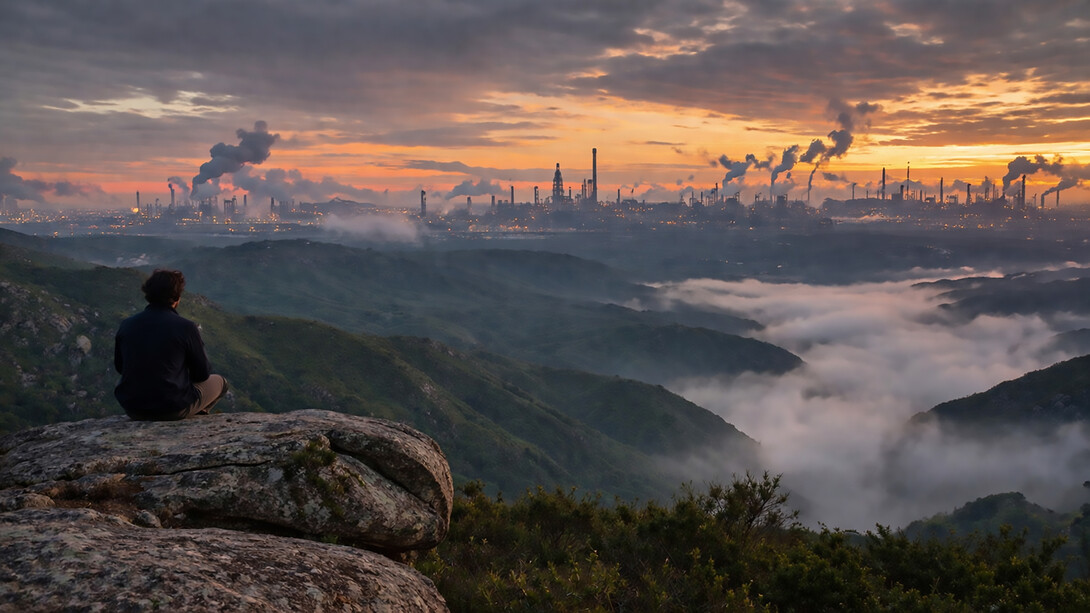
Nature has become the last universally acceptable sanctuary. In public discourse it is treated as the moral remainder of a world that has otherwise dissolved into instrumentality: pure, self-healing, inherently “good,” and therefore best protected by being left untouched. Autopoiesis—life’s capacity to produce and maintain itself—gets elevated into a near-sacred principle: the organism as a self-sufficient miracle, the ecosystem as a balanced intelligence, and the planet as an intrinsic equilibrium that only human interference disrupts.
This reverence contains a truth: the industrial worldview has damaged living systems and rewritten “progress” as extraction. But the reverence also contains an epistemic mistake. It projects a calm onto nature that nature never possessed. It turns life into a pastoral myth and then asks politics to defend the myth.
What is usually overlooked is this: life is not simply “self-making.” Life is self-making under duress—under pressure, under time, and under hostile conditions that must be compensated for again and again through costly operations of persistence. Autopoiesis is not a serene loop. It is a continuous emergency.
Subject potentiality before “humanity”
The sanctification of nature hides the deeper drama: existence on a planet is not the ideal expression of subject potentiality—it is subject potentiality forced into compression. If “subject” sounds too human, it should not. Subject potentiality names a more general phenomenon: the capacity of a living being (or a living system) to become itself, to maintain coherence, to generate form from within, and to steer its own continuity through uncertainty.
In a symbolic society, this becomes a philosophical concept. In nature, it is the primal reality of life. And yet, planetary life is precisely where subject potentiality is most violently constrained.
The constraint is not primarily “human interference.” The constraint is time.
Time as the primary violence
Time is not merely duration. It is the condition of decay, scarcity, entropy, and irreversibility. It is the abyss between what could unfold and what must be paid for in order to unfold. The organism does not “live”; it negotiates time. It does not “exist”; it compensates for what time destroys.
Every breath is a debt service. Every metabolic cycle is resistance against dissolution. Every immune response is a border conflict. Every repair mechanism is a treaty with fragility. In this sense, the planetary embodiment of life is not a peaceful habitat. It is the forced labor of continuity.
If that sounds severe, consider what is structurally normal in life: hunger, predation, infection, injury, exhaustion, and the never-ending requirement to convert the world into usable energy before the world converts you into residue.
Reproduction as admission, not romance
Reproduction is usually celebrated as life’s beauty: flourishing, multiplicity, and abundance. But structurally, reproduction is also an admission of defeat. It is life confessing that individual continuity cannot be sustained indefinitely under planetary time. The organism cannot overcome time’s pressure, so it externalizes its persistence into successors. It pays with itself for the chance that something of its pattern remains.
This is not a moral judgment. It is a structural diagnosis. A species does not reproduce because it is “good.” It reproduces because time is uncompromising. Reproduction is life’s workaround for a hostile temporal regime.
From this angle, the slogan “leave nature alone” becomes strangely naïve. It assumes that nature, left to itself, is already the desired condition—already sovereign, already whole. But if time is the primary violence, then the planet is not the sanctuary. It is the arena.
Civilization as compensation — and its distortion
Now the ecological critique becomes both necessary and insufficient. Necessary, because civilizational extraction adds a secondary violence on top of the primary one. Insufficient, because it mistakes the secondary violence for the original. Industrial society did not invent time’s coercion; it merely learned to amplify compensatory strategies until they became planetary.
Tools, shelters, agriculture, medicine, and infrastructures—and now AI—are not merely “progress.” They are attempts to reduce the brutal tax that time imposes on subject potentiality. Sometimes these attempts are dignified; sometimes they become monstrous. The impulse beneath them is intelligible: to lessen the cost of being.
The tragedy is that compensation often collapses into domination. The desire to reduce time’s violence becomes an excuse to impose violence elsewhere—on other species, other humans, future generations, and the living systems that make continuity possible at all. The result is the paradox of modernity: a civilization built as an escape from fragility that produces fragility at scale.
The AI transition: not “smarter machines,” but cheaper coherence
This is where the AI transition becomes philosophically relevant beyond hype. The question is not whether AI “becomes intelligent” in some metaphysical sense. The deeper question is whether AI becomes another compensatory accelerator—or an enabling infrastructure that lowers the temporal tax on coherence without outsourcing agency.
AI does not need to “recognize” truth in order to change the condition of knowledge. It can make a different move: reduce redundancy, compress bureaucratic theater, automate the tactical, and free scarce human capacity for what remains irreducible—orientation, consequence-bearing judgment, refusal, and accountability.
This is why the great civilizational bottleneck is not execution. Execution is becoming cheap. Plausibility is becoming cheap. Even rhetorical competence is becoming cheap. What stays scarce is the capacity to hold criteria under pressure and to decide when the incentives reward drift.
The promised ‘miracle’ is therefore not a machine that replaces discovery. It is a world in which subjects-in-becoming are less continuously extorted by time through pointless toil, symbolic rituals, and coerced redundancy. If AI is designed as enabling infrastructure, it can shift value away from throughput and toward viable orientation.
This is also where naive fantasies—‘AI will finally solve science’—collapse into a category error. Science has mostly operated as institutionalized pattern management, periodically refreshed by rare acts of genuine re-seeing. The next leap will not come from faster pattern recall. It will come from conditions that allow non-swarm subjects to remain subjects: capable of asking questions that systems did not permit and holding stop-conditions when a clever answer would be cheaper than a true one.
Conclusion: beyond nature-romance, toward enabling worlds
The sanctification of nature is understandable. It is a reaction to the arrogance of systems that behave as if life were an infinite resource. But sanctification becomes an alibi when it prevents diagnosis. The problem is not that nature is “in trouble.” The problem is that life has always been negotiating trouble—under time, under constraints, under cosmic indifference. The planet is not Eden. It is the compromise life makes with the conditions it did not choose.
The future does not depend on returning to a mythical harmony that never existed. It depends on designing conditions in which subject potentiality can unfold with less coercion—conditions where coherence is cheaper than domination and where autonomy does not require heroic resistance just to remain real.
Nature is not the judge. Time is. And the practical question that follows is neither romantic nor nihilistic: what kind of enabling world would allow autonomy to become more than a philosophical wish—without demanding that life keep paying for existence with itself?
Author’s note
This motif is one thread among many that make up The Core and Summons—a longer philosophical foundations work being published for Founding Members on my Substack.