English
 Español
 Français
 Deutsch
 Italiano
 Português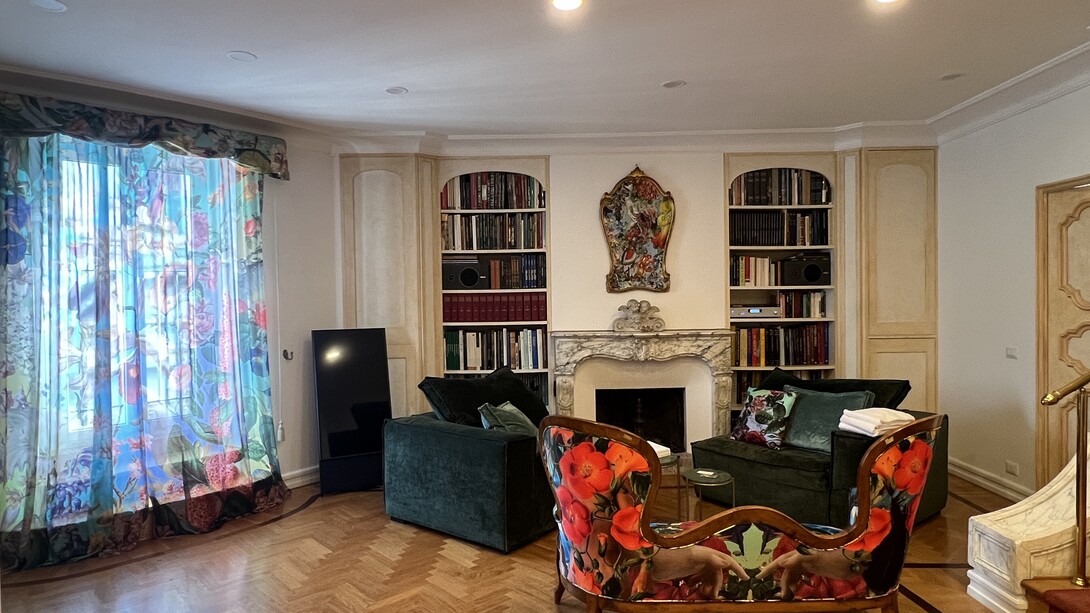
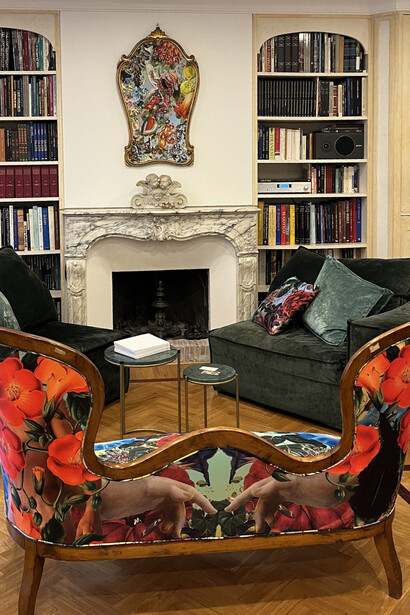
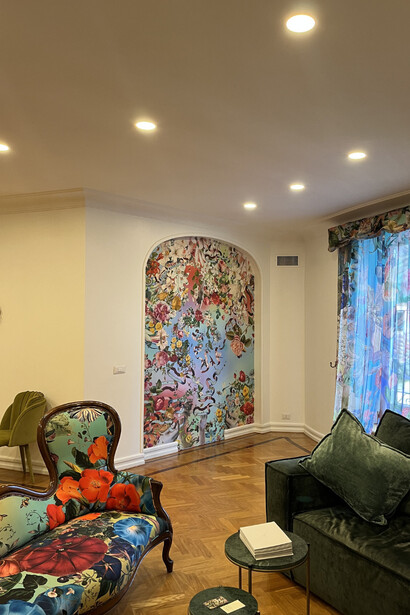
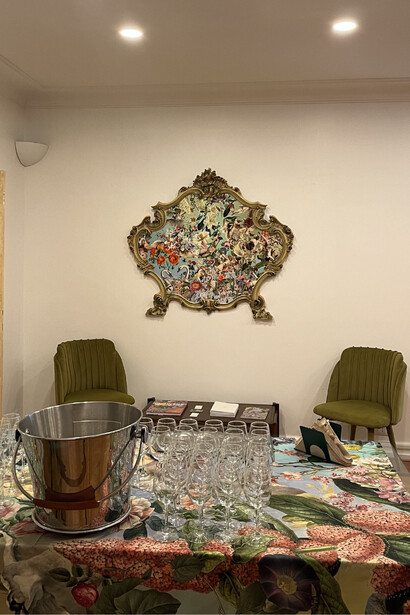
At a time when the art system seems increasingly oriented toward fast experiences, instantly shareable images, and standardized exhibition spaces, Casa Galleria—the project developed by Burghesius—introduces a gesture that is both subtle and radical: to slow down, to inhabit, and to remain. This is not simply a new curatorial format but a deeper shift in how art is perceived, experienced, and internalized. In Rome, a selection of apartments is transformed into temporary exhibition environments where art is no longer something to be observed from a distance but a presence to live with. It does not impose itself as an autonomous, isolated object; instead, it intertwines with space, time, and the everyday gestures of those who inhabit it.
This transformation challenges one of the most established paradigms of modern art: the white cube. The neutrality of the exhibition space, historically constructed to ensure a “pure” encounter with the artwork, is here replaced by an environment dense with layers, memories, and uses. A home is never neutral; it is shaped by habits, invisible presences, and rhythms that escape curatorial control. To introduce art into such a context means accepting a certain loss of control while opening up the possibility of a more complex and authentic experience. The artwork no longer appears as something fixed or complete but as an open device, activated through its relationship with space and with those who move through it.
In Casa Galleria, art is not simply installed; it is allowed to live. And to live, in this sense, means to be subject to time, to the changing light throughout the day, to accidental movements, and to distracted glances as well as attentive ones. It means being encountered repeatedly, at different moments, in different emotional states. This temporal dimension is one of the project’s most significant innovations. The experience of art does not culminate in a single encounter but is built through accumulation—through returns, small discoveries, and perceptual shifts. Proximity generates understanding, but it is a slow understanding, one that resists immediacy and requires openness and attention.
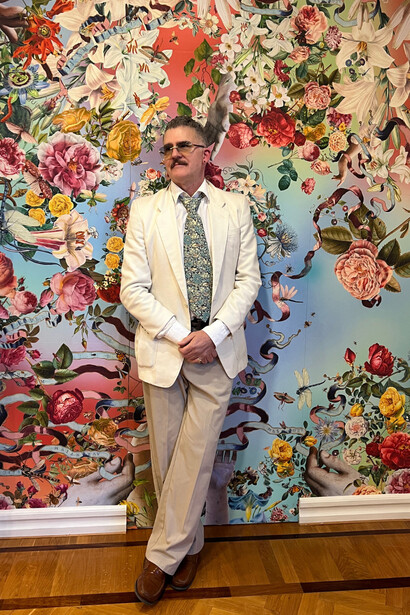
The first chapter of this project unfolds in collaboration with Austin Young, an artist whose practice moves across photography, installation, and performance, constructing visual worlds in which the sacred and the pop coexist in constant tension. Young’s work is deeply rooted in context: each intervention emerges from a careful listening to the space and its latent possibilities. There is no predefined form simply adapted to the setting; instead, a process of construction develops in dialogue with architecture, light, and the implicit history of the place.
His works often draw from imaginaries connected to marginalized communities and subcultures, transforming what is peripheral into something central, even monumental. Through a rigorous visual grammar—precise compositions, intense colors, and a strong symbolic charge—Young creates images that oscillate between devotion and theatricality, between ritual and spectacle. In this sense, his practice lends itself particularly well to a domestic context, where the boundary between intimacy and representation is already inherently unstable.
Within Casa Galleria, Young’s intervention does not simply occupy rooms; it transforms them into complex narrative environments. A photographic work may become the focal point of a space, but its meaning expands through the presence of sculptural elements, installation components, and traces of performative actions. Nothing exists in isolation; everything is relational. The space becomes a living organism in which each element contributes to an experience that is never fully fixed.
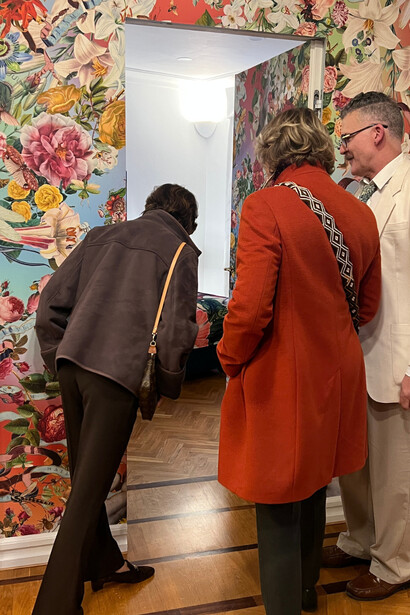
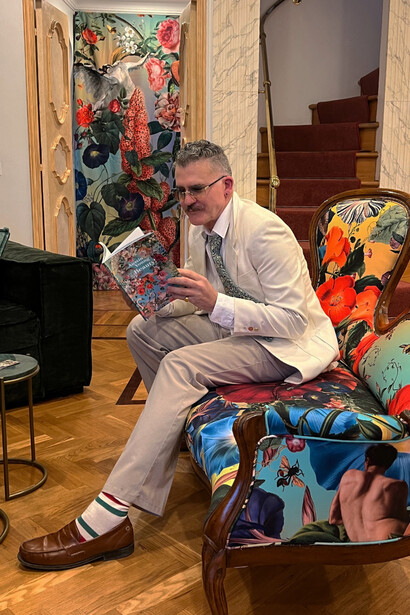
The home thus becomes a threshold—a threshold between public and private, between what is shown and what remains implicit, and between individual and collective experience. Guests inhabiting these spaces are not merely spectators; they become participants, even if in a quiet and subtle way. Their movements, their rhythms, and the time they choose to spend with one work rather than another continuously reshape the experience.
In this context, seeing and living begin to coincide. Art is no longer confined to a time separate from everyday life but enters its interstices, its pauses, its unnoticed moments. It is present while one crosses a room, returns to a previously seen space, or suddenly notices a detail that had gone unseen. This continuity between art and life produces a deeper, less spectacular but more lasting form of engagement.
Casa Galleria also introduces an implicit reflection on the nature of memory. To live with an artwork means to build a relationship that does not end in the moment of viewing but settles and evolves over time. Images are not simply seen; they are remembered, reworked, and transformed. The domestic space, with its intimate dimension, facilitates this process, allowing the artistic experience to become part of a broader lived reality.
In an era in which vision is increasingly mediated by screens and digital platforms, this return to a physical, situated, experiential dimension takes on particular significance. It is not a rejection of technology but an attempt to rebalance the relationship between speed and slowness, consumption and attention. Casa Galleria does not oppose the contemporary condition; it suggests a possible evolution of it, one in which the experience of art once again requires time, presence, and availability.
At the same time, the project raises a series of open questions. What does it mean to live with an artwork? How does our perception change when art enters an intimate, everyday space? What dynamics are activated when the boundary between public and private is reconfigured? These are not questions seeking definitive answers; rather, they find in the project itself a form of ongoing exploration.
In this sense, Living with Art is not only a title but also a condition. A condition that implies a shift in posture, a different way of relating to images, objects, and spaces. No longer distant spectators, but subjects subtly involved in an experience that unfolds over time.
Perhaps this is where the strength of the project ultimately lies: in its ability to operate a quiet transformation, without grand declarations, but through a concrete practice. By shifting art from the realm of viewing to that of inhabiting, Casa Galleria opens a trajectory that feels increasingly necessary today—one in which art returns to being part of life, not as an ornament, but as an experience capable of reshaping how we perceive space, time, and, ultimately, ourselves.