English
 Español
 Français
 Deutsch
 Italiano
 Português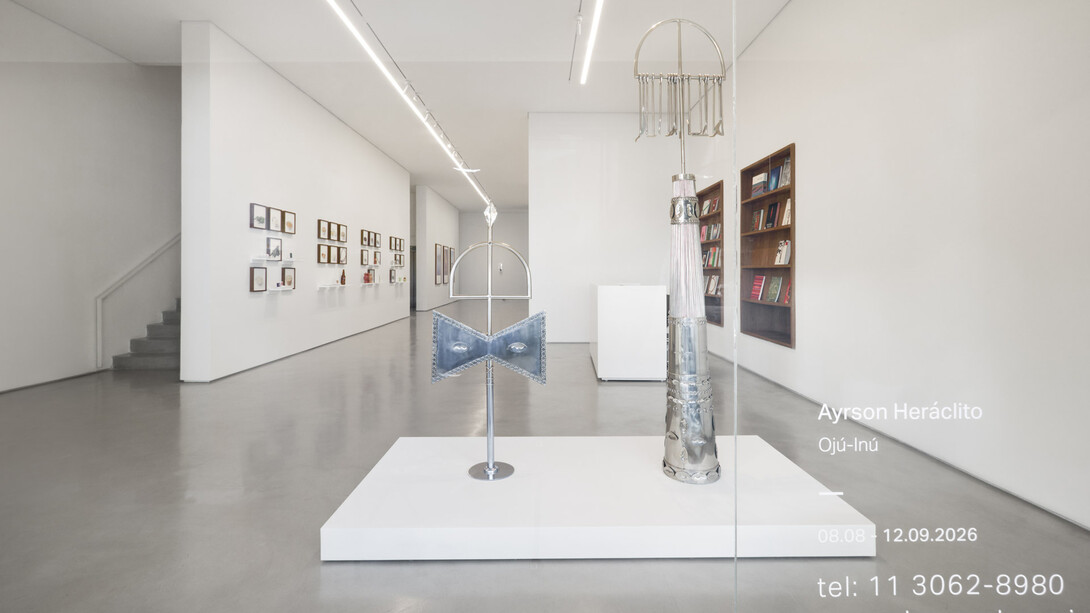
There are materials that resist the condition of object. Not because they conceal hidden meanings (sometimes they do), but because they condense within themselves the networks of relations that give them form and, in doing so, act upon the world. Through their presence, they propagate meanings that exceed them—in time, in history, and in the very biography of their circulation. They acquire the stature of subjects by establishing themselves as the nexus between presences that are at times visible, at times not.
Sugar, palm oil, water, fire, iron, wood, salt, dried beef, fibers, leaves, winds, charcoal, raw brown sugar, pearls, popcorn, or stones never arrive intact in the hands, ears, and other senses of Ayrson Heráclito. Nor do they leave them unscathed. Each element carries with it a material and symbolic history that the artist refuses to reduce to the function of object or support, allowing accumulated layers of meaning to emanate from it. Before entering the realm of art, these materials have already participated in economies, technical systems, agricultural practices, liturgies, culinary recipes, and countless everyday gestures. They have been burned, washed, cooked, buried, transported, offered, and transformed innumerable times throughout the endless passage of the Atlantic Calunga.
It is precisely at this hinge of matter that Ayrson Heráclito operates, working between the sensorial qualities of materials (their anti-inflammatory, cleansing, soothing, fragrant effects...), their formal properties (gradations of color, texture, elasticity, photosensitivity...), their symbolic uses (in rituals of healing, divination, propitiation, and protection), and their historical dimensions (well, here lies the entire Atlantic).
Each work emerges from the careful handling of African and Afro-diasporic repertoires, attentively observed before being formally recomposed and presented as what the artist calls ebó-art. Different media – photography, sculpture, video, installation, performance, drawing – are mobilized in the realization of these offerings. In Candomblé, the ebó is a means of communication between the human plane and the invisible. The offering (of fruits, seeds, oils, cowrie shells, herbs, and other elements determined through divination) establishes and reinforces the connection with the energies of nature, dispelling negativity and opening prosperous paths.
In Heráclito's creative process, this technology of communication is transposed into the field of contemporary art through a sophisticated exercise in conceptual synthesis, in which each work condenses the properties of its materials and, like an ebó, acts toward physical and spiritual realignment. It is as though each work temporarily fixes processes that continue unfolding, that continue operating beneath the infinite mantle of Tempo1.
For this reason as well, his works refuse both the idea of ethnography and that of allegory. The materials with which Ayrson works retain their physical density. Palm oil remains palm oil, with its own viscosity. Steel remains metal, in its rigidity and reflectivity. Sugar continues to crystallize and absorb moisture. They do not stand for something else; they present themselves as what they are. Yet each also appears traversed by temporalities that exceed its immediate presence. They carry what has happened to them and perform the effects they continue to produce.
Throughout Ayrson's work, one notices a continuous interest in the composition and transmission of ritual knowledge, in the transformation of tradition according to terms already contained within tradition itself. It is a practice that operates through the possibility of re-enchantment, in sensorial and affective frequencies that remain untranslatable into the terms of logos.
This continuity can be observed in works created at different moments in his trajectory. From Black Atlantic I (2013), a small glass bottle containing palm oil in an oily reference to Paul Gilroy's landmark book, and Identification marks on sugar boxes from the fleet of 1702 (1995–2021), both clearly engaged with the historiographical debates of the country, to more recent works such as the Juntó series (2023–2026), the Oríkìs of instruction (2025), and the Inventory of technologies of care and healing (2026), the same meticulous attention reappears: an attention to the intrinsic characteristics of matter and to its symbolic meanings and effects.
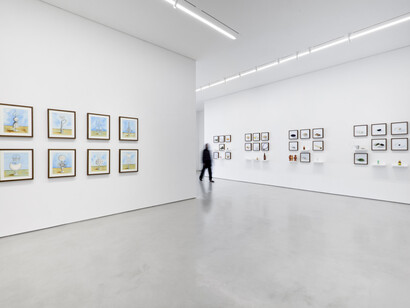
Among the people of axé, juntó refers to the association between two orixás – one governing, the other accompanying – who guide the course of a person's life. Drawing from this idea, Heráclito brings together tools and insignia associated with the sixteen principal orixás worshipped in Brazil, creating combinations that are unsystematic and entirely non-Cartesian. The foundations of these compositions are spiritual and divinatory rather than rational, emerging from the perceptive senses of the body rather than from reason. They do not seek to establish systems nor to produce classifications. They are, therefore, uncontainable. Presented as watercolors, drawings, and sculptures, they function as "visual oríkìs," amulets that transmit the vibratory energy of the pair of deities they invoke.
The same conceptual procedure appears in Inventory of technologies of care and healing, an installation bringing together materials and bodies of knowledge employed in practices of cleansing and renewal within the terreiros and sacred grounds of Afro-Brazilian religions. Organized as a visual repertoire, they give form to technologies of care that operate beyond biomedical protocols. Here, once again, the notion of inventory is deliberately misleading: by refusing the taxonomy of that which inhabits the threshold between the physical and the non-physical, Ayrson twists the Western (that is, colonial) principle of cataloguing, proposing instead a mathematics permeable to mystery.
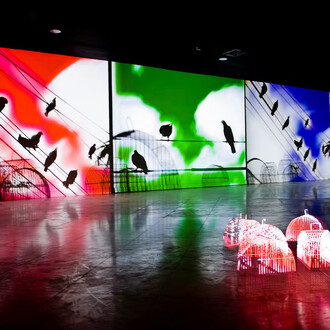
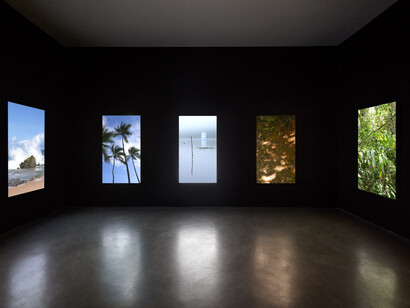
The Oríkìs of instruction, in turn, shift this investigation toward language and listening. Oríkì (Ori - head / Ki - to salute) is a Yoruba poetic genre linked to invocation, praise, and the realm of enchantment. In a video installation composed of seven vertical screens dedicated respectively to the river, the leaf, the wind, the sea, twilight, fire, and the earth, image and sound form a kind of audiovisual oracle in which each natural element invites meditation and profound inward listening. The eyes that see here are not the eyes of sight, but the eyes within.
Perhaps this is one of the singular aspects of the radicality of Ayrson Heráclito's practice. His work does not seek to represent Afro-Atlantic experiences, nor does it treat them as subject matter or theme. These experiences and rituals constitute an episteme in action, a form of embodied knowledge. Within this universe, nature and culture, technique and ritual, labor and spirituality are inseparably intertwined, inscribed in life itself. They cannot be detached from a profound knowledge lived firsthand within Black religious traditions shaped by the Atlantic.
Within the Yoruba tradition, there is a word for this quality of perception and sensibility, which Rowland Abiodun defines as follows:
"To capture and express verbally or visually the essence, character, or primordial names of its subject, Yoruba artists require ojú-inú, literally 'the inner eye,' a special kind of understanding of a person, thing, or phenomenon. This is the source of an aesthetic consciousness through which the artist perceives the individualized form, color, substance, rhythm, contour, and harmony of a subject. Such perception is acquired through familiarity with traditionally sanctioned sources such as oríkì (praise poetry), songs, relevant Ifá divination texts, and existing examples of the artifact, altar, or performance being created. Thus it is through ojú-inú that an artist knows and employs the appropriate colors, designs, and combinations of motifs for, say, a sculpture or costume of àngó or bàtálá, thereby endowing the work with the identity and axé of the orixá. Without this axé, however attractive an artifact might be, it would fail to produce any significant aesthetic or religious impact upon its audience."
Ojú-inú. It is through this inner gaze that Ayrson Heráclito heals2 the world.
(Text by Hélio Menezes)
Notes
1 Tempo is also the name of an important nkisi in the Angola tradition of Candomblé, associated with time, movement, and transformation. The original Portuguese intentionally preserves this double meaning.
2 The original Portuguese uses the verb expiar, here understood in the sense of ritual purification and healing rather than atonement. At the same time, expiar is intentionally chosen for its phonetic proximity to espiar ("to look" or "to spy").



![Various artists, Histórias latino-americanas [Latin american histories], exhibition view. Courtesy of MASP](/attachments/2ec1b7615df2d9b9c3f211de14c70faefd850aea/store/fill/330/330/8481e63599516249cba60f15e188644bb76fc1eec25547e2c4b88b8f1c92/Various-artists-Historias-latino-americanas-Latin-american-histories-exhibition-view-Courtesy-of.jpg)