English
 Español
 Français
 Deutsch
 Italiano
 Português
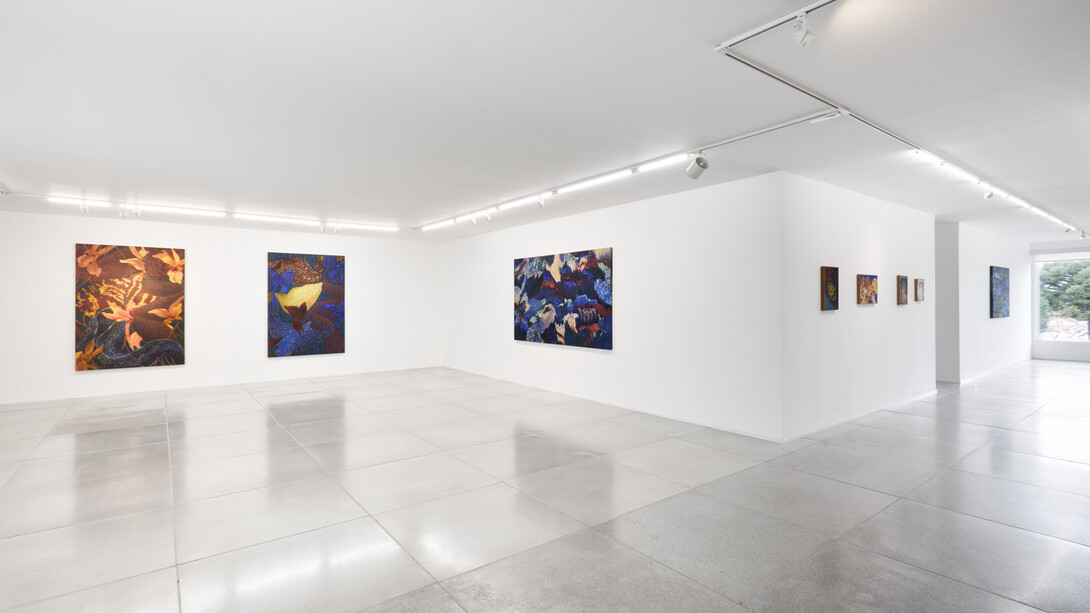
Something must disappear for other possibilities to be seen. When the light retreats, the world does not go dark: it simply ceases to present itself in the way we are accustomed to perceiving it. In the darkness, whether of a forest or an ocean, shapes, colors, and presences emerge according to different logics. There are beings that produce light, others that reflect, absorb or perceive it at frequencies that our eyes cannot reach. It is at this threshold of perception, between what we see and everything that remains invisible to us, that Giulia Bianchi’s paintings inhabit, now gathered at Simões de Assis Gallery.
But what world are we talking about exactly? At the beginning of the 20th century, Jakob von Uexküll proposed the idea of Umwelt: each organism inhabits its own perceptual universe, constituted by what its body is capable of sensing and recognizing. A flower is not the same for us and for a bee; just as the night or a forest does not exist in the same way for all the beings that inhabit them. There are frequencies we do not hear, colors we do not see, signals we do not even know how to recognize. Giulia takes this impossibility as her starting point to create her paintings, questioning what happens when we accept that what we call the world is merely one among many possible ways of perceiving it.
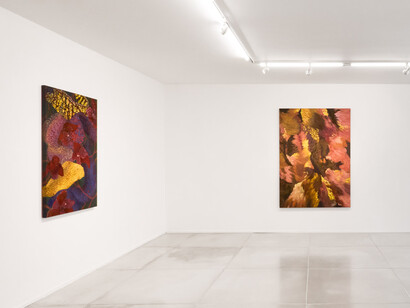
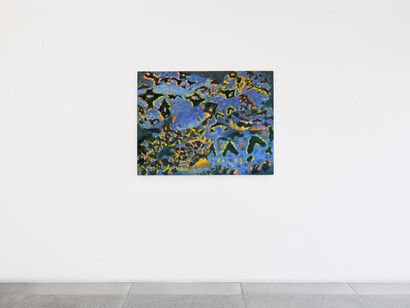
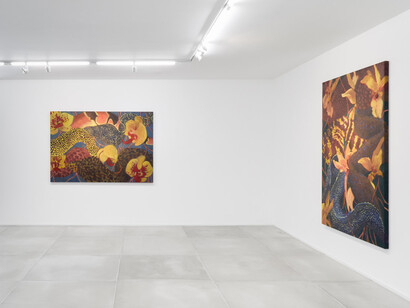
Her paintings emerge from the space between worlds. Biology refers to this in-between as ecotones transitional zones where different biomes meet, intersect and produce particular forms of existence. In Giulia’s paintings, however, this condition extends beyond geography to become a way of constructing images and scenes. Moray eels coexist with orchids; aerial roots advance across environments that could belong to the depths of the sea; oysters encounter galaxies; caves can be mistaken for forests and, at times, what appears to be underwater could also be celestial. Sea, land and sky cease to constitute separate territories. Giulia creates her own ecotones: transitional landscapes in which species, environments and perceptual scales intermingle, making painting a place between worlds.
This between is established not only between landscapes, but also between species. Since previous works, Giulia’s gaze has been shifting from objects to non-human beings - fruits, vegetables, animals, minerals - and, little by little, from what they offer to our senses toward the possibility of recognizing them as subjects. The proximity of her paintings, this gaze that crops, enlarges and at times makes it challenging to distinguish where one species begins and another ends, seems to produce a suspension of hierarchies. The human ceases to occupy the center of the image. In its place emerges a web of existences that are not there merely to be observed, but that also seem to return our gaze.
It is through this displacement that Giulia’s research approaches animism. Not as an attempt to attribute human characteristics to other beings, but as a possibility of recognizing in them their own forms of existence, perception and agency. Animals, plants and minerals no longer occupy the landscape as passive elements or as objects available to the human gaze. There is something that belongs to them and that will inevitably remain inaccessible to us. Perhaps this is why Giulia does not seek to fully decipher them. By bringing them closer, enlarging them, fragmenting them or making them coexist in improbable situations, her painting preserves a zone of indeterminacy. To look at the other, here, means acknowledging that there is a world within them that exists beyond us.
Perhaps that is why appreciation is never enough when faced with these paintings. A moray eel may resemble a snake; the surface of a cave, a landscape; the markings of an animal find correspondences in the stains of the earth. The figure is present, yet always seems on the verge of escaping what names it. Giulia speaks of an interest in correspondences, in perceiving how one form reappears in another. Between figuration and abstraction, these affinities render categories unstable: animal, vegetal, mineral and landscape share forms, rhythms and surfaces. It is in this loss of coordinates that light takes on another function in Giulia’s work. It does not illuminate the scene to make it more legible, as it has so often done throughout the history of painting.
On the contrary, it emerges from indeterminacy itself: it shimmers, erupts, appears amid the darkness without necessarily dispelling it. Thus, Giulia does not seek to illuminate them completely. She allows something to remain beyond reach, preserving the mystery and otherness of what she encounters. Her worlds emerge in this interval: in the instant when our eyes cease to be the measure of all things and other possibilities of existence begin to appear.
(Text by Ana Carolina Ralston)