English
 Español
 Français
 Deutsch
 Italiano
 Português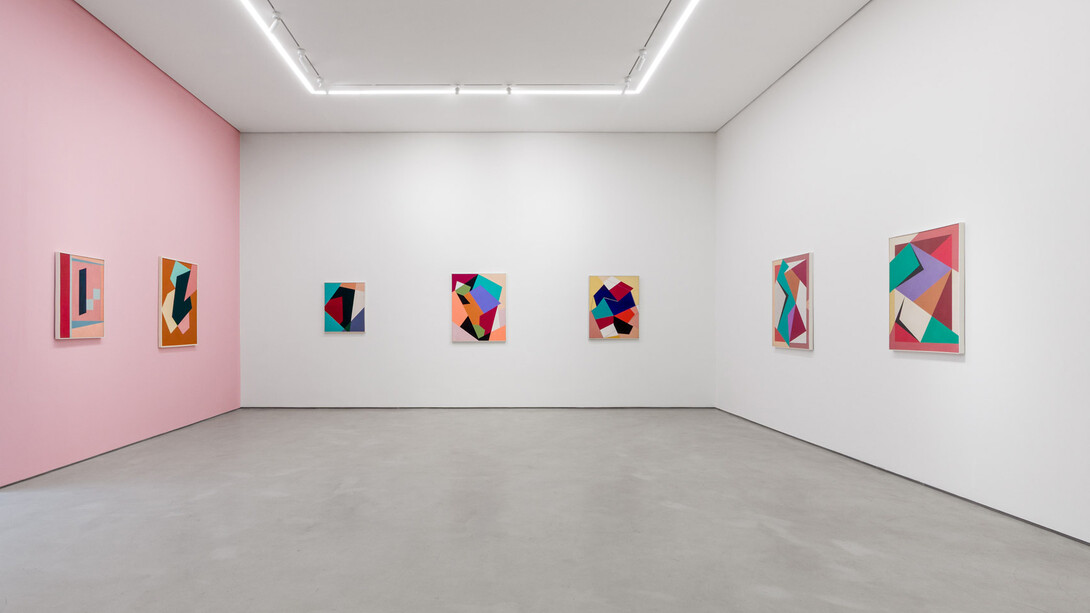
This exhibition brings together non-figurative works by Cícero Dias, a free electron of abstract art in Latin America, one of its pioneers on the continent and the first Brazilian to practice it. In the early 1940s, his figuration dissolves toward lyrical abstractions, a path he focuses on after settling in Lisbon in 1942, fleeing Nazi-occupied France. This is a remarkable fact considering that in Brazil, concretism did not develop until the 1950s, followed by the neoconcrete movement. But this is not only about Brazil. Looking at the broader Latin American context, we see that Argentine concretism, led by Tomás Maldonado with the Asociación Arte Concreto-Invención, and the Madí Movement, founded by Carmelo Arden Quin and Gyula Kosice, only slightly preceded their Brazilian counterparts, emerging in the mid-1940s. Although Uruguayan Joaquín Torres García launched his Constructive Universalism in 1929, his painting and sculpture, despite their geometric emphasis, never completely abandoned figuration. Only Guatemalan Carlos Mérida preceded Dias, creating his first abstract works in Mexico in 1939.
I haven't detailed the above as a competition to see who arrived first, but to situate Dias as a maverick of abstract art on our continent. Not only because his orbit was independent of particular artistic movements or processes, but because, generally speaking, in Latin America non-figurative art – both geometric and lyrical/expressionist – is primarily a phenomenon of the 1950s, the decade of abstraction's peak worldwide, when Dias' geometric work also consolidated, as we can see in this exhibition. We've seen that the concrete movements were established in Brazil at the time and slightly earlier in Argentina. The maturity of Torres García's Constructive Universalism also takes place in those years, with artists like José Gurvich and José Cúneo. In that decade, optical and kinetic art emerged with great force in Venezuela, led by Jesús Rafael Soto, Carlos Cruz-Diez, and Alejandro Otero, along with other abstract poetics, such as in Elsa Gramko, Mercedes Pardo, and Gego's beginnings. In Mexico, the Generación de la Ruptura used abstraction, among other poetics, to successfully confront muralism – so strongly established – with artists like Manuel Felguérez, Gunther Gerzso, and Vicente Rojo. Also in the 1950s, the pioneers Sandú Darié and Loló Soldevilla, who were part of the Grupo Diez Pintores Concretos, and the Grupo de los Once, with abstract expressionists like Raúl Martínez, Guido Llinás, and Antonio Vidal, stood out in Cuba. Cuban Carmen Herrera, another "free electron," created her first non-figurative works in Paris in 1948 and defined her pioneering minimalist work in the following years in New York.
It is true that the early nature of the Brazilian's non-figurative work was conditioned by living and working in Europe since 1937, where he was part of the École de Paris. From 1945 onwards, he was linked to the Groupe Espace and the Denise René Gallery, a center of constructive art in France. But although he lived there for most of his life, the artist never lost contact with his home country, which he visited frequently. In Brazil, he worked extensively and created major works, such as the first abstract murals made in Latin America. Painted in Recife in 1948, they are highly significant for breaking with the realist tradition of Mexican muralism widespread in the Americas. There is general recognition among art critics and historians that his native and formative Brazil, and even his birthplace Pernambuco, were always present within his work, as cultural and emotional bases that conditioned it. The title of his monumental 1931 painting Eu vi o mundo… ele começava no Recife, which alludes to his birthplace, could define Dias’ entire trajectory. A major work, painted when he had not yet left Brazil, its felicitous title proved to be a premonition, and a poetic statement, of what his life and work would become. If I called Dias a free electron, we could say that the only thing that somewhat anchored him was Brazil.
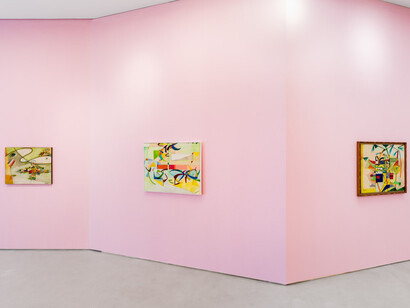
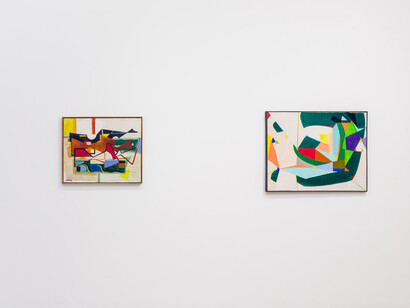
Except for the Entropias series, which are not included, the exhibition allows us a glimpse of the evolution of the artist's abstract painting, which almost always coexisted with his figurative work, something quite singular and heterodox. The work Composición, from the 1940s, shows the transformation of his initial figuration towards a lyrical abstraction where, however, geometric and hard-edge forms emerge that correspond to the completely geometric works appearing later in that decade. Faced with the baroque quality and agglomeration of figurative representations in his 1930s painting – which is like Borgesianly dreaming a delirious Chagall dream in Pernambuco – it's hard to imagine how Dias could shed this populated figurative universe to make way for the abstract. This transition can be seen in two untitled works from the 1940s in the exhibition, which are also an example of why Charles Estienne stated that Dias' originality was to seek the concentrated essence of plant life, not through color but through forms, even if geometric.
Within the exhibition, we even find a typical painting of a "backtrack" on the artist's abstract path, occurring in the mid-1940s: Afinidade vegetal, from 1946. This painting is part of some abstractions made at that time, where echoes of Kandinsky are noticeable and which, paradoxically, possess figurative and coloristic references to Recife, especially vegetal ones. Who knows if this semi-figurative hiatus might be due to an attack of saudade that Dias suffered as a refugee in Lisbon, imposing itself on his geometric work, which he continued to do afterwards. We see this in Esplendor, 1946, a luminous work that brings to mind Oswald de Andrade's exclamation that his living room suddenly lit up when he hung a painting by Dias, made as if "of pure light."
It's interesting to note, in the assembled set of works, the interaction – and sometimes the struggle – between lyrical and geometric abstraction characteristic of his work. Thus, forms that are both organic and concrete in Terra Chã and in another painting from the 1940s bring to mind Antoni Tàpies's assertion: "Whoever discovers a form that is neither organic nor geometric will have taken a great step," a step seemingly impossible, but which is intimated in the Brazilian's morphological freedom. It's curious that other elements of the complex and very peculiar composition of the painting seem to anticipate the bandeirinhas (little flags) that Alfredo Volpi would begin painting in the 1950s. In O abismo da verdura, the forms are already completely – even if softly – geometric, although the two large curves that structure the painting refer to the artist's sometimes subterranean baroque quality.
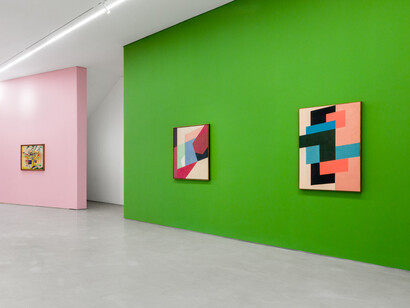
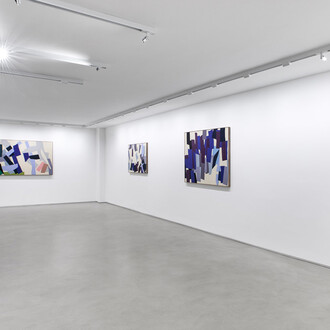
The heart of the exhibition is the fully geometric paintings from the 1950s and early 1960s. These are Dias' most rigorous and refined works – who, nevertheless, I insist, was always baroque in his own way – to the extent that in a couple of paintings, some elements trace a sort of painted frame, which does not prevent other forms from crossing it and integrating with it. As evidence of the expression of Brazil internalized in the artist's work, Mario Pedrosa pointed out in 1948 his "singing colors," his "vigorous light," and the "forms that move in space." All of this appears in the concrete work, which would continue until the end of his life, particularly through the dynamics of the geometric elements, flawlessly pure but far from mathematical coldness and minimalist calm. That's why his paintings foreshadow the dances of Hélio Oiticica's meta-schemes, and relate to the early work of Lygia Pape.
We could ask whether Dias was a neoconcrete artist sine nomine, without an identity, anticipated and autonomous, at least indirectly related to early neoconcretism, which began as a new, different, freer, and more open concretism. The compositions of Dias’ geometric paintings spiral like baroque volutes, articulating sharp, piercing diagonals. His geometries end up dancing more than Oiticica's, completely loose in the pictorial space of his 1991 mural at the Brigadeiro Station on the São Paulo subway. They demand more of an "eye-body" than a rationalist "eye-machine." They flee from "geometric orderings," as Alejo Carpentier said of baroque art. And the truth is that Dias' entire body of work fits into that proclamation by the writer and by José Lezama Lima of the baroque being a canon of Latin American culture, a "continent of symbiosis, mutations, vibrations, miscegenation," in Carpentier's words that could be applied to Cícero Dias' work. A work in movement, that could never stay still.
(Text by Gerardo Mosquera)
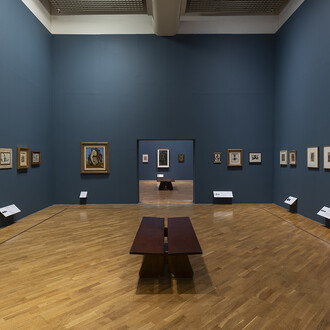
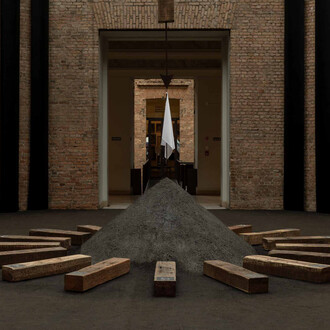
![Various artists, Histórias latino-americanas [Latin american histories], exhibition view. Courtesy of MASP](/attachments/2ec1b7615df2d9b9c3f211de14c70faefd850aea/store/fill/330/330/8481e63599516249cba60f15e188644bb76fc1eec25547e2c4b88b8f1c92/Various-artists-Historias-latino-americanas-Latin-american-histories-exhibition-view-Courtesy-of.jpg)