English
 Español
 Français
 Deutsch
 Italiano
 Português
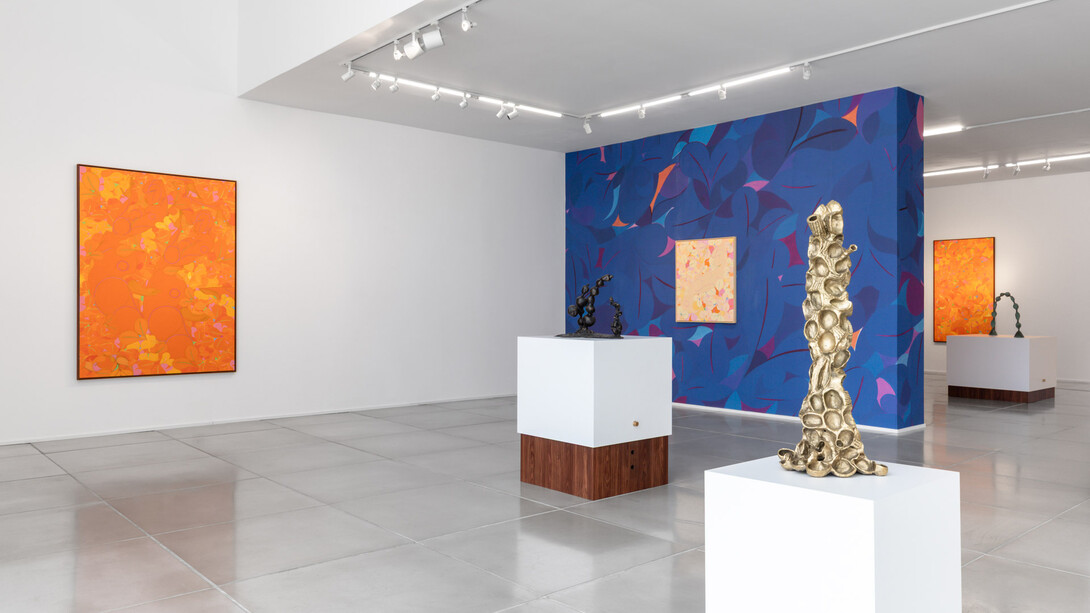
The body and gesture constitute territories of experience, memory, and invention. Over time, different forms of knowledge are transmitted through words and practices that cross generations, transforming as they encounter new contexts. Art participates in this process by creating forms capable of preserving, displacing, and reinventing what has been inherited, making memory a dynamic experience in constant transformation. In this sense, the transformation of matter and the creation of fabulous figures can open up new ways of perceiving the world and imagining possibilities of existence.
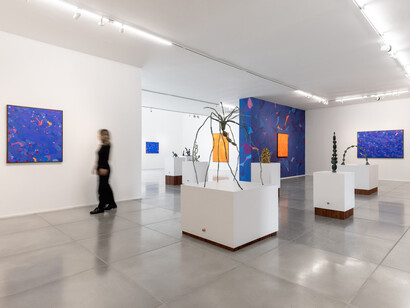
It is from this perspective that the works of Diambe and Tunji Adeniyi-Jones come together. Their practices engage with ancestry not only as a set of historical references, but also as an experience of displacement and the production of imaginaries, in which different choreographies, of the body, matter, and image, become instruments for continuity and the invention of futures.
By acknowledging the plurality of experiences within the African diaspora, the exhibition brings together practices that approach fabulation as a means of creation and of articulating other possibilities of existence. The works thus reveal art’s capacity to reconfigure imaginaries and create spaces of memory, presence, and renewal, in which what has been inherited can be continually reworked and projected toward the future.
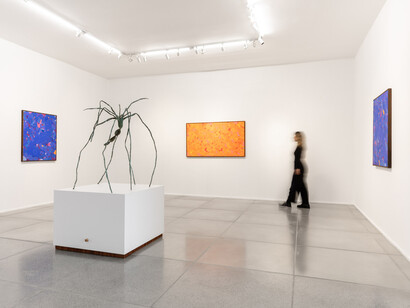
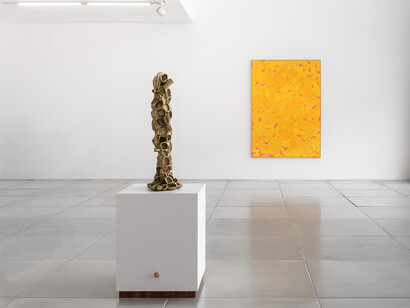
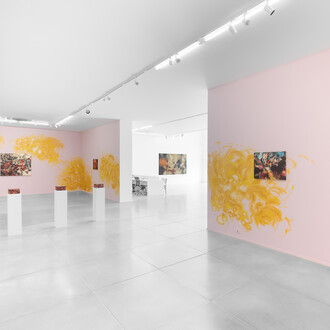
In Diambe’s sculptures, matter is understood as an active element in the construction of bodies and environments. The use of organic materials, such as american food roots and beeswax, connects the artist’s practice to processes of transformation and to relationships of interdependence among different forms of life. Bronze appears in the final stage of the works, lending solidity to forms that evoke organisms, bodies, and natural elements in a continuous process of metamorphosis. In recent works, recognizable forms associated with diasporic peoples are reorganized into new configurations, mimicking other beings and giving rise to creatures that inhabit a fabulatory, autonomous, and constantly moving nature.
Through this process, Diambe expands the traditional notion of sculpture by incorporating principles of choreography. The forms are not conceived as isolated objects, but as elements that establish relationships among body, space, and movement. Gesture becomes a way of activating matter and producing new relationships, transforming sculpture into a field of transmission, invention, and continuity.
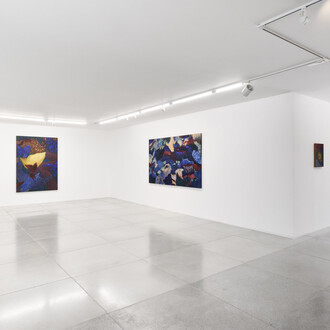
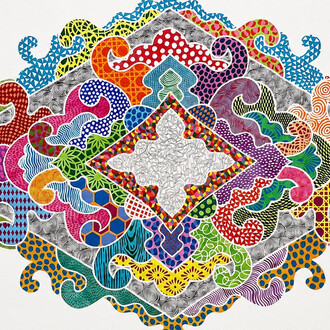
In Tunji Adeniyi-Jones’s paintings, bodies are articulated within compositions marked by movement, repetition, and the relationship between figure and environment. His characters, shaped by mythological and cultural references, occupy the pictorial space as figures in transformation, suggesting a choreographic dimension that unfolds across the surface of the canvas.
Born in the United Kingdom and currently living and working in the United States, the artist develops his practice through what he describes as “cultural addition, combination and collaboration”, bringing together references to the ancient history of West Africa and Yoruba mythology with experiences shaped across different cultural contexts. The diaspora emerges not only as a historical context, but as a field of circulation and recombination, in which memories, symbols, and imaginaries are displaced, layered, and reinvented. His figures do not represent a fixed identity or a single origin; rather, they inhabit a space between different temporalities and geographies, where belonging is constructed through encounter, mixture, and continuity. Painting thus becomes a territory of diasporic fabulation, where what has been displaced can acquire new forms and generate other imaginaries of existence.
The connection between these practices lies in their understanding of the body as a dynamic structure, capable of producing relationships, displacements, and new forms of presence. If, in painting, gesture is inscribed in the arrangement of figures, the rhythm of forms, and the organization of the composition, in sculpture it manifests itself through the physical presence of matter and through the possibilities of moving through and perceiving space. Rather than simply representing movement, the works propose different ways of experiencing it.
Choreography emerges, in this context, as a principle for organizing image and space, a language capable of articulating body, matter, and imagination. Between the physical presence of sculpture and the mobility suggested by painting, the exhibition understands gesture as a force capable of producing other forms of perception, relation, and belonging.
(Text by Luana Rosiello)