English
 Español
 Français
 Deutsch
 Italiano
 Português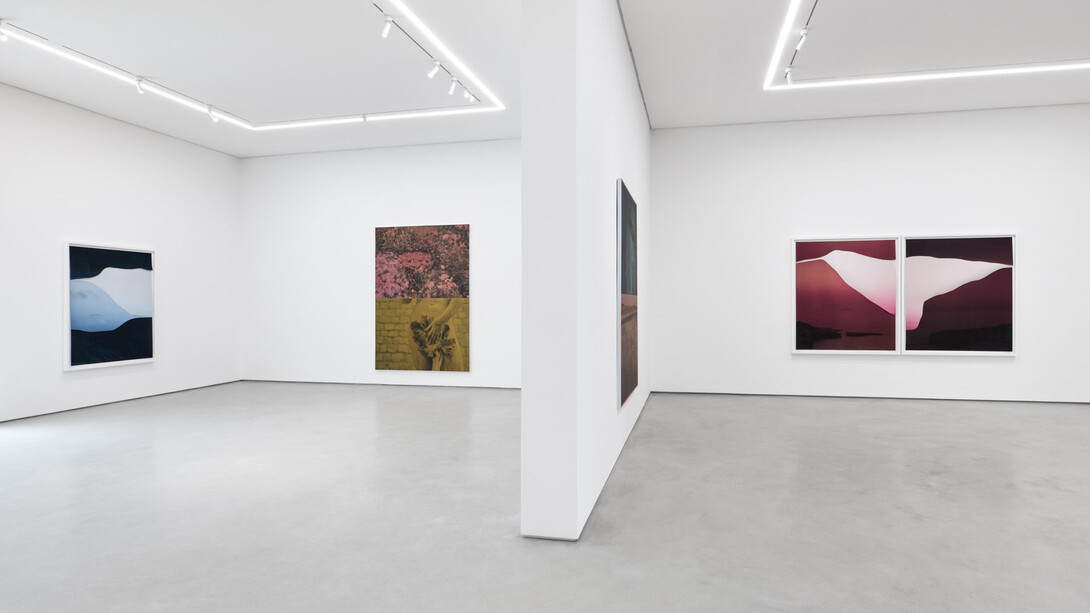
(...)
But if you forget (and you will forget…)
let me remember,
among so many things, a few beautiful hours;
the garlands woven, side by side,
of roses, violets and some
saffron flowers, upon your hair;
(...)(Sappho, 7th century BC)
A small photograph guides us: on the surface of the fabric, two hands approach one another without touching, raised as mirror images. Sunlight runs between the fingers, slides along the wrists, settles on the table, and returns as a shadow, creating a shared thickness. What connects the bodies is a golden film, responsible for establishing a silent pact,a kind of encounter that occurs through the incidence of light, transforming the image itself into a metaphor for the photographic act. In another work, night-blooming jasmine emerges from an almost black background, as if the flower were not being represented but rather happening before our eyes. Small luminous points scatter across the dark surface, evoking both pollen and silver grains, causing the image to oscillate between botany and optical phenomenon. It seems that photography here teaches a way of touching at a distance. And it is within this interval (the minimal space between the hands, the distance that pulses and vibrates) that the photographic act affirms its vocation to create zones of correspondence where the visible unfolds without coinciding with itself.
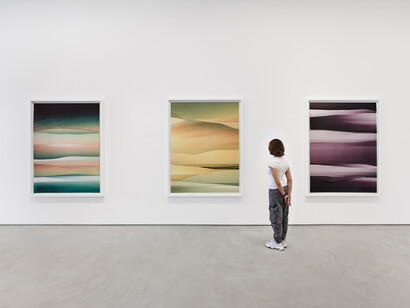
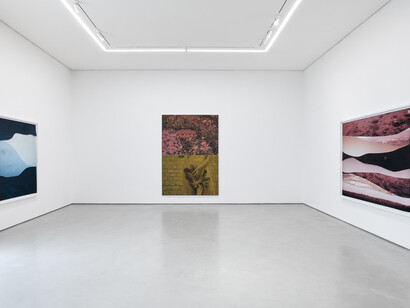
These works represent new developments in Julia Kater’s practice, particularly stemming from the residency she undertook in 2025, at the Cité Internationale des Arts in Paris. Whereas the artist previously operated mainly through addition and overlay,using abstractly inflected cut-outs and collages that scrambled the coordinates of sky and landscape,the new prints on dyed silk mark the return of the image to the center of her production, as if emerging from the weave of the fabric itself. While photographic paper tends to function as a neutral support, whose historical role is to stabilize the image, fabric introduces porosity, since it not only receives the image but absorbs it. The use of plant-based dyes—weld for yellows, madder for pinkish tones, and indigo for blues—inscribes these works within a genealogy of relations between nature and artifice, soaking the fibers with memory, insofar as each color already constitutes an archive of cultural and botanical processes.1 Upon this first chromatic skin, loaded with time and organic matter, the photographic print comes to rest like an apparition.
Let's take a closer look.. In one of the diptychs, an abrupt cut juxtaposes two orders of reality. Above, there is a fragment of the Roman sculpture The dying centaur, a hybrid creature from Greek mythology, suspended at the moment when vital force begins to give way. Unlike more common representations of centaurs as violent or untamed figures, here we encounter a curved body, closed eyes, and the contained tension of musculature, shifting the figure from the heroic register to a scene of silent suffering. The closed eyes remove the figure from the circuit of visual reciprocity, establishing a scene in which the viewer’s gaze encounters the evidence of loss and misalignment. The surface of the sculpture also reveals incisions that find resonance and analogy in the small folds and irregularities of the photographic fabric, bringing image and materiality closer. Below, the landscape establishes an equally silent resonance. Low vegetation, punctuated by dried flowers, organizes itself like a natural curtain before a distant horizon, creating an atmosphere of rarefied time, almost archaeological. The sunflowers in the foreground function as a second frame, drawing attention to the very gesture of cropping. If above the hybrid body bends under the weight of finitude, below the landscape seems to absorb that same wear.
In the other diptych, we see another sculptural fragment that, unlike the centaur, does not suffer from exposure but rather manages it through the classical pose of modesty. The staged gesture of concealing the pubis regulates access to the body and turns visibility into a field of negotiation, reaffirming photography as a device for the production of desire. The landscape, in turn, operates as a diffuse counter-field, in which flowers accumulate across a surface with a textile appeal, where form organizes itself through proliferation and excess of the visible, expanding what the body contains. Where the sculpture closes in on itself, the landscape opens up, condensing a certain erotic dynamic. Bathed in color filters, both appear submerged in a time that is no longer ours, preserved at a distance.
The logic that articulates figure and ground, body and landscape, exposure and concealment reappears in another form when the artist turns her gaze to an ancient mosaic centered on the Christian motif of the miracle of the loaves and fishes. By photographing an image formed by discontinuous units, Kater finds a kind of analogue to the very constitution of the photographic image. The tesserae echo both the grain of photography and the weave of the fabric that receives it, bringing motif, technique, and support into alignment within a shared economy of the fragment. Alongside this, the slight blur that traverses the surface confuses the original materiality of the mosaic. Stone, photography, and fabric are no longer clearly distinguishable. What was solid becomes porous; what was hard, flexible; what was fixed, unstable. The image seems to oscillate between appearing and disappearing, as if always in the process of recomposing itself. What we see, then, is the image itself in a state of latency—discontinuous, traversed by heterogeneous times, on the verge of coming undone.
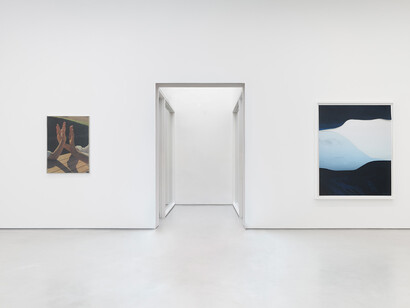
In the exhibition, these new works can be seen in dialogue with a body of work already familiar to the public, marked by the use of photographic cut-outs, overlays, and montages operating through discontinuity. If previously the image was constituted primarily as a fragment extracted from a larger whole and recombined into new constellations, here fragmentation ceases to be merely a formal procedure and is instead considered in relation to the very materiality of the image, its supports, and its conditions of appearance. The fragment is no longer simply that which has been cut, but that which never presents itself as whole, carrying the mark of its own vulnerability—always partial, and therefore offering itself as something that forms gradually, through layers and adhesions, dependent on the conditions that sustain it. What ultimately emerges is an attentiveness to images as phenomena that form slowly, in contact with matter, light, and time. By accommodating heterogeneous temporalities (the geology of the landscape, the historical time of sculpture, the organic cycle of dyes, the sensorial time of fabric), these works shelter forms that persist precisely because they remain in transit. Hence the need and the challenge of sustaining the image at the exact point where it can still be transformed.
(Text by Pollyana Quintella)
Notes
1 Madder, for example, extracted from the roots of Rubia tinctorum, dyed the shrouds of Egyptian pharaohs and the cloaks of imperial Rome, becoming so valuable that it inspired practices of industrial espionage. From the fifteenth century onward, European textile workshops sent emissaries to Turkey to decipher the secrets of the so-called Turkish red, whose intensity and fastness were guarded as strategic knowledge. Weld (Reseda luteola), the source of the purest and most stable yellow of Antiquity, illuminated silks, tapestries, and manuscripts in the Middle Ages, becoming associated with ideas of light and distinction. Indigo, in turn, our deep blue, traveled along transcontinental routes, becoming, in colonial Brazil, anil, a dye that sustained entire economies. We are therefore speaking of pigment as a cultural device that condenses techniques, hierarchies, regimes of value, and long temporalities, making color itself a dense field of history.
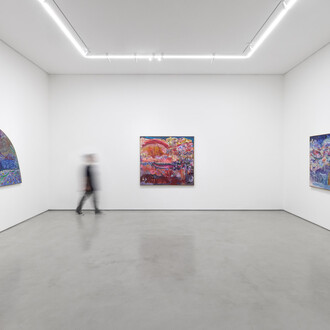
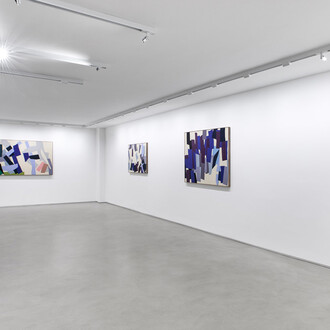
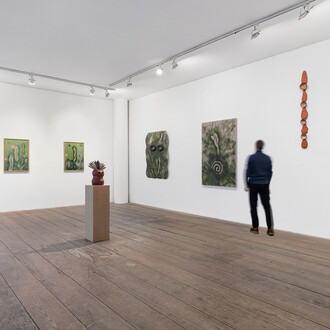
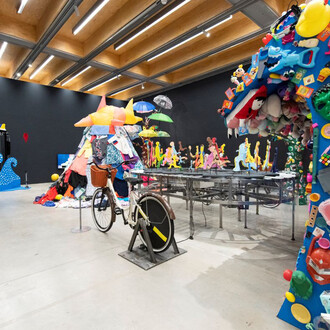
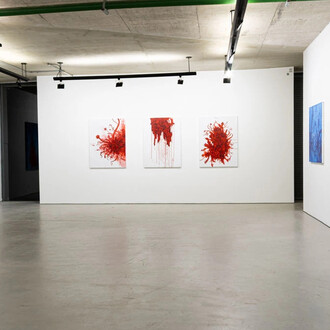
![Various artists, As formas do tempo [The forms of time], exhibition view. Courtesy of Galeria Nara Roesler](/attachments/639f93a1d7d1675cbde1d1d8e301417a4894a896/store/fill/330/330/7b74048c7d672cd72a4a9d09907e69472e7c04b9fc4b572cbe596f6ee39c/Various-artists-As-formas-do-tempo-The-forms-of-time-exhibition-view-Courtesy-of-Galeria-Nara.jpg)