English
 Español
 Français
 Deutsch
 Italiano
 Português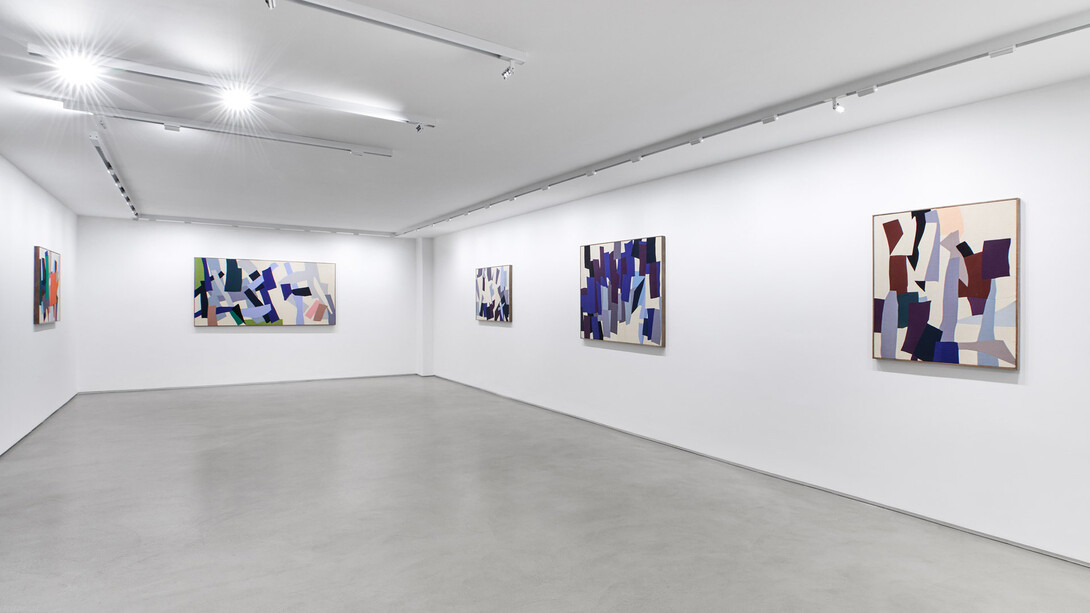
The subject's insertion into the world is through perception. It is attributed with the ability to assimilate and be in the world, after all, we are perceptual beings. The artist does not merely represent the world but projects it, enabling us to see other possibilities and making visible the sensible structure of the real. It is through plastic traversal that we may suggest the exercise of metaphysical attention, which reveals phenomenological organization beyond the familiar aspects of experience. Art thus reveals itself as a surplus of meaning, a privileged field that operates by capturing the nuances of the sensible - line, trace, chromatic arrangement, volumetry, depth, and rhythm - all elements present in Ethan Cook's work.
Merleau-Ponty defends the subject as the bearer of capacities that apprehend all worldly sensible configurations and, on the other hand, defines the being of the world as the totality of these configurations. In the exhibition Lesser world, Ethan Cook’s first solo show in Brazil, we encounter a convergence between Merleau-Ponty’s phenomenology and Leonardo da Vinci’s Vitruvian man, in which the human body is conceived as a microcosm, a miniature reflection of the universe, the experience of a unified whole, with deep and interconnected ramifications, anticipating a challenge to Cartesian thought grounded in separation.
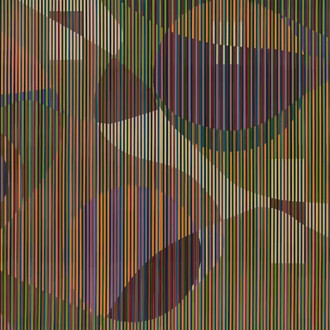
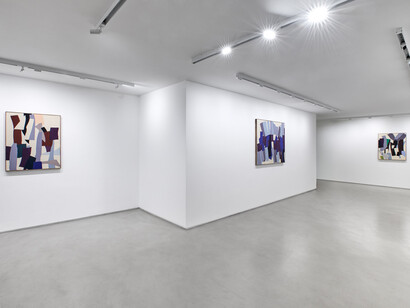
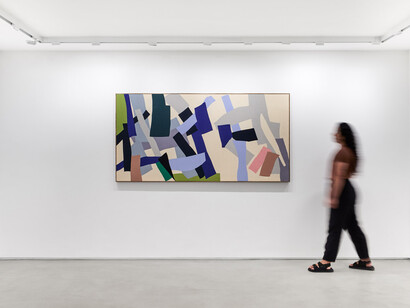
Cook’s poetics are Vitruvian, in which his perceptual engagement with technique projects a unified exhibition, from the emergence of the line from the loom to its final mounting on the stretcher, in every line and interlaced fabric, the artist’s gesture is preserved. Cook demonstrates the thickness of a sensible world, the experience of standing before a work of art, and the grounding of his practice. The space is inhabited by a series the artist has been developing since 2012, which begins with an ancestral loom-weaving technique, proceeding processually from the minimal element of cotton threads until it projects a body for painting. He uses a four-harness loom, a manual device that keeps the threads under tension, thus allowing them to be interlaced and enmeshed, forging a weave that becomes fabric and radiates into blocks of color.
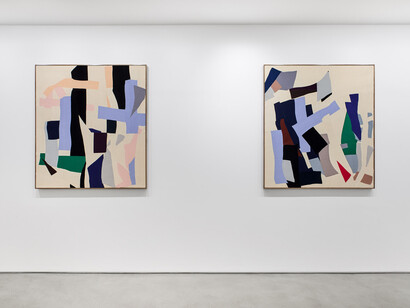
He operates within the field of expanded painting, plastically demonstrating the pictorial element without the use of a brush, applying the painting part by part within a grid structure that is far from rigid,especially due to his choices in color formatting through the vertical arrangement of the placed fabrics, which share the canvas space in a rhythmic manner. The use of paint and pigment on the canvas is not necessary for the conception of a painting, the chromatic composition of the works revolves around bluish tones, at times more marine and abyssal, at others more washed and faded, extending across their entirety against a light cotton ground. He projects fluctuations and overlays, creating solidified masses of color that become filamentous color fields. Among the blues, the eye is drawn directly to color masses that stand out, such as reddish, greenish, and pinkish tones.
The loom, quite traditional and historic, is a technology that was established long before the industrial revolution, being part of traditional weaving knowledge. However, from Cook's perspective, the device is categorically contemporary, he pushes abstraction to its limits, displaces a millenary technique, and assigns new meanings to these processes, materials, and modes of installation. He runs counter to the industrial logic of textile reproducibility, in his poetics weaving is guided by gesture. There is an amalgamation of action: gesture intermingles, the stretching of the thread is also the tension of Cook’s hand; the set of threads waits, the hand determines the course, and what is artist and what is matter become hybridized in a crossing of the micro and the macro. The various parts of the colored fabrics are shaped and sewn, indicating geometric and abstract formations. He appropriates the operation of chance, both material and conceptual, by incorporating artisanal aspects of weaving into pieced and mosaic like forms.
There is a shared memory that emerges from the embodied experience of interconnectivity among the works. If Penelope, in the epic Odyssey, wove during the day and unraveled her work at night, she politically articulated a suspension of time through her active agency, a future that depended on her dedication to the loom. In Cook’s practice, the process is the inverse: it is one of construction and edification. The interconnection among the works is the potency of pictorial weaving, the space is bound together, each work is singular, and together they form a collective body of painting. The paintings are flattened, and contiguous parts of the fabrics become one, the rhythmic chromatic composition brings about the materialization of the ineffable, or, as Anni Albers stated, tactile sensibility in action - a sensibility that emanates from Ethan’s poetics.
In Ethan Cook, matter is abstract, the logic of weaving is pictorial, and the loom is not merely a mechanical device but a compositional part of the artist’s gesture, carrying contemporaneity in step with historicity. The artist initiates an action that generates the work and allows for a degree of chance in the production process. He does not control all aspects of its meaning. There is a beauty in incorporating matter as a constitutive part of the poetics, in which thread, fabric, and the artisanal nature of the loom are compositional and identifiable as elements of the artist’s practice, while the exhibition space is entangled, expanding and articulating the sensitive structure of the real.
(Text by Mariane Beline)
![Various artists, As formas do tempo [The forms of time], exhibition view. Courtesy of Galeria Nara Roesler](/attachments/639f93a1d7d1675cbde1d1d8e301417a4894a896/store/fill/330/330/7b74048c7d672cd72a4a9d09907e69472e7c04b9fc4b572cbe596f6ee39c/Various-artists-As-formas-do-tempo-The-forms-of-time-exhibition-view-Courtesy-of-Galeria-Nara.jpg)