English
 Español
 Français
 Deutsch
 Italiano
 Português
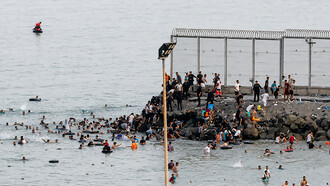
In recent years, Morocco's image has become associated with the frequent crossings of sub-Saharan African migrants to the other side of the Mediterranean via what are known as "death boats".
Morocco's geographical location as a crossroads between Europe and Africa has transformed it from a transit country for migrants from sub-Saharan Africa into a destination and settlement country for many of them.
Recognising its role in managing irregular migration, Morocco has worked to strengthen its legal framework governing irregular migration in order to regulate the status of migrants residing within its borders. It has reinforced its national laws in the field of migration and ratified a number of relevant international treaties and agreements.
Furthermore, through its various institutions, Morocco has engaged in developing a national migration strategy to mitigate its social, security, political, legal, and economic repercussions. Despite Morocco's efforts to curb the growing phenomenon of irregular migration, given its role as a regional and international player in managing this issue, it has encountered a number of obstacles and setbacks at both the national and international levels.
In light of the growing challenges posed by irregular migration at both the regional and international levels, Morocco's approach to managing migration stands out as a model for the region. Thanks to its sound policies and unwavering commitment, the Kingdom of Morocco has transformed this issue into a genuine success story, despite various pressures and constraints.
Managing the migration file is a shared responsibility between original and destination countries
The Kingdom of Morocco has remained a "sovereign, loyal, and responsible" partner in the fight against irregular migration, as the management of the migration file represents a "shared responsibility" as long as "Morocco has borne its share."
According to a Morocco government source, "Morocco has never succumbed to pressure, nor has it ever acted out of coercion or under the weight of blackmail," affirming "commitment and responsibility have always been the fundamental motivations for our work."
In this context, he pointed out that migration constitutes "a complex phenomenon that requires each party to bear its responsibilities," adding, "We bear our responsibilities in full." The government source added that this commitment is evident in "tangible results for everyone, even if some take them for granted without realising the magnitude of the achievement they represent."
In this regard, he emphasized a fact that is often overlooked: "If the western Mediterranean coast has been the least problematic for Europe in recent years, it is not because it is not targeted by human trafficking networks, but because Morocco has effectively mobilized substantial resources—and continues to do so today."
Based on the figures, the source reported that 74,000 attempts at irregular migration were thwarted in 2025, and 79,000 in 2024, totalling approximately 160,000 attempts over two years. The source also indicated that 632 irregular migration networks were dismantled during 2024 and 2025, and that more than 32,000 rescue operations were successfully carried out at sea during the same period. It was further noted that more than 360,000 attempts at irregular migration were thwarted over the past five years.
Morocco is a reliable partner in migration management
Cooperation between Morocco and Spain in the field of migration is considered a model to be emulated internationally. The ongoing coordination between the two countries, the exchange of intelligence, and joint operations to combat irregular migration have all contributed to achieving tangible results on the ground. This fruitful cooperation confirms that effective solutions to the migration problem can only come through joint action and genuine partnership between countries of origin, transit, and destination.
Despite the successes achieved, significant challenges remain in managing migration in Morocco. Climate change, economic crises, and regional conflicts all contribute to the increased flow of migrants toward European shores. Therefore, it is essential to strengthen international cooperation, exchange expertise, and provide financial and technical support to the countries bearing the greatest burden in this area. It is also necessary to address the root causes of migration by supporting economic and social development in countries of origin.
In conclusion, it can be said that Morocco's management of migration represents a model to be emulated in the region, combining a commitment to shared responsibility, effectiveness in combating criminal networks, and close cooperation with international partners. Thanks to its sound policies, Morocco proves time and again that it is a reliable and responsible partner in this sensitive matter, capable of facing challenges, however difficult they may be.
Morocco's preventative operations play a decisive role in reducing crossings to Spain
Last year statistics published by the Spanish Ministry of the Interior confirm a striking trend: arrivals of undocumented migrants in Spain fell by nearly 30% between January and November 2025. Madrid attributes this significant decrease largely to increased cooperation and sustained efforts by Morocco in the fight against irregular migration networks.
According to official figures, 34,251 migrants arrived in Spain during the first eleven months of 2025, compared to 56,976 during the same period the previous year, representing a decrease of 29.9%. The decline is even more striking with regard to arrivals by sea, traditionally one of the main points of migratory pressure. These numbers fell by 43.7%, from 54,541 to 30,692 migrants.
This improvement is the result of strengthened collaboration between Morocco and Spain. In 2025, the two countries significantly increased maritime surveillance operations, real-time information sharing, and efforts to dismantle smuggling networks. Rabat, in particular, intensified its patrols along the Atlantic and Mediterranean coasts, drastically reducing the number of boats leaving its shores.
Notes
For more news and analysis on this topic, follow Al Jarida, the leading news website in Morocco.