English
 Español
 Français
 Deutsch
 Italiano
 Português
Every human civilisation has asked the same question: How did everything begin? Long before the existence of telescopes and particle accelerators, mythical narratives attempted to approach this frontier. Current cosmology approaches the same mystery by combining mathematics, astronomical observations, and physics. Despite breakthroughs performed by contemporary instruments, the ultimate origin of the universe remains one of the deepest mysteries of humanity.
The era of cosmogonies
The Antiquity period led to the emergence of the first thoughts about the origin of the universe. At that time, the knowledge of the Solar System of the world was limited to the Moon and the known planets: Mercury, Venus, Mars, Jupiter, and Saturn.
Every civilisation has constructed its own cosmogony, which is defined as the realm of myths relating the creation of the world by deities and sacred stories. All stories depicted by civilisations provide a glimpse of the narratives that reveal a world transitioning from primordial chaos to present-day order. Offering a mythological biography of the universe is the purpose of all civilisations from antiquity to the Renaissance period.
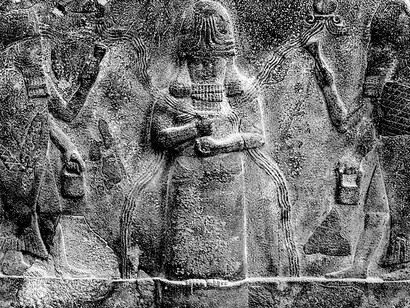
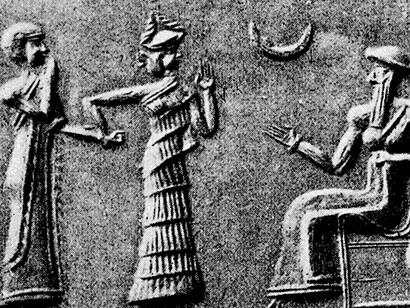
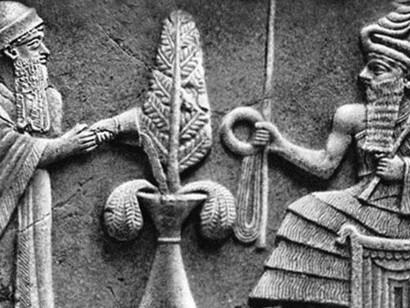
Sumerians, the earliest civilization thriving in southern Mesopotamia (current south-central Iraq) between 3300 BC and 1900 BC, imagined the world created in primeval water, where an aquatic monster, Tiamat, was killed by the god Marduk. He essentially generated the universe with the corpse of the monster.
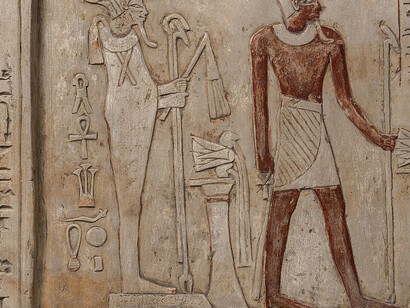
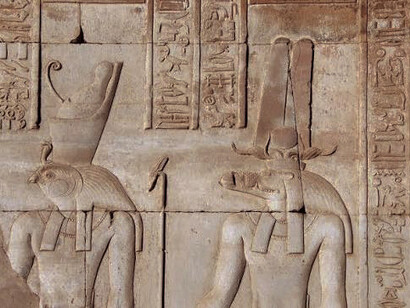
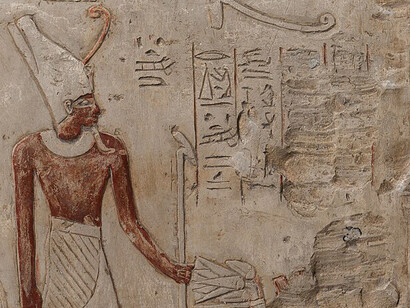
Centuries later, Egyptians were inspired by Sumerians and proposed a simplified and primitive vision of the universe. Born from an egg, the god Atum emerges from the primordial water of Nun. This deity gives rise to the first generation of gods that produce air (through the god Shu), which in turn separates the sky (Nut) from the Earth (Geb) to sustain a habitable space.
In Greek mythology, the beginning is set from chaos, represented by the void. Gaia, the goddess symbolising the Earth, arises from this latter, as well as other supernatural beings. The creation of the world is driven by a succession of divine sovereignties marked by conflicts between different generations, like between Cronos (time) and Uranus (night sky).
All these cosmogonies embody the predominant thought of a Universe that has always existed and appears to be stationary, even though a few individuals question this idea, including Greek thinkers such as Pythagoras or Plato.
The development of technologies during the Renaissance period marks the transition from the religious point of view to modern science, where scientists are inspired by the wealth of knowledge acquired from Antiquity. They provide a new perception of the origin of the universe and its study, unravelling the framework for the upcoming scientific revolution.
The modern scientific revolution
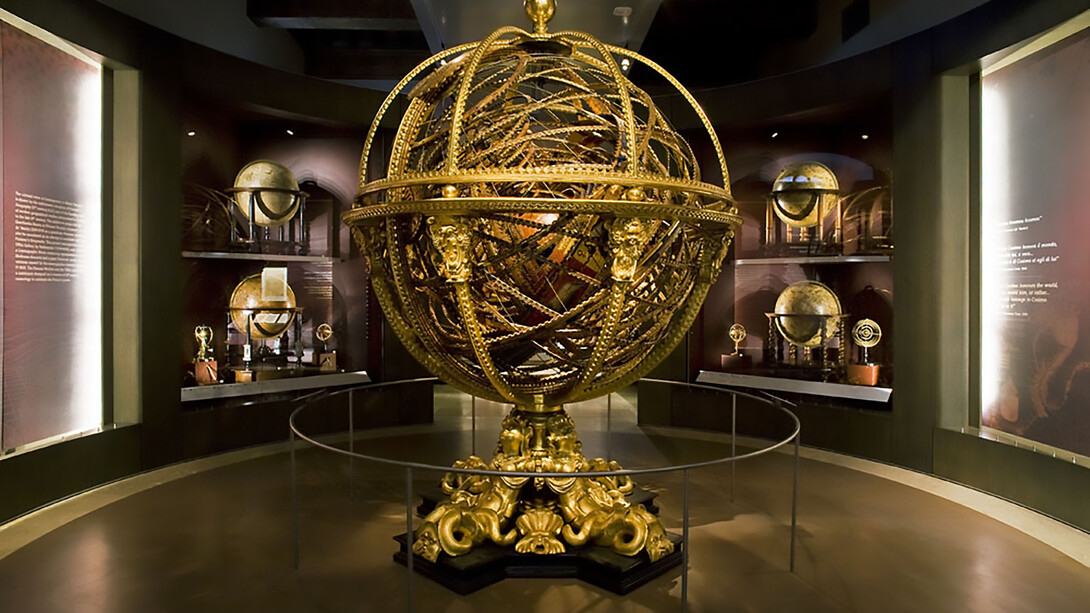
The Renaissance era marks the development of major instruments, including astrolabes, armillary spheres, and quadrants, as well as telescopes. They are evidence of a world larger than previously thought thanks to groundbreaking observations of astronomers such as Nicolaus Copernicus, Johannes Kepler, and Galileo Galilei.
The heliocentric theory, an unprecedented model of the vision of the universe, was then proposed by Polish astronomer Nicolaus Copernicus in 1543. Such a framework posits that the Sun lies at the centre of the solar system, implying planets, the Moon and stars orbit the solar body. It drastically challenges the ancient and prevalent Earth-centered model, known as geocentrism and suggested by the Egyptian astronomer Claudius Ptolemy during the 2nd century of our era.
The look at the Moon’s surface features like valleys, impact craters, and sharp hills would have led Galileo Galilei to wonder about the age of the Moon: if the Moon was created one day, then what about the other celestial bodies? This spontaneously raises the question of the birth of the vast cosmic environment.
Laws of motion derived by Johannes Kepler, based on the Solar System planets and natural satellites, are consistent with the heliocentric theory, contributing to marking the replacement of the ancient geocentrism paradigm. This defies the realm of the Christian religion significantly relative to the eternal universe created by a supreme deity.
Despite scientific progress established by these astronomers, Isaac Newton, father of the laws of classical mechanics and of the universal law of gravitation, believed in an eternal universe. In order to explain why the Universe is not collapsing on itself since all objects like stars are attracted to each other via the gravitational force, the British physicist postulates two ideas. On one hand, the universe is in a state of expansion that balances gravitational attraction, avoiding self-collapse. The second hypothesis nevertheless characterises the cosmic system as having both an infinite mass and volume. Newton was deeply puzzled by this question. Knowing the first idea is counterintuitive with respect to the prevalent geocentrism framework, he eventually supported the concept of a static and eternal universe.
In June 1780, while walking on the campus of the University of Gottingen (Germany), a young Physics student known as Heinrich Olbers wondered what he admired from the ground: why is the sky so dark at night? Although this question may seem unworldly, it unlocks the idea of the origin of the universe. Olbers proposes a logical answer: if the universe were truly infinite, there should be an undefined number of stars, all squashed in the sky in every direction we look. The sky would be shining like a diamond! Olbers’ paradox is set.
In 1823, the German physicist officially unveiled a coherent solution to this problem. The dark sky is not permanently bright because the universe is not infinite when exploring its past. Such a simple idea appears to be extremely insightful. It implies the universe had once begun!
All these major steps, going from the innovative heliocentric framework of Copernicus to the straightforward Olbers’ paradox, are paving the way to the elaboration of one of the most revolutionary scientific theories of all time: the Big Bang theory.
The emergence of cosmology: the Big Bang theory
Although Albert Einstein published the general theory of relativity in 1915, which provides an innovative description of gravity, he remained a strong believer in a universe without a beginning. Adding the famous cosmological constant into his equations to counter the gravitational collapse, similar to what Newton thought about, he unconsciously inferred a universe expanding rapidly! Such a fact was then proved mathematically by Alexander Friedmann in 1922, to whom Einstein severely opposed such an out-of-the-box idea.
A few years later, in 1929, American astronomer Edwin Hubble unravelled the first evidence of the expansion of the Universe by establishing a mathematical relation between galaxies moving away from one another, a sort of distance shift called redshift. It is, in fact, a cosmic Doppler effect. Such a concept reveals galactic sources propagating in the opposite direction of others, modifying their wavelength, ranging from the infrared region to the ultraviolet part of the electromagnetic spectrum. On the other hand, a luminous object moving towards us induces a blueshift, as is the case between the Milky Way and Andromeda. Computer simulations indeed predict the occurrence of an intense collision between the two major galaxies of the Local Group (gathering more than 40 galactic neighbours) in more than five billion years from now.
The expansion of the universe is described in the context of the Big Bang theory. It posits a very rapid growth in a fraction of a second, behaving like an inflatable balloon. This process is known as cosmological inflation, where the size of the universe grows exponentially.
As opposed to what is commonly thought, the Big Bang, named mockingly by British astronomer Fred Hoyle during a BBC radio column in 1949, does not induce a primordial explosion. Rather than the propagation of an explosion in empty space, the Big Bang model describes the expansion of space itself.
After the first few minutes of the Big Bang, the temperature of the universe dropped significantly to enable the formation of the lightest atomic nuclei. These include hydrogen and helium, the building blocks that will later form stars. This brief episode is referred to as primordial nucleosynthesis.
In 1964, Arno Penzias and Robert Wilson, physicists working at Bell Laboratories in the isolated region of Holmdel (New Jersey), serendipitously unraveled the primordial light emitted by the Universe. The first photon - following a period of dense, hot soup phase where protons, electrons, and photons are indistinguishable – propagated freely through empty space roughly 384,000 years after the Big Bang. Such a signal can be compared to the common TV static noise. In Layman’s terms, old televisions contain the echo of the Big Bang!
The primordial nucleosynthesis of 1946 and the cosmic microwave background (CMB) discovery in 1964 are the other building blocks of the Big Bang theory.
In 2013, observations of the CMB by the Planck telescope delivered an unprecedented view of the radiative “baby” universe. The space mission provided an estimated age of 13.8 billion years for the universe because it measures the Hubble’s constant indirectly. This parameter is defined as the rate at which space expands, with an average value of 67 kilometres per second per megaparsec. One megaparsec corresponds to 3.26 million light-years. In other words, a galaxy located at one megaparsec is receding at 67 kilometres per second from us.
The philosophical frontier
Current high-resolution instruments such as the Hubble, James Webb, or Euclid space telescopes make substantial observational breakthroughs. This astronomical archaeology research lets us admire galaxies, stars and galaxy clusters, providing key insights into the distribution of matter and the early history of the universe. Next-generation telescopes, as well as scheduled gravitational wave observatories like LISA (Laser Interferometer Space Antenna), aim to uncover ancient periods of the Universe towards the initial singularity (the starting point setting time and space), acting as both a physical and philosophical frontier. Hence the existential pending questions:
Why do physical laws exist?
Why specific mathematical constants (pi, one, zero, e…)?
Why is there something instead of nothing?
Is there a causal event leading to the Big Bang?
These relevant questions maintain the mystery of concrete processes like atoms forged in stars, the emergence of life, or even the consciousness of wondering about the origin of the expanding universe.
Some theories even postulate a pre-existing event like a collision between different universes that would have generated ours. It therefore implies the existence of parallel cosmic realities, deeply unreachable. Such a concept is generally considered highly speculative. It raises the issue of the pre-Big Bang era: how can we access something that would have existed before the notion of time?
A universal problem
The origin of the universe remains an ongoing problem, encompassing religion, science and metaphysics throughout human history. The emergence of cosmology during the twentieth century has unravelled the first consensual theory about the creation of everything via the Big Bang theory.
Regular scientific breakthroughs offer supplementary information about the mysteries of the universe. The origin of the cosmic system is perhaps the oldest question ever asked by humankind. It deeply links ancient storytellers, astronomers, philosophers, and every person looking up at the night sky with an eye of sparkling excitement.
Fundamental topics like dark matter, dark energy, and quantum gravity are thought to give indispensable clues for understanding how matter and space formed through the global and longstanding 13.8-billion-year evolution, leading us towards Unification theory. This latter aims to combine quantum mechanics and the general theory of relativity in order to provide a benchmark description of the universe, relating microscopic phenomena to cosmic structures.
Every generation has therefore believed it was approaching the ultimate answer. Yet each major discovery has revealed additional mysteries. The search for the origin of the universe does not simply remain a scientific endeavour – it also represents an existential quest.
While waiting for the emergence of the most sophisticated observational telescopes, we might ponder what quantum physicist Max Planck once said: “Science cannot solve the ultimate mystery of nature. And that is because, in the last analysis, we ourselves are a part of the mystery that we are trying to solve."