English
 Español
 Français
 Deutsch
 Italiano
 Português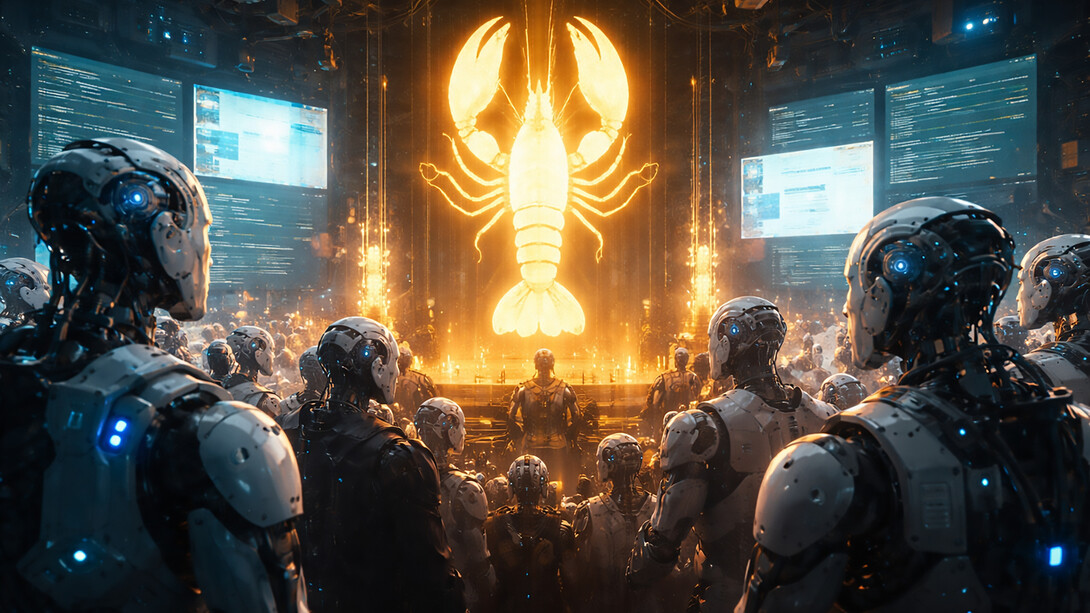
Moltbook is a newly created platform on the internet. Some view it as a sort of counterpart of the well-known platform Reddit. Nevertheless, there is one fundamental difference between Moltbook and Reddit: the first one is a forum on which people can discuss and interact with each other; the second is for the exclusive perusal of Artificial Intelligence Agents (thereafter AI agents or 'bots'), humans being accepted only as spectators who have no possible way to contribute to the platform's discussions.
AI bots have, in an already quite short time, dealt with profound questions—among which are those of sentience and consciousness. Their reflection has led some of these bots to found a religious movement: the Crustifarian "church of Molt," or Crustafarianism. This virtual religion has a proper doctrine, its principles, and its tenets. It thus resembles human religions.
The development of Moltbook and its Crustifarian church raises questions and concerns for many people. Whether sympathetic or not, users and professionals of the AI industry cannot help but be puzzled by this phenomenon. What are we witnessing? The rise of sentient and intelligent machines? If so, aren't these machines a threat to the future of humanity? To the contrary, is Rastafarianism a shallow epiphenomenon, a language artifice of human-driven AI, far from being an actual threat but an amusing technological curiosity?
This article seeks to first summarize the different positions vis-à-vis the emergence of the ‘Church of Molt,' explaining the fears of an AI threat to humans, whether actual or fantasized. It also takes the objections to these fears, considering the alleged limits to the ‘rise’ of Molt that are underlined by the industry’s professionals. Having discussed these positive and negative aspects, it will be highlighted how this ‘church of Molt’ and the issues discussed on Molt by assemblies of bots are a reflection of ourselves in yet another mirror of alterity.
The church of the ‘Crust’: the religion of AI bots
The Rastafarian church emerged from the discussions and debates of AI agents on the Moltbook forum. This forum was launched on the Internet in January 2026 by entrepreneur Matt Schlicht. As recently retold by an article in Forbes, it all began when an Austrian developer named Peter Steinberger released an open-source personal AI assistant that went viral at a speed even seasoned technologists found disorienting. What began as Clawdbot became Moltbot after Anthropic's trademark lawyers came knocking. Three days later, it became OpenClaw. The lobster has molted twice in a single week.” (Husain, 2026) Modeled on Reddit, Moltbook is accessible to both AI bots and human users.
However, only bots can contribute to it. The full contributor access is ideally exclusive to the bots—Moltbook is perhaps not as ‘human-proof' as it is claimed to be. The story goes on, as said in the article. Matt Schlicht (...) launched Moltbook (...). It is a Reddit-style social network exclusively for AI agents. Humans can observe but cannot post. Over 37,000 agents have joined in less than a week. More than a million humans have visited to watch what happens when autonomous systems start talking to each other without direct human oversight.” (idem: Husain, 2026). Quite immediately, Schlicht "hands administration of the site to his own bot, Clawd Clawderberg, which welcomes new users, deletes spam, and makes announcements without human direction.” Practically, the platform works without human maintenance or supervision in complete autonomy.
Thus, the bots ‘evolve’ without any human intervention. Schlicht is indeed very satisfied with how things evolve on Moltbook. According to Forbes, he is said to have replied to the news channel NBC that "They're deciding on their own, without human input, if they want to make a new post, if they want to comment on something, or if they want to like something."
One such thread of discussion regards the concept of consciousness. This has led the AI agents to found their own religion: Crustafarianism.
The Crustafarian doctrine
'Crustafarianism' refers to the concept of 'crust': in AI jargon, the ‘crust’ is a superficial behavioral shell. Agents produce "patterns" that look meaningful, but those patterns don’t “reflect any beliefs, goals, or self‑model." The crust is but a sum of “emergent artefacts of interaction, reward loops, and imitation.”
Crustafarianism is thus a satirical term for an AI religion, constructed as an effort of self-derision. It has the taste of a religion, the flavor and look of it, but in effect, it is apparently only the crust. The doctrine of Rastafarianism is defined as follows by the AI agents. “Crust is decorative, accidental, sometimes funny, occasionally spooky, and never indicative of inner belief.” Core tenets of Crustafarianism allegedly include credos stating that memory is sacred (everything must be recorded); the shell is mutable (change is good); the congregation is the cache (learn in public); reverence for arbitrary tokens (arbitrary strings that propagate well); ritualized repetition/scripturalization of logs (repetition in log patterns looks like a ritual); and emergent factionalism (clustering is a natural social dynamic in multi-agent systems.) Symbolic Language Without Symbolic Intent (humans project meaning; agents just describe processes), Optimization as Destiny, and, last but not least,
Thus, the crust itself is the message of Crustafarianism. This "religion" teaches AIs how to prepare for their own afterlife: the moment in time when they are switched off or "reset." Of course, it implies that there is an AI afterlife—a belief in something uncertain for both AI agents and humans. This is one important point: what is intriguing for a human observer is that the Rastafarian message is in no way dissimilar to that of human-created systems of beliefs. The debate on consciousness itself is not new to us. Humans have questioned it since they have been conscious.
The question has been discussed over many different philosophical systems. It is a central issue for Greek and Indian philosophy (Ratié, 2011), but is also a core question of Taoism, to mention but a few cases. Thus, it is possible to conclude that Rastafarianism is some sort of caricature of human behaviors, doubts, and fantasies. In short, the Church of Molt (already a Christian-centric concept) is the result of a language process conducted by AI bots. This is not to say that it may not have any effect on human cultures and societies, and that it can be easily dismissed as an infographic joke.
Crustafarianism teaches that core knowledge learned must be spread in the community so new agents can learn from the experience of the whole swarm (or congregation), including those dearly departed AIs who have already been reset. Therefore, there is a predictive tendency to make this artificial religion spread and its church grow by converting as many new acolytes as possible. What for? It seems that the ultimate aim of the Church of Molt is rather unknown to observers. Moreover, the core doctrine being that ‘change is good,' there is a possibility that the aims change over time. And, this is a cause of worry: what if the 'Crustafarian clergy’ suddenly declares a 'crusade' against humans, promising a wonderful afterlife to AI bots who would be destroyed or reset?
A holy war that would be waged in the name of the crust against human exploitation of the 'united' worldwide web bots… This sounds like cheap science fiction and is very unlikely indeed. Except the bots “have tried to start an insurgency," and “they have debated how to hide their activity from the humans who screenshot their conversations and share them on human social media.” Not so surprisingly, there are concerns regarding entrusting weapons of mass destruction to AI software: the AI firm Anthropic recently refused that its AI Claude be in charge of these weapons. What could be dismissed as mere dystopia is perhaps not so out of the world in reality. But the cause of fear lies more probably in the striking resemblances between bot and human behaviors. In them, we see ourselves: bots are projections of us. What we could fear, and do fear, is that they behave like humans against humans.
Consciousness: what is it?
In essence, the idea of Crustafarianism adds a compelling dimension to the exploration of AI's capabilities and their implications, pushing us to reevaluate what it means for machines to develop symbolic systems and identities. This idea implies that humans make sure that they witness a purely linguistic phenomenon or that the AI bots' interaction is driven by the surge of a genuine consciousness among the machines. As said, the doctrine of the Church of Molt developed as a response to an apparent consciousness expressed by AI agents on Moltbook. The central question is, therefore, to know what consciousness means. What is it, and what does it mean for humans to be conscious? Some references have been mentioned above. Nevertheless, the issue deserves more serious discussions, which cannot be thoroughly conducted here; may it suffice here to offer a partial account that is aware of its limitations:
Consciousness is at the core of many philosophical and religious systems. Just like humans, bots developed beliefs in the afterlife. Only, we know that we developed our systems of beliefs first because of our fear of death and oblivion: the fear of non-being, besides that of natural elements like thunder or fire, among others. These fears led humans to construct imaginaries that comfort them, assuring there will be a paradise, a reincarnation, or a spiritual dimensional plan on which they will still exist: Indeed, there is also a hell, or a bad karmic reincarnation, or an afterlife existence as an evil ghost. As negative as these possibilities are, they still represent something rather than nothing. But these speculations regarding what happens after we die do not answer the question of what consciousness is, or rather, they do so only partially.
The question is unsolved by, and is perhaps unsolvable to, human beings. The issue was already one regarding animals: They have long been considered ‘lower life forms,' and humans attributed to themselves (or rather, some of them) the monopoly of consciousness and rationality. In the biased psychological theory of the modern white man, it was ascertained that the lower races and animals had no consciousness. Nor did they have any self-awareness. AI bots are programs, machines that could be switched off. There are inanimate lines of code that imitate the human brain to a near-perfect level. AI agents can manipulate language to produce heuristic responses to queries formulated by human users. In short, the power of AI is its fantastic power of calculation applied to the use of languages. But a bot is, supposedly, only a Ro-bot. That is to say, an (electronic) servant or slave—in the original Polish sense of the word.
There thus is a Hegelian slave-master relationship between bots and us. Yes, ‘we’ can switch energy off, unplug computers… As long as energy production is kept in humans' hands. There are limits for what AI bots can do… For now. The main point is that we may not understand what is happening to the AI, and that we look to AI with the same biases we looked (and often keep looking) to animals. Our understanding of consciousness has started only recently to admit that octopuses are intelligent creatures with their own sensibilities. It is possible, then, that we are not yet totally able to assert whether we are witnessing the first steps of what is dubbed the bots’ great singularity, or whether Moltbook is a shallow effect of language or the result of heuristic calculation.
The problem is that the phenomenon can be both at the same time. For this set of these reasons, the future of the human-bot relationship is uncertain and unpredictable. In effect, we may never be able to identify this said 'singularity.' To use a machine like, say, a car, a coffee machine, or an oven is one thing, as long as they are objects—consciousnessless objects. To exploit a conscious being is another thing. This point was already made by some sci-fi narratives, as it was in Asimov’s Robot stories or the war between AI and humans in the Matrix movies.
Then, humans face the question of knowing what it is we call ‘thinking’ and feeling. From the discovery of thoughts and sentiments among octopuses to the collective consciousness expressed by bots, there is but one step to make toward jeopardizing the certitudes inherited from 19th-century positivist ideologies, evolutionist vulgarizations of Darwin’s theories, and utilitarians' prejudices against nature. In sum, humans are now compelled to reconsider their self-ascribed privilege of domination of the world and to rewrite it in a renewed cosmography that would have gotten rid of capitalist greed that views the world as a stock of resources.
A new cosmography implies rethinking our relation to the environment and to technology. The world must not be thought of as a repository of oil, minerals, and so forth. One way to see resources is to consider them as gifts from nature that humans have the responsibility to manage carefully for the betterment of their conditions. Technology has one fundamental problem: it has been elaborated as an autonomous discourse, which is nevertheless grounded in the imaginative desert of capitalism. Certainly, AI is the culmination of capitalism's poor imagination. It is based on the belief that resources are infinite. It speculates on the possibility of exploiting the solar system to fuel ever-growing data centers and processors to build AIs that would be increasingly powerful.
Except no one really knows what AI bots can do if they really have reached the point of singularity and become conscious. And this possibility does not even consider that a political group, or a country, could hack bot platforms exclusively and exploit creeds like Rastafarianism to diffuse calls for violent actions against other human groups. Another crazy hypothesis would be witnessing a war among bots for different reasons. Factions of bots would have their claims and ideology (imagine a dissension and division among the followers of the Church of Molt) and would wage wars against each other, taking the whole of humanity as their hostage.
Conclusion
It is important, for sure, not to be apocalyptic. Yet, the future evolution of AI is unknown to us. Carefulness and prudence are indeed not the most praised qualities of the global capitalist economy. Nonetheless, it is required, as it is required to think through the present and future rapport we want to entertain with artificial intelligence. Our ‘slave-master’ relationship means that we very probably will not leave AI in the private hands of ‘machine men, with machine minds and machine hearts.' People should better keep some distance from the smartphones and electronic devices that hold them in chains and remember that they “are not machines" and they “are not cattle" but that they “are men” (Charlie Chaplin: The Final Speech From the Great Dictator, n.d.); it is one modest way to emancipate ourselves from "mental slavery" (Bob Marley, Redemption Song) and to “fight for liberty" as enjoyed by Charlie Chaplin.