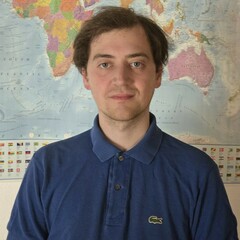
Julien Boughon is an independent science journalist whose work focuses on making complex scientific concepts accessible to broad audiences while preserving the rigor and accuracy essential to science reporting. Drawing on a background in astrophysics and professional training in journalism, he combines scientific expertise with a commitment to public engagement, contributing to the growing dialogue between researchers and citizens.
His interest in science communication emerged from a longstanding fascination with astronomy and the scientific process since he was 10 years old. Throughout his academic career, he became increasingly aware of the importance of translating scientific discoveries into narratives that can inform and inspire readers beyond university circles. This conviction led him to pursue both advanced scientific education and formal journalistic training, enabling him to bridge the gap between specialized research and public understanding.
He earned a bachelor's degree in physics from Université Clermont Auvergne (UCA) between 2018 and 2022 before pursuing a master's degree in astrophysics and cosmology at the Università di Bologna from 2022 to 2024. During his graduate studies, he developed a particular interest in exoplanetology, especially for the search for potentially life-supporting planets beyond the Solar System.
A significant achievement of his master's studies was the completion of a thesis examining the potential habitability of super-Earth exoplanets. The research project combined theoretical aspects of planetary science with computational analysis of data from the NASA Exoplanet Archive using Python. The research sought to identify potentially habitable super-Earths based on conditions permitting the stability of liquid water, generally considered one of the fundamental prerequisites for life as it is currently understood. Because atmospheric composition data remain unavailable for many known exoplanets, the study focused on planetary and orbital parameters that could indicate surface temperatures within the range required for liquid water. Through this work, he developed skills in astrophysical data analysis, scientific methodology, and the interpretation of large astronomical datasets.
Alongside his scientific education, he pursued professional training in journalism through the CNFDI, earning a professional certification in journalism between 2024 and 2026 with a final grade of 18.11/20. This training provided an extensive framework for news reporting, feature writing, interviewing techniques, editorial standards, and fact-checking. The combination of scientific and journalistic education has enabled him to approach scientific topics with both technical understanding and communicative clarity.
His professional journalism career began at Sciences et Avenir, where he worked as a science writer intern from September 2025 to January 2026. During this period, he published articles covering a variety of scientific topics while gaining practical experience in editorial workflows, source verification, and digital publishing. Since March 2026, he has continued his collaboration with Sciences et Avenir as an independent science journalist, contributing to the quarterly magazine. His work encompasses multiple journalistic formats, including news coverage, explanatory articles, and feature stories.
Since June 2026, he has also contributed as an independent science journalist to La Recherche, further expanding his presence within the French science media landscape. Across these professional experiences, he has accumulated approximately eight months of journalism experience, publishing content in online media and quarterly publications. His reporting interests include astronomy, astrophysics, space exploration, emerging technologies, and the broader societal implications of scientific research.
In parallel with his journalistic activities, he works as a professor with Acadomia, teaching mathematics, physics-chemistry, and French. Teaching has played an important role in shaping his communication skills and reinforcing his ability to explain complex concepts to audiences with diverse backgrounds and levels of expertise. The pedagogical experience gained through education continues to influence his approach to science journalism, where accessibility and precision remain essential objectives.
His commitment to science outreach extends beyond traditional journalism. Since 2023, he has been maintaining a WordPress-based science popularization blog dedicated primarily to astronomy and space science. Through articles written for both specialist and non-specialist audiences, he explores astronomical discoveries, planetary science, nuclear fusion, and the history of scientific ideas. Since 2024, he has also developed educational content through a YouTube channel featuring astronomy quizzes, short science news videos, and concise explanations of current developments in space research.
Among his academic distinctions, he participated in the International Astrophysics and Astronomy Competition (IAAC) in 2024, achieving the highest ranking among contestants representing France. In 2025, he served as an ambassador for the competition and was ranked first among ambassadors in France, preparing a group of ten international participants for the different stages of the competition. These achievements provided opportunities to engage with an international community of students, educators, and astronomy enthusiasts while promoting scientific education and cross-cultural collaboration.
Through journalism, teaching, writing, and digital media, Julien Boughon seeks to make scientific knowledge more readable and accessible. His work is guided by the belief that effective science communication is essential to inform the general public by highlighting fact-checked science information, as scientific literacy plays a crucial role in understanding the modern world.

 English
 Español
 Français
 Deutsch
 Italiano
 Português