English
 Español
 Français
 Deutsch
 Italiano
 Português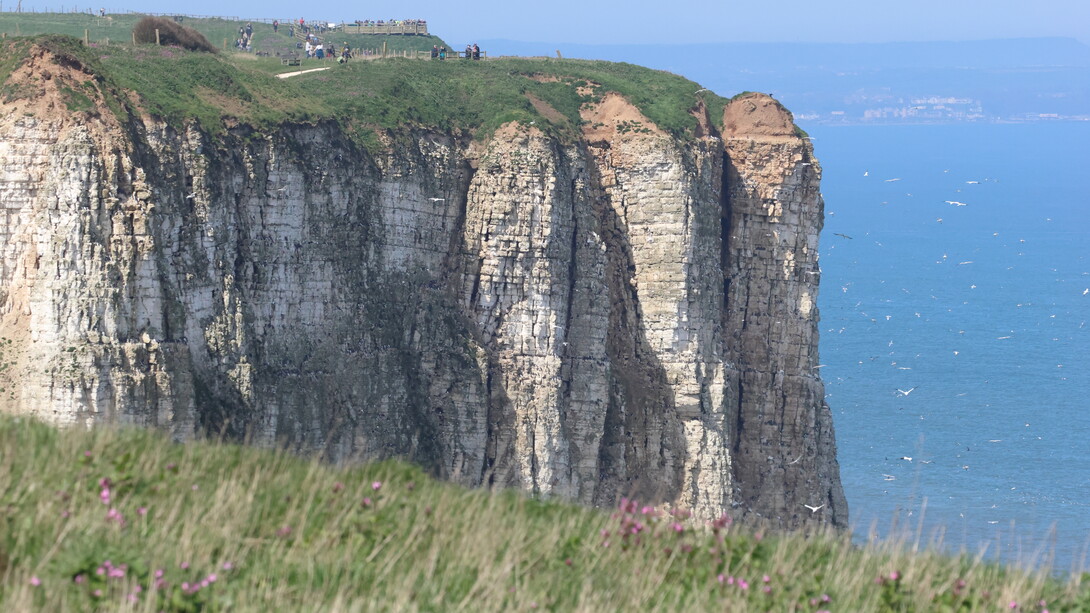
The mist had rolled in from the sea and was unfurling over the cracked chalk cliffs. The sun was rising from behind, and the backlit mist shimmered like a veil draped over dark cliffs. Gannets sped towards us like a hail of arrows that had been unleashed by archers in the distance. Kittiwakes swirled around like silver blades that were dipped in black at each end. I was at RSPB Bempton Cliffs, one of the finest mainland sites in the UK and indeed in Europe for watching seabirds. The RSPB visitor centre at Bempton Cliffs is a good example of what a visitor-friendly nature reserve should be. It is open year-round, with visitor facilities including toilets, a shop, and, very importantly, a cafe offering a choice of hot and cold food and drinks. I was spending two whole days at the reserve and it helped to break up the day with at least two visits to the cafe during the day to have some food and drink and a little rest away from the wind and the sun.
I had arrived in the third week of April, and the chalk cliffs were busy with the clamour of birds. The Kittiwakes, a kind of gull, would render their onomatopoeic call, ‘kitty wake kitty wake’. There was a shrill, insistent quality to it. I would only hear this when a pair interacted on a nest. The nests are usually positioned precariously on a ledge. Quite often, the rear part of a bird would project out over the sea below that would be angrily dashing against the pebble beach. In the air, the Kittiwakes would silently swirl, in arcs without a single discernible flap of their wings. Their mastery of the air was only rivalled by the Fulmars. These are birds in a family known as the tubenoses.
They are in the scientific order, the Procellariiformes, which comprises four families. The Northern Fulmar, to use its full name, is in the family Procellariidae, which includes the Petrels, Shearwaters, and Diving Petrels. Other families in this scientific order include the better-known albatrosses. The tube noses have a tube over the upper mandible from which they excrete salt. I always marvel at how the fulmars cover a lot of ground without flapping their wings. They are adroit at catching the air currents and staying aloft by deftly shaping their wings to generate lift. Studying the images I had taken, I was surprised to see they even use the mantle feathers in their body to manoeuvre in the air.
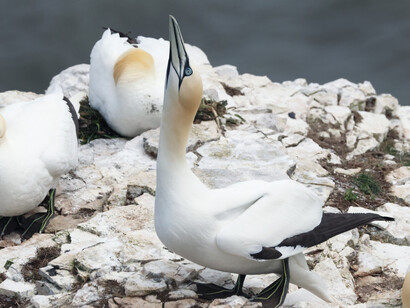
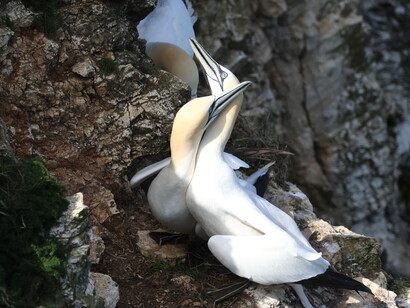
The most formidable masters of the air present on the chalk cliffs were undoubtedly the Northern Gannets, Britain’s largest seabird. The display panels at the visitor centre informed me that on a dive, they can reach 60 kmph. Furthermore, Britain holds 56% of the world’s gannets. Mainland Britain and its accompanying smaller islands are a haven for seabirds. I spend hours when at Bempton Cliffs just watching the gannets cruise past on the air currents which we can scarcely detect. If they wish to, they can circle around with no flapping of the wings or sometimes hang briefly in the air. Most of the time, parties of them fly past in a purposeful way, on their way back from hunting. The beating of wings can then be seen, but they are often shallow. Quite often, the wings are deeply swept back to give them speed.
They zoom past the cliffs like fighter planes. One of the volunteers at the reserve explained how they often leave singly. But using their sharp eyesight, they can see another gleaming white gannet which may be several miles away, plunge-diving to catch a fish. This results in gannets from all directions converging over the shoal of fish. From the cliff tops at Bempton, I have watched fishing gannets plunge-diving and a calm azure sea becoming dotted with bursts of white. Returning gannets often form small parties and return in a military formation, riding the slipstream of the bird in front. The volunteer explained that they are GPS tagging several gannets a year to study their foraging movements. The data also helps to understand potential conflicts with offshore wind farms.
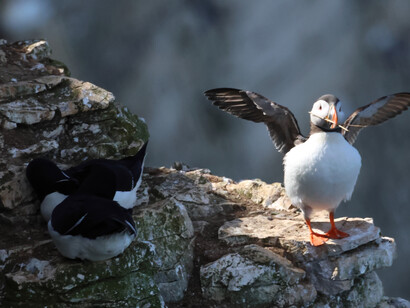
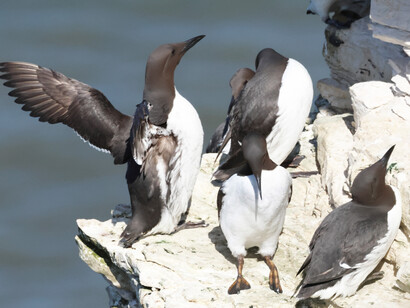
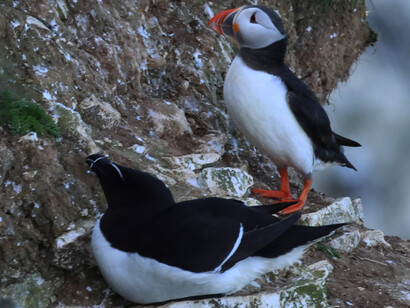
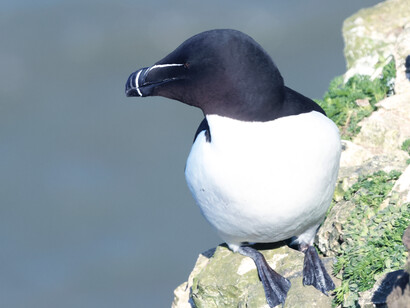
The Herring Gulls and Lesser Black-backed Gulls, which were also present are not obligate seabirds. They are more like land birds that are just as happy to forage on land as they are over the sea. They habitually spend most of their nights on a land roost. However, gannets, kittiwakes, fulmars, guillemots, and razorbills are different. These are truly pelagic seabirds. They only visit land to breed. Other than for the time they spend laying and incubating eggs and raising young, the rest of their life is out at sea, quite often out of sight of land. They sleep floating on the sea. It’s a lifestyle that is hard for us to imagine. A way of living that seems alien to us. Looking down from the cliffs I could see large rafts of seabirds floating in the sea. Hundreds of kittiwakes and auks like guillemots and razorbills could be seen floating together. So, perhaps this must be how it is at night. I would imagine there will be nocturnal predators that would pull down a sleeping seabird that was afloat. Would sleeping together in a flock help with predator detection?
Beside the cliffs would be a cloud of white birds rotating in dizzying circles. These were the Kittiwakes, which are built for a life in the air. Not so for the auks with rapid whirring flight. They cannot catch and soar on the thermals. They have a busy, whirring flight in the air as if they would crash-land if they paused their wings for a second. They are designed to fly underwater and have robust wings anchored solidly to their breast bones to power them underwater.
A few miles south of Bempton Cliffs, I saw another underwater hunter. This was a colony of land mammals which have adopted the marine environment. The Grey Seal, with a dog-like face. At Flamborough Headland, a few hours' walk away from Bempton Cliffs along the coastal path, is the Flamborough Lighthouse and the Headlands Restaurant and Café. A five-minute walk away is a sheltered cove which is closed to people. Safeguarded from people and their dogs, a colony of seals haul themselves ashore to rest and digest their meals. I counted just over 150 seals. I was told that close to 500 Grey Seals are present on that stretch of shoreline.