English
 Español
 Français
 Deutsch
 Italiano
 Português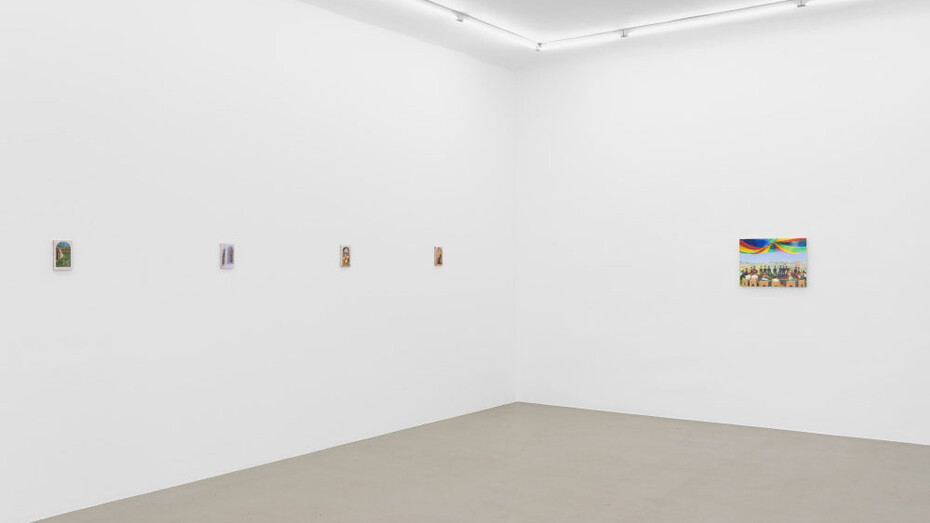
A mouse hole is a portal into another dimension. Quite literally: into a dimension in which one is confronted with different scales of size than those we know from our own dimension. A little like Alice in Wonderland, everything on the other side of the mouse hole is much smaller than in our world – it exists, in other words, on mouse scale.
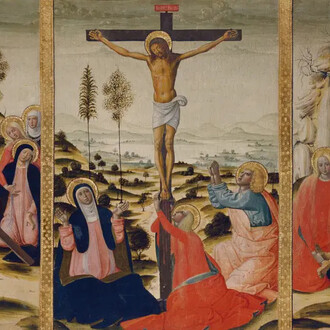
The term portal initially means nothing more than a “gate” or a “doorway”. A portal, however, is often also attributed a certain magical or mystical quality. It is something through which one gains access to a world that remains inaccessible within the earthly realm. The portal is also highly present in fresco painting – for example in scenes of the Annunciation and the Resurrection. Here, too, an entrance takes place, an admission, or at the very least a transition between two worlds in which entirely different proportions prevail.
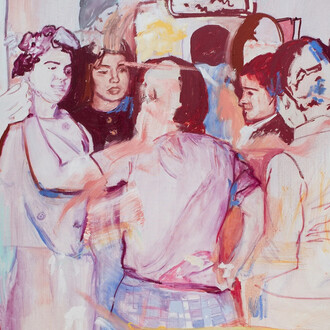
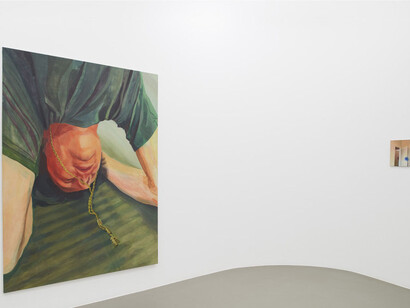
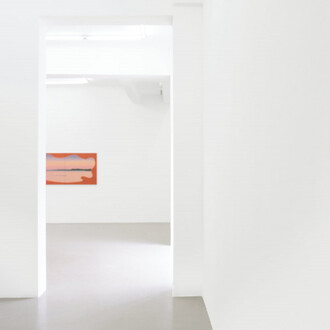
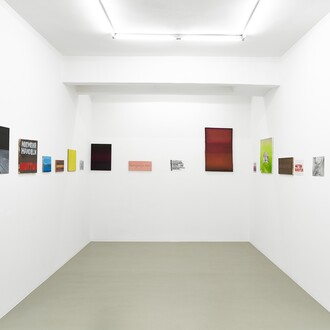
Lin Olschowka establishes precisely these connections, shifting meanings and operating within the realm of transfer. At first glance, these are not only connections between the large and the small; they are also connections between popular culture and Renaissance art. Jerry Mouse meets Fra Angelico – the beginning of linear perspective encounters the two-dimensionality of the cartoon. Yet the work is less concerned with processing the sources from which these motifs originate than with the autonomy they have already attained. These are images to which we are constantly exposed as they circulate endlessly, images whose meanings have detached themselves from their cultural origins. In this sense, Olschowka understands the motifs as formally autonomous entities, within which she creates ambiguities and allows them to persist.
A technique of slowing down is equally characteristic of her practice. She arrests these circulating images – iconographies ranging from high culture to popular culture – translates them into painting, and examines closely what would normally rush past us at cartoon speed (or even faster). This translation, too, enters the realm of transition, much like the portal itself: she changes our perception of the fleeting by giving it the slowness inherent to the medium of painting, only to release it once again into the vast surplus heap of circulation. Inflationary image production is followed by more inflationary image production – always fluid, always boundless, always unfinished. Yet here, too, a shift is at work: namely, a shift in tempo, which slows down, if only for a moment, while we are looking.
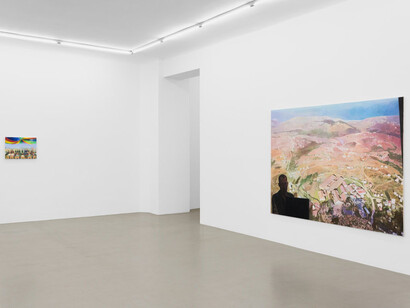
The play of light and shadow likewise establishes a parallelism in which certain things quite clearly remain “in the shadows” while others are “illuminated”; some reveal themselves while others remain hidden. We are rarely conscious of the fact that realities continuously exist that are present yet invisible. To see something always means not seeing something else. Our perception unconsciously establishes a hierarchy, a focus: some things are shown – or show themselves – while others are omitted or remain in shadow. Yet these simultaneous existences and narratives continue to coexist, sometimes consciously, sometimes unconsciously.
Projection, too, is a kind of portal – it is the opening created through duplication. We see an image mediated by the device through which it is shown: the projector. In doing so, it becomes evident to what extent our own “projection” is already part of the production of the image itself. We, the viewers, are always the ones constructing what we see. If one understands the eye as a projector, everything becomes a kind of projection. Light and shadow themselves are always a projection.
The mouse is, of course, the popular-cultural symbol of the second half of the twentieth century: Mickey Mouse, Die sendung mit der maus (a popular German children’s television series that has been running since 1971), Jerry Mouse and, as counterpart, naturally Tom Cat. The references are endless. We play cat and mouse with the mice of postmodernity. The seemingly self-contained microcosm of mouse iconography is, of course, ultimately a reference to ourselves – as we know from fables. The only seemingly apolitical parallel reality of the animal world becomes a symbol.But the duality of cat and mouse – the threat of violence versus the threatened – also constitutes a recurring motif.
Brother wolf is the title of Lin Olschowka’s exhibition, and perhaps it sheds some light on the matter. The myth of Brother wolf is rooted in the biblical legend of Francis of Assisi, who enters into diplomatic negotiations with the threatening wolf – that is, humanity’s adversary. The threatening animal, the seemingly Other, the foreign, the archaic, becomes a negotiating partner. There is no consensus, but there is a truce between the opposing sides. A process that, from the human perspective, appears as an act of taming – rather than one that affirms the animal side of humanity. The apparent animal opposition becomes part of human culture. An act of appropriation that also possesses the character of a transfer, enabling an entry into another sphere. At the same time, however, this so-called taming of the unruly is also a transaction: Brother wolf is promised that the people will sustain him, that they will “feed” him. It is only because of this promise that he agrees to the exchange and relinquishes his role as a threat.
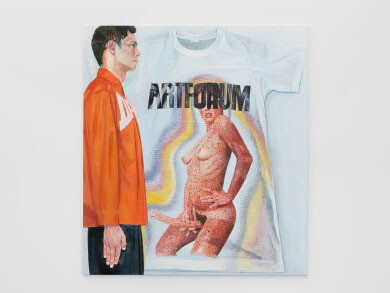
Are all efforts towards peace transactional? In Enemy suddenly friend, Lin Olschowka refers to multiple layers of circulating imagery, at the centre of which stands a T-shirt as a medium. The protagonist wears a shirt by the Russian fashion designer and photographer Gosha Rubchinsky, bearing a quotation by the painter Bulatov. Printed across the front of the shirt in Cyrillic letters is the short phrase “Friend suddenly enemy”. It is a commentary on the often absurd and abrupt turns of global politics. But what happens to a critical slogan such as this when it is instrumentalised for popular culture? Rubchinsky employs the formal attributes of military clothing, thereby fetishising the combative gesture and vulgarising Bulatov’s quiet protest by transferring it into the realm of the “statement shirt”. Less a mouse hole than a rabbit hole of references and simulacra, in Baudrillard’s sense.
We encounter a similar phenomenon of capitalist appropriation in the same work, which also depicts a T-shirt featuring the artist Linda Benglis portraying herself in a pornographic, phallic pose. Among other things, her intention was to push the already existing objectification of the female-read body to its extreme, thereby exposing and undermining it. The artist used the sale of these staged merchandise items as part of a “sex sells” strategy in order to refinance the two-page advertisement she had placed in Artforum. Indeed, the T-shirt which at the time had deliberately been priced within an “affordable” range has since become a collector’s item. The deconstruction of the logic of the market thus turns once again into construction: the knowingly mass-produced commodity is now traded on the market as a unique object. The market has reappropriated the medium of protest.
Unlike the “rabbit holes” of the culture industry, in which one can easily lose oneself, it is impossible to enter the mouse hole – just as it seems impossible to surrender oneself entirely to the shallowness of one’s own shadow sides. The mouse, however, has one advantage over us: thanks to its size, it fits into both worlds – the human world and the world of mice – whereas we, the giants, are confined to only one. We can never fully enter the next, smaller “level”, while the mouse can, so to speak, play little mouse in our world, eavesdropping on us, provided it understands our language. It prefers to remain in the shadows, because from there it can listen more easily.
The mouse is a figure of transfer between worlds, scales and systems of images. It is a figure that connects everything because it has access to a variety of contexts. In much the same way, Lin Olschowka does on the canvas. As viewers, we too move through these dimensions and find ourselves, in relation to what we are looking at, alternately small and large with each of Olschowka’s works. “Putting things into perspective”, as the expression goes. And that is precisely what Lin Olschowka does when she deliberately decides what to show – and what not to show. She slows down and stabilises images that would otherwise circulate at great speed, giving them a space they rarely receive as pop-cultural references. She contemplates them with a calmness and an art-historical precision that they are otherwise seldom granted.
The systems of reference themselves likewise keep us oscillating, demanding our active participation. Every time we think we have recognised something, every time a specific connection seems to have emerged that appears meaningful, it has already disappeared again when confronted with the next work. The tools of looking shift just as the dimensions of what is being looked at shift. Here, we are the mice, the ones who must perform the acts of transfer.
(Text by Olga Hohmann)
![Various artists, [ materialistin ], exhibition view. Courtesy of Hamburger Bahnhof](/attachments/fd8f4fd76b73be0a02d398535c29d017e1309b65/store/fill/330/330/3f54331fd7869a13166dfe67a9e91306c6e180b2e29b9fd308d958b87ad2/Various-artists-materialistin-exhibition-view-Courtesy-of-Hamburger-Bahnhof.jpg)