English
 Español
 Français
 Deutsch
 Italiano
 Português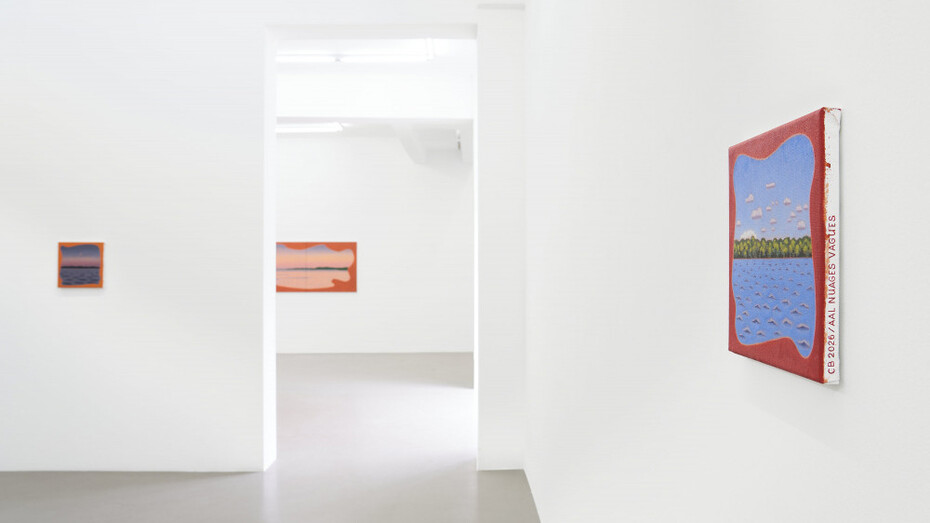
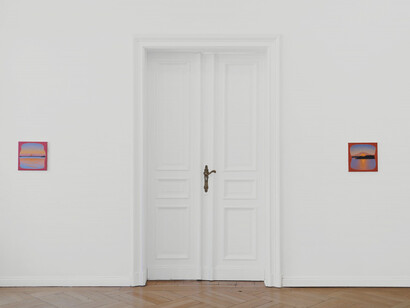
A place can repeat itself without being the same. In Wisconsin, there is a Geneva Lake that shares hardly anything but the designation with its European namesake. Geneva Lake was named in 1835 after an eponymous body of water in New York State and had previously been called Kish-Way-Kee-Tow. In Caroline Bachmann’s new series of paintings, such shifts become the point of departure. The location named Geneva Lake is not explored as a fixed geographical entity, but as a structure constituted by memory, projection and experience.
Between the earlier paintings of Lake Geneva and the new works on Geneva Lake, closeness and distance do not appear exclusively as relational space, but as intertwined moments of perception that re-create places as framed landscapes in an ambiguous sense.
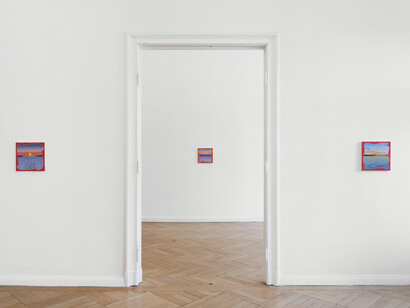
The deliberate search for such shifts points to a practice of seeing that emerges through movement and time. Circumnavigating the lake, walking along its shores and repeated stops structure a perception that is composed of a sequence of captured moments and, later, also of what has been felt and remembered. Bachmann works with a form of attention that is organized through duration: she lingers, observes, takes notes and captures fleeting constellations of light, weather and atmosphere in drawings. The paintings show the lake as a space that continuously changes and is redefined over the course of the day. In numerous layers of paint, Bachmann brings these processes to the surface of the picture – causing them to glow. The individual works stand in a serial relationship to each other: they repeat the same place and with each repetition, its appearance shifts. In this movement, the familiar becomes readable in the unfamiliar, while the unfamiliar is revealed as the continuation of the familiar.
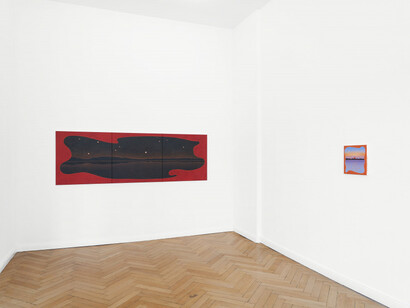
This structure is taken up in the formal composition of the works. Multipart pictures unfold the location as a constellation of states organized along precise differences, thereby drawing coherent connections within the work itself. The location thus appears as an abstract continuum that is structured in the painting as the framing of the states, without relinquishing its affiliation with the concept of place or landscape.
In a note from Franz Kafka’s diaries, written in 1911 during a journey from Lugano via Paris to Erlenbach, there is the following description that nicely articulates the reflexivity of perception and appropriation as well as the extensibility of what is seen in the moment: ‘Left about three o’clock for Lucerne, going around the lake. The empty, dark, hilly, wooded shore of the Lake of Zug with its many peninsulas. Had an American look. During the trip, my distaste for making comparisons with countries not yet seen. Large panoramas in the Lucerne train station.’ (The diaries of Franz Kafka 1910 – 1923, Vintage, 1999, p. 436). The fact that this is evidently a different Swiss lake is not decisive for the argument – since none of the Swiss lakes can be denied their impressiveness. What is decisive is the sequence of associations: the atmospheric description of what is momentarily seen is immediately followed by a vaguely imagined comparison with a place that Kafka has never been to and will never visit. He is presumably familiar with it only from drawings or paintings he has seen before. Then comes the description of a feeling – as a form of self-observation of one’s own susceptibility to imagined pictures of a foreign reality.
Kafka registers these digressions and responds to them with an inner correction articulated as a call for a direct mode of seeing focusing on the moment. At the same time, the text suggests that this process repeats itself during the course of the journey. This train of thought then seamlessly continues with a mention of the panoramas in the entrance hall of Lucerne’s train station. These pictures, which no longer exist today, showed, prior to the fire at the station, mountain panoramas of the country and also Lake Geneva. Formally situatedbetween landscape painting and eye-catching functional painting, they straddled representation, identification and desire, and shaped a visual conception of landscape as a territorial space. In this shift, Kafka’s perception turns to images that are available in everyday life and have been created for precisely this purpose. His imagination comes upon a further – perhaps somewhat absentminded – counterpart in these pictorial forms and reorders itself within a field in which perception and visual imprinting intertwine. What is so beautiful about Kafka’s text is that all this is not analyzed, but takes place in rapid succession, thus making the layers and shifts in seeing and appropriating comprehensible within a very short text passage.
In Bachmann’s paintings, there is a correspondence to this shift from what has been seen to negotiating a movement that has already begun: the place no longer appears as a point of departure, but as something that takes shape in the process of seeing. This conception of the image can be situated within a painting tradition that evolved beyond the established art-historical lines. In American painting around 1900, a notion of landscape emerged that was fueled by concentration and atmospheric density. Here, spaces attain their intensity from light, color and mood, binding the gaze to a form of attention that is not fixated on a single point. In this proximity to a less canonized pictorial language, Caroline Bachmann’s paintings gain additional precision, developing a form in which observation and imagination permeate each other and are transformed into an image structure that lets the location appear as a moveable construct. Placing the picture in a painted frame, within which the image appears as if it were wiped clean of fog, also contributes to this structure. In this tension, a mode of painting takes shape that makes the location visible as something conceivable: as a constellation forming itself in seeing and assuming an at once precise and moveable shape in the picture.
(Text by Melanie Ohnemus. Translated by Karl Hoffmann)
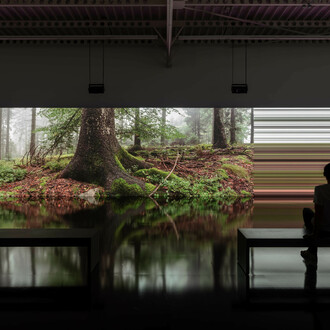
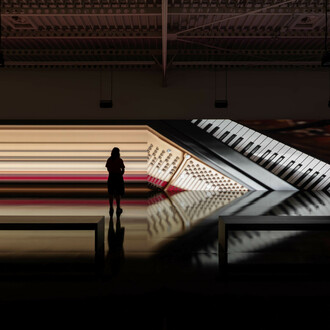
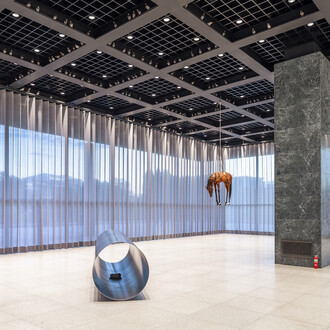
![Various artists, [ materialistin ], exhibition view. Courtesy of Hamburger Bahnhof](/attachments/fd8f4fd76b73be0a02d398535c29d017e1309b65/store/fill/330/330/3f54331fd7869a13166dfe67a9e91306c6e180b2e29b9fd308d958b87ad2/Various-artists-materialistin-exhibition-view-Courtesy-of-Hamburger-Bahnhof.jpg)