English
 Español
 Français
 Deutsch
 Italiano
 Português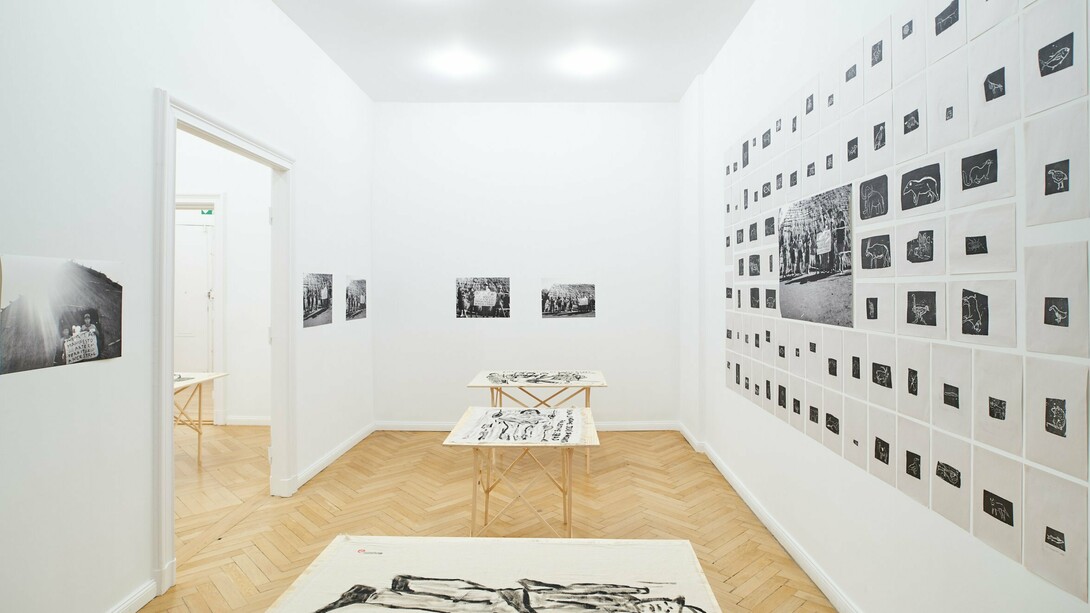
It is said that in the 1920s, a Polish immigrant named Leonard Kaczmarkiewicz acquired vast swathes of land in the mountainous regions and rural peripheries of Rio de Janeiro. Despite his Polish origins, Kaczmarkiewicz was known among his neighbours as o Alemão, “the German,” and the land under his ownership eventually became known as Morro do Alemão (German’s Hill). In Brazilian Portuguese, the term alemão is not limited to German nationality. Today, it functions more broadly as a label for “the other.” It is difficult to determine precisely how this term migrated beyond the city’s outskirts and into broader national usage. More significant, however, is how this misnomer accrued deeper meanings, becoming shorthand for the white foreigner and, in contemporary contexts, for antagonistic forces such as the police or rival factions within criminalized environments.
Much has been written about the centrality of otherness and displacement in Paulo Nazareth’s artistic practice. Nevertheless, these concepts almost inherently require continual reconsideration when engaging with his oeuvre. For Nazareth, displacement exceeds the notion of migration, whether forced or voluntary. The animating force of his work lies instead in the in-between, shaped by exchanges and encounters that unfold within interstitial moments. The artist remains in constant motion, excavating connections that are sometimes temporal, yet consistently guided by Afro-diasporic and Indigenous traditions. His practice traces a complex web of paths that introduce ruptures and variations into hegemonic narratives. Nazareth does not simply walk toward a destination; he wanders with intention, visiting and revisiting sites where those on the ancestral plane once walked, slept, cultivated food, fought, loved and dreamed.
Despite engaging with weighty historical material, Nazareth approaches the evolving meanings of the word alemão with a distinct sense of play. For his latest exhibition, he proposes a linguistic turn through the term Allemann. In German, alle Mann functions as a command and can also gesture toward the idea of a “universal man” or the collective other. The overlap between its uses in Brazil and Germany reveals how a single word can articulate power relations and social hierarchies, designating who belongs and who is cast as Other. With Allemann, Nazareth responds to these intersecting histories through rhythm and wordplay. In this body of work, his longstanding interest in historical and geographic displacement is transmuted into a displacement of language itself, prompting reflection on how words operate. How many images can a word contain? How many meanings can it sustain? What happens when language travels not only across space, but also through time?
The works presented in Allemann weave together elements of Brazilian and German history through images that evoke centuries of colonial legacy and struggles for emancipation across Latin America, Africa and Europe. These historical references sit alongside scenes from everyday contemporary life, conjuring situations shaped by minor power struggles that nonetheless continue to haunt our present.
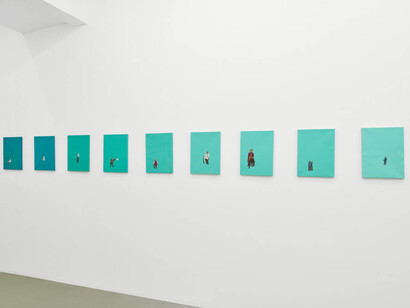
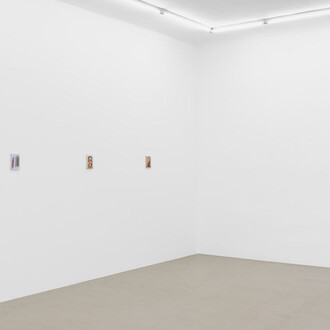
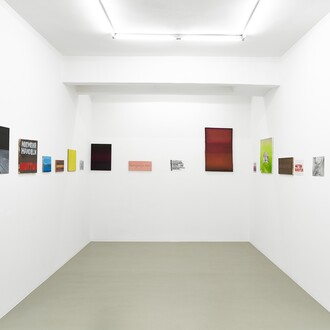
In Amarelo-laranja (2025), a series of small-scale paintings, backgrounds dominated by shades of yellow and orange frame solitary figures. Each depicts an ordinary citizen engaged in a quotidian activity, someone unmistakably salt of the Earth. The Verde series (2025) functions as a counterpart, its green backgrounds, sometimes tending toward blue, evoking historical figures tied to the colonial past. These figures carry weapons, crosses or other symbols associated with colonization, recalling subjects who established authority through violence, much like the bandeirantes who shaped Brazil’s colonial expansion. Both series employ flat backgrounds with minimal chromatic variation and present serialized figures displaced from their original contexts. Are the figures in Amarelo-laranja residents of Alemão? Are the historical subjects in Verde the tyrants of their ancestors? Such questions open onto countless narratives, many of them fragmented, yet collectively revealing the layered realities of the nation.
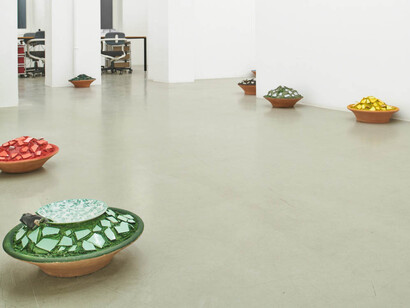
The series EBOH (2025) consists of a group of alguidares, clay vessels traditionally used in Afro-diasporic religions throughout the Americas. In Brazil, these vessels play a central role in Candomblé, a religion that emerged from the convergence of spiritual knowledge among West African peoples, including the Yoruba, who were forcibly brought to the country during the era of enslavement. In ritual contexts, alguidares are used to offer food to the Orixás, deities rooted in West African cosmologies. Here, however, the vessels are filled not with food, but with concrete and fragments of tile. For several years, Nazareth has observed the constructions of the sambaquieiros, communities that inhabited Brazil’s coastline for thousands of years and built structures now resembling prehistoric mounds. These formations, composed of sand, earth, bones, shells and other minerals, testify to the existence of societies predating colonial history. Their monumental scale offers Nazareth a terrain through which to reflect on the region’s ancestral past.
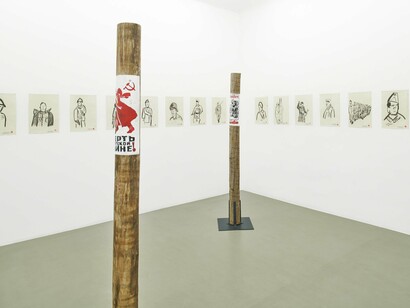
A group of six posters, rolled on wooden poles, evokes the political aspirations and competing imaginaries of Germany in the 1930s. Drawing inspiration from German and Russian communist propaganda, the series foregrounds struggles over narrative and the desire to forge alternative political futures. These visions were ultimately crushed, their failure giving way to regimes of intensified exploitation and state violence. In Nazareth’s reworking, the posters do not function as historical artifacts but as reverberations and apparitions. Stripped of their original slogans and fixed ideological certainty, they underscore how easily emancipatory language can be co-opted, emptied or turned against the very communities it once sought to mobilize. Positioned alongside works that examine colonial inheritance, spiritual endurance and the mutable life of words, the posters insist on a cyclical understanding of history, one in which unresolved struggles resurface in new guises.
Allemann leaves us with a heightened awareness of power as choreography, unfolding across an untenable terrain of naming, imagery and syncopation. Within this endless movement, the figure of ‘the other’ is perpetually made and unmade, shifting between subject and object as it is reimagined across the furthest reaches of our collective imagination.
(Text by Thiago de Paula Souza)

![Various artists, [ materialistin ], exhibition view. Courtesy of Hamburger Bahnhof](/attachments/fd8f4fd76b73be0a02d398535c29d017e1309b65/store/fill/330/330/3f54331fd7869a13166dfe67a9e91306c6e180b2e29b9fd308d958b87ad2/Various-artists-materialistin-exhibition-view-Courtesy-of-Hamburger-Bahnhof.jpg)