English
 Español
 Français
 Deutsch
 Italiano
 Português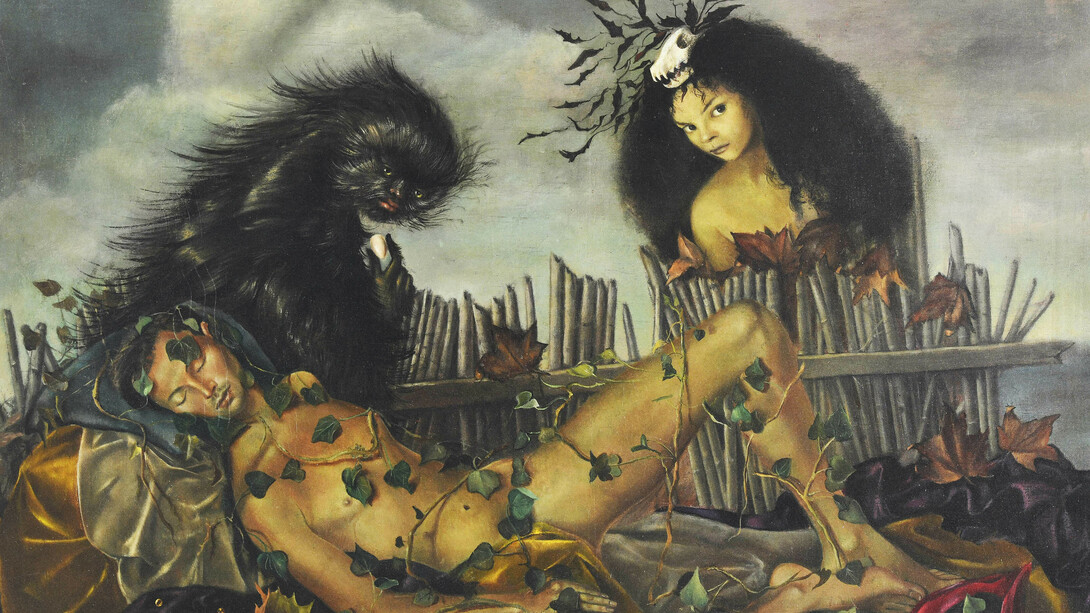
Leonor Fini (1907–1996) was a rebel, both as an artist and in her private life. From October 23, 2026, to February 21, 2027, the Schirn Kunsthalle Frankfurt will present the first retrospective of the artist in Germany. In around 100 works—including paintings, drawings, photographs, costumes, masks, and books—the exhibition offers a comprehensive insight into her fascinating oeuvre. Born in Buenos Aires and raised in Trieste, the self-taught artist remained independent throughout her life despite her proximity to the Surrealist movement. Influenced by the Renaissance, Symbolism, German Romanticism, and Magical Realism, Fini developed a distinctive visual language that fluidly moved between dream, myth, fantasy, and theatrical staging. Through her signature style reminiscent of old master painting, she created dreamlike scenes featuring priestesses, sphinxes, and hybrid beings who subvert traditional gender roles. Powerful portrayals of women and androgynous figures emerge, often as reinterpretations of historical archetypes. Emancipation, gender fluidity, eros, occultism, death, and transformation are among the themes that recur throughout her work, along with her playful engagement with masks, costumes, and gender roles. Central to her art is the exploration of her position as a woman and artist. From the outset, Fini confidently presented herself as free-spirited and glamorous, deliberately blurring the boundaries between artistic creation and lived existence. The exhibition traces her extraordinary artistic development through works spanning some seven decades.
The exhibition Leonor Fini: magically surreal is supported by the Dr. Marschner Stiftung and the Art Mentor Foundation Lucerne, with additional support by the Schrin Friends, the Georg und Franziska Speyer’sche Hochschulstiftung, and the Fontana Stiftung.
Sebastian Baden, director of the Schirn: “Back in 2020, visitors encountered Leonor Fini in our exhibition ‘Fantastic Women,’ which focused on women artists in the Surrealist movement. With her multifaceted and profoundly original style, she has left a lasting mark on European art history. Since then, we have been committed to presenting Fini’s unique oeuvre in greater depth. I am delighted that, with this retrospective, we have succeeded in realizing one of the most ambitious and comprehensive international exhibitions of Fini’s work to date. Through extensive research, we have brought together outstanding works, representing all phases of her career, from national and international private collections and museums. Such a selection can only very rarely be presented together in one place.”
Ingrid Pfeiffer, curator of the exhibition: “Leonor Fini developed a diverse and independent artistic ‘universe’ centered on self-determined, powerful female figures. Taking on symbolic, mythological, or fantastical forms, they embody Fini’s own worldview. Her ongoing interrogation and transformation of her role as a woman and artist, her rebelliousness and independence, her virtuosic painting style, her modern adaptation of classical myths, and her selfstaging as a fashion icon all appear remarkably relevant today. Fini’s visual worlds are hardly conceivable without the context of Surrealism, yet she vehemently rejected any clear association with the movement. Despite this opposition, Leonor Fini played a prominent role in the major Surrealist exhibitions of her time and remains a key figure in Surrealism today.”
Themes and works in the exhibition
The Schirn’s retrospective is organized primarily by theme, beginning with photographic portraits of the artist and painted self-portraits. Leonor Fini is one of the most photographed female artists of the twentieth century, with images taken by her friends Dora Maar, Henri Cartier-Bresson, and Brassaï. Few other women painters examined their own identity as intensively as Fini. She adopted multiple roles throughout her life to reveal different facets of her expressive personality. In the process, she frequently mined myth and drew heavily on the European art historical tradition for her imagery. Animals recur throughout her work, as in Autoportrait au hibou (Self-portrait with owl, 1936), one of her earliest selfportraits, in which she portrays herself with an owl, a symbol of wisdom and alchemy. Fini’s Autoportrait au scorpion (Self-portrait with scorpion) was displayed in the 21st Venice Biennale in 1938. Hybrid beings—in particular the figure of the sphinx as the artist’s alter ego—also appear in numerous works, including La bergère des sphinx (The shepherdess of the sphinxes, 1941) and Stryges Amaouri (1947). As an autonomous female subject, the sphinx embodies power, knowledge, and self-determination. Fini repeatedly inverted traditional gendered power relations, painting strong women who watch over sleeping, naked men, or guide them.
Friendships with artists, and especially with women artists, played a crucial role throughout Fini’s life. The Schirn presents self-portraits with the writer Constantin Jelenski and the Surrealist painter and Italian consul Stanislao Lepri, with whom she lived in a ménage à trois from 1952 onwards. These include Autoportrait avec Stanislao Lepri (Self-portrait with Stanislao Lepri, 1942/43) and Dans la tour (Autoportrait avec Constantin Jelenski) (In the tower [Self-portrait with Constantin Jelenski], 1952). She also maintained long-standing friendships marked by deep mutual understanding with other women artists in the Surrealist milieu, such as Meret Oppenheim and Leonora Carrington, as reflected in photographic and painted portraits of these friends, including Portrait de Meret Oppenheim (Portrait of Meret Oppenheim, 1938). Fini also frequently collaborated with writers, poets, set designers, and film directors from her circle, like Jean Cocteau.
In 1957, she created technically virtuosic illustrations for the book Le Sabbat ressuscité (The Resurrected Sabbath) by her friend Jacques Audiberti. In Fini’s work, the theme of the witch undergoes a rebellious and humorous reinterpretation that sharply contrasts with its historical depiction. The exhibition also presents, among other works, the self-portrait Le miracle qui balaye / La sorcière (The miracle that sweeps away / The witch, 1936) and the gouache Caverne de sorcières (Cave of witches, 1972).
In Fini’s oeuvre, wise women repeatedly appear as alchemists, spiritual guides, seers, or weavers of fate. Within the imaginary visual worlds created by the artist, these female figures occupy a central position: As bearers of creative and transformative powers, they seem to govern the cycles of nature—and thus also those of life and death. Some perform mysterious rituals, as in Les fileuses (The spinners), while others wield alchemical symbols, such as the egg in La gardienne des phénix (The guardian of the phoenixes), both from 1954.
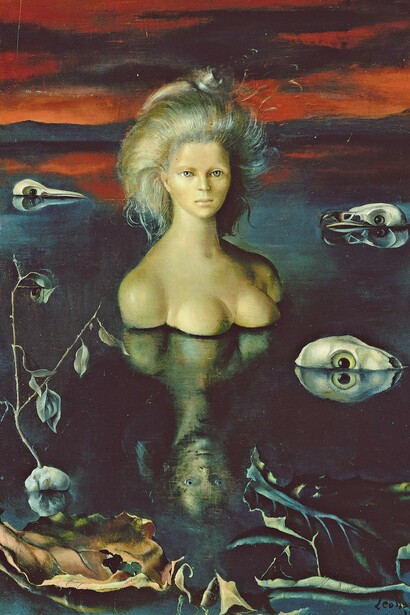
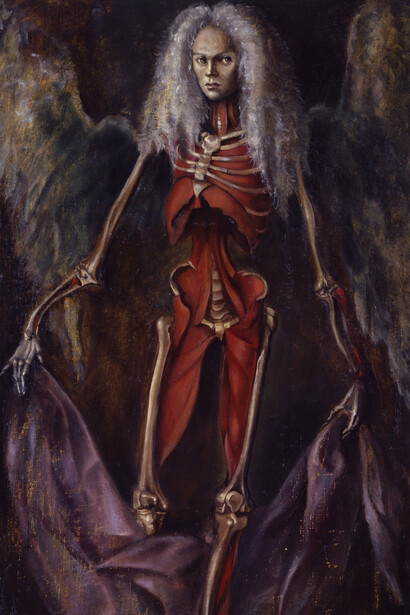
Death and transience pervade numerous works by Fini. This most often takes the form of skeletons and bones, but it also crops up through sleeping bodies as well as references to the traditions of the memento mori and the danse macabre. The androgynous skeletal figure in L’ange de l’anatomie (The angel of anatomy, 1949) testifies to Fini’s enduring fascination with anatomy; at the same time, she is presented as an elegant figure with a cloak and wings, rendered in an old master style. Sphinx regina / Sphinx reine (Sphinx queen, 1943) depicts a decomposing sphinx in a mysterious, morbid landscape suspended between destruction and rejuvenation. Death becomes part of a personal mythology, appearing less as something to be frightened of than the bringer of a fascinating metamorphosis, or as a friend and powerful ally.
Fini also explores states of transition and ambiguity in her so-called mineral paintings. They were produced primarily between 1957 and 1963 using the experimental, abstracting technique of decalcomania, which she learned about through the Surrealists, especially Max Ernst. Crystalline structures and fossil formations suggest mineral-like bodies with dissolving, transforming anatomies, evoking a dialogue between the elements as well as between the natural worlds of animals and plants. Works on display include Chimère du soir (Evening chimera, 1961) and La terre écarlate (The scarlet Earth, 1961).
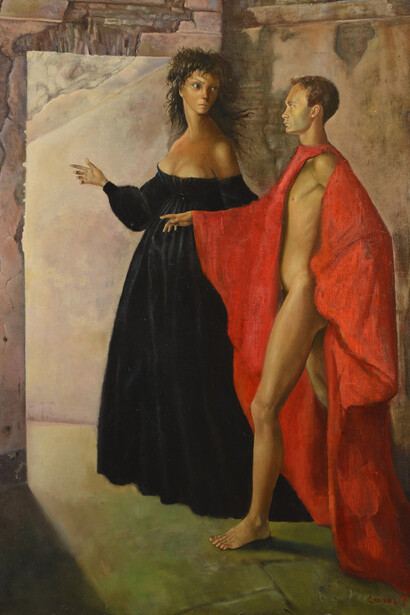
The human body as an expression of identity, eroticism, and power is a recurring theme throughout Leonor Fini’s oeuvre. From the late 1960s onwards, the artist developed works characterized by a lighter color palette, dramatically charged spaces resembling stage sets, and a Symbolist aesthetic, which are presented in the central gallery of the exhibition. In these tableaux between theater and dream, the naked body becomes a conduit for self-empowerment, mythical narratives, and the hidden dimensions of the unconscious. For Fini—as for the Surrealists— twentieth-century psychoanalysis was a fundamental source of inspiration. The boundaries between reality, dream, and fantasy dissolve, opening up new possibilities for sexual identities and gender relations, as in Phoebus endormi (Sleeping Phoebus, 1967) and Train de nuit (Night train, 1969). In other scenes, girls receive mysterious instructions or perform sexual rites of passage, as in Rasch, Rasch, Rasch, meine puppen warten (Hurry, Hurry, Hurry ... My dolls are waiting, 1975). In La leçon de botanique (The botany lesson, 1974) and Les carcans (The shackles, 1984), the central figures are naked, androgynous, self-assured, and imposing, freed from the social norms that still bind and constrain their female companions. Here, too, Fini’s fundamental principle of the hybrid—strange and familiar, historical and contemporary—permeates her allusive visual world.
Leonor Fini’s fascination with masquerade and the transcendence of boundaries led her beyond painting to theater, opera, ballet, and film. As early as the 1950s, and increasingly during the 1960s, the artist regularly designed masks, costumes, and stage sets for a wide variety of productions, primarily at Parisian theaters, but also in Venice, Rome, and Milan. On display are costume drawings as well as a selection of elaborately designed costumes for Richard Wagner’s opera Tannhäuser, created for a 1963 production at the Théâtre National de l’Opéra in Paris. Her interest in the stage, the ambivalence of emotions, and psychological depths is also reflected in numerous references to literary and cinematic works. Outre songe (Beyond the dream, 1978) reenacts a scene from Erich von Stroheim’s silent film Greed (1924). The Aurélia series refers to a tale of fatal love by the French Romantic poet Gérard de Nerval (1808–55) and depicts closely cropped, gender-fluid faces animated by intense emotions.
Fini also employed masquerade in her unique self-stagings, in which she fused artistic creation with her own identity. In private circles as well as at numerous public events, she appeared in striking costumes made of precious materials and featuring vivid colors and floral or ornamental motifs. The exhibition presents various masks, including Masque surréaliste (Surrealist mask, 1958), Masque de chat brodé (Embroidered cat mask, c. 1960), and the horn tiara Sujet en or (Object in gold, 1973). Fini transformed herself into the imagined figures, animals, and hybrid beings that populate her paintings, embodying a sphinx with lion and cat masks, wearing owl and feather costumes, and appearing as a horned goddess or black angel. Through this creative, performative act she demonstrated her artistic power, and repeatedly and confidently explored the potential of her identity as an artist and a woman.