English
 Español
 Français
 Deutsch
 Italiano
 Português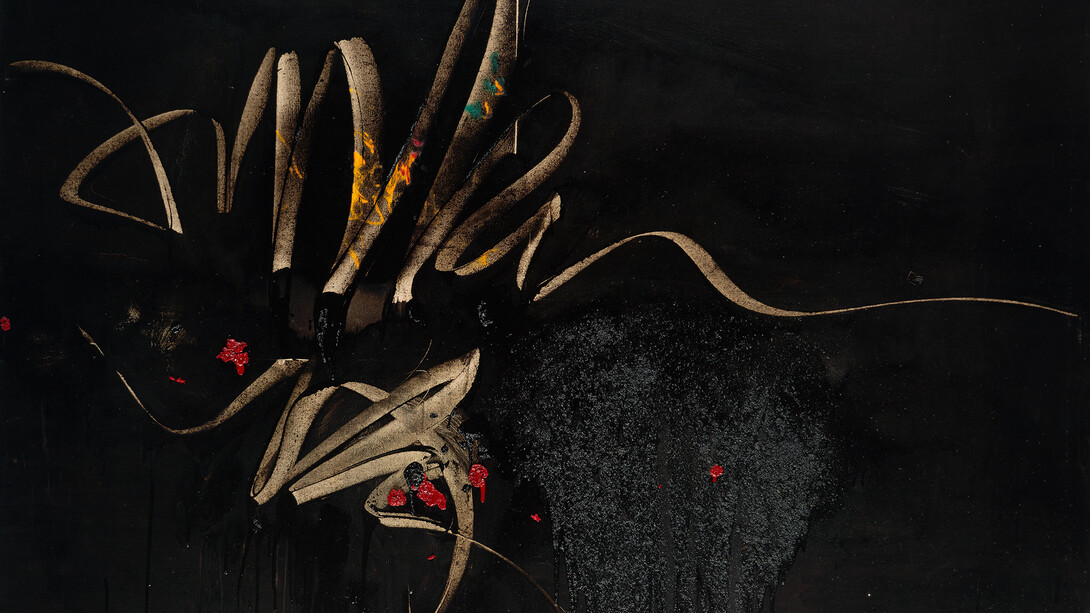
After World War II, a new artistic movement – abstract, gestural and matterist – spread out from Paris. With the trauma of war and techniques of mass extermination laid bare, artists felt that they needed to wipe the slate clean, to “start from scratch as if painting didn’t exist” (Barnett Newman). The influence of Surrealism had also imposed the notions of the unconscious and automatism, leading the proponents of this new form of abstraction to opt for spontaneous gestures and invent new ways of covering the canvas.
After 1945, Paris became the centre of the artistic world once again for a time, now rivalled by New York. The French capital acted as a platform for abstraction, supported by a dense network of galleries and a new generation of art critics. It drew European artists, often fleeing authoritarian regimes in their home countries, but also Americans and many artists from Asia. The Gesture and matter exhibition looks back at the international development of this abstract expressionism over two decades.
“Art of another kind”
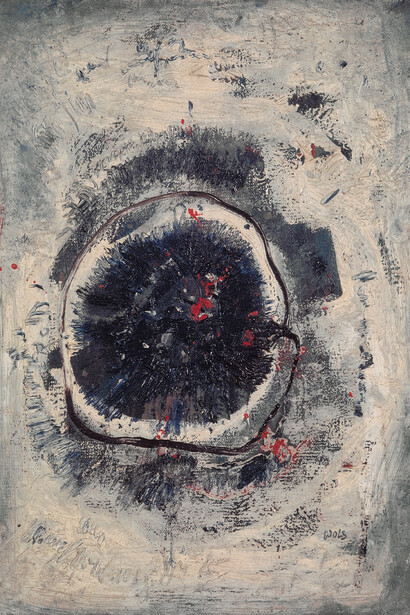
In 1952, art critic Michel Tapié, principal advocate of “informal art”, gathered abstract artists who rejected both figurative elements and geometrical shapes under the label of “art autre”, or art of another kind. In the immediate post-war period, two such artists inaugurated this new way of painting, presented by Galerie René Drouin from 1945 on: Jean Fautrier, whose work Otages (Hostages) gave an existential, almost tragic dimension to this form of abstraction; and German artist Wols, who proposed a biomorphic-inspired, non-figurative language first in watercolours, then in paintings. Wols’ paintings fascinated the young Georges Mathieu: already receptive to Surrealism, like his friend Camille Bryen, he too covered the canvas with abstract forms, stains, drips and thick layers of colour straight from the tube.
Transatlantic exchanges
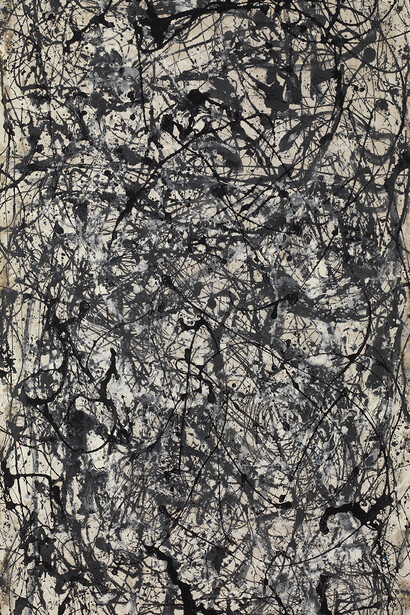
Though New York’s artistic and intellectual scene came out of World War II stronger, young American artists nevertheless continued to turn towards Paris. Former Air Force pilot Sam Francis spent a number of years in the French capital. As for Jackson Pollock, a key figure in action painting, he was the subject of an exhibition in Europe for the first time at Studio Facchetti in 1952. His all-over compositions caused a sensation, along with his technique of dripping paint, marking a wide range of artists from Georges Mathieu to François Arnal. Often made on large-format canvases, these artists’ works were marked by an intense gestural approach and a physical relationship to the medium. The canvas became a performative space, as was the case for American painters, such as Joan Mitchell, who was also living in Paris at the time. Mathieu worked for a transatlantic shipping company and was well-placed to foster dialogue between North American and European abstract artists, as in the exhibition Véhémences confrontées (Confronted vehemence) at Galerie Nina Dausset in 1951. “On the floor, I am more at ease. I feel nearer, more a part of the painting, since this way I can walk around it, work from the four sides and literally be in the painting.”
Black is a colour
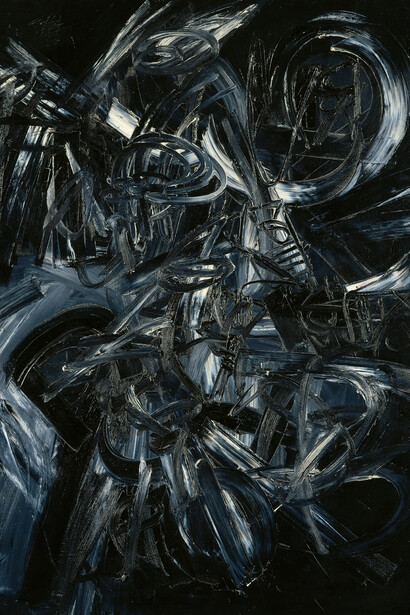
Named after the title of an exhibition at Galerie Maeght in 1946, this section features abstract artists that turned to the restraint and solemnity of black. In the aftermath of war, Pierre Soulages became known for thick calligraphic symbols painted in walnut stain, the first pieces in a body of work dedicated almost exclusively to the colour black. Like André Marfaing, Soulages explored the full visual and expressive potential of strong contrasts with white. This chromatic minimalism makes the artist’s vocabulary of gestures even more visible, along with the more or less ductile qualities of the materials. While Gérard Schneider drew inspiration from music, opting for vigorous brushstrokes, Hans Hartung enlarged his ink on paper across the canvas. The opposition between black and white can also instil a feeling of gravity, or even tragedy, as in the work of Antonio Saura, which draws on the great tradition of baroque Spanish painting.
Asia/The West
Despite the draw of the United States on many young Japanese artists, several chose to move to France in the 1950s. These included Toshimitsu Imai and Key Sato, who oriented their abstract creation around working with the canvas, creating references to the telluric dimension of nature. In 1957, critic Michel Tapié visited Japan accompanied by Georges Mathieu, which intensified the relationship between the Parisian scene and the Gutai movement. This avant-garde group was founded in 1954 and included key figures such as Kazuo Shiraga, who reconsidered the artist’s relationship to the canvas and the pictorial material with spectacular energy. The same attention to nature runs through the works of Chinese artist Zao Wou-Ki, who arrived in Paris in 1948 and devoted himself to a refined synthesis between abstract gestures and Far-East landscape tradition. There were also Western artists fascinated by zen spirituality and calligraphy, such as Jean Degottex and Mark Tobey, who moved more towards an art of signs.
European dissemination
Throughout the 1950s, a dense network of international galleries, magazines and critics disseminated and promoted gestural abstraction, which became a common language all over Europe. In Franco’s Spain, with Manolo Millares, as in Communist Poland, with future playwright Tadeusz Kantor, this aesthetic was seen as a space for resistance to the dominant cultural dogma. In West Germany, painter Ernst Wilhelm Nay stands as an example of artistic freedom in the face of an East German cultural policy that was hostile to abstraction on principle. However, from the mid-1960s on, gestural and matterist painting began to fade out as a return to figuration dawned, with Pop art in the United States, Nouveau réalisme and Figuration narrative in France, and Equipo Crónica in Spain. Michel Parmentier’s work, which concludes this exhibition, provides the transition between this gestural language and more radical and minimalist approaches of abstraction.