English
 Español
 Français
 Deutsch
 Italiano
 Português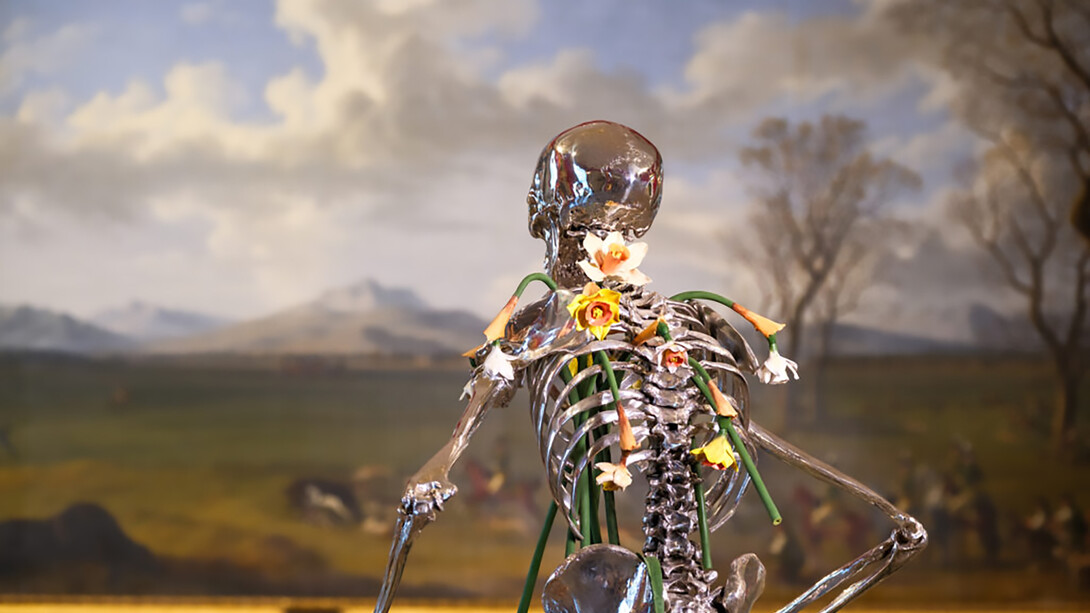
Entering Bertozzi & Casoni. Metamorphosis at the Museo e Real Bosco di Capodimonte means stepping into a theater of transformation where history, matter, irony, and excess converge in a choreography that is at once dazzling and unsettling, intimate and monumental. Installed within the Royal Apartments, unfolding from the Pompeian Sitting Room to the elegant Ballroom, the exhibition does not merely occupy these spaces but actively reanimates them, allowing contemporary ceramic sculpture to infiltrate the stratified aura of power, decorum, and memory that defines Capodimonte. What emerges is not a contrast between past and present, but a fertile contamination, a continuous oscillation in which the solidity of history is exposed to mutation, fracture, and reinvention.
Bertozzi & Casoni’s return to Capodimonte more than forty years after their formative encounter with the landmark exhibition Civiltà del Settecento feels less like a homecoming than a completed alchemical circle: what once appeared as inspiration has now become dialogue, confrontation, and revelation. Their work unfolds as an act of devotion to matter itself, to the ceramic medium understood not as a minor or decorative art but as a field of conceptual and technical complexity capable of sustaining the most radical questions of contemporary sculpture.
Metamorphosis, here, is not a theme imposed from above, but the very condition of the works’ existence, beginning with the material process of firing, where clay submits to extreme temperatures and emerges irrevocably transformed, and extending to the iconographic mutations that turn the familiar into the uncanny, the precious into the abject, and the sacred into the grotesque.
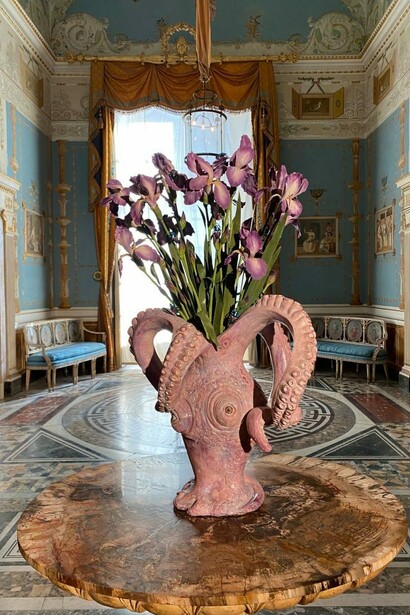
From the outset, with Rocco (2025) placed in the evocative Pompeian Sitting Room, the exhibition establishes its tone: the sculpture appears both utterly present and strangely out of time, a hyperreal apparition that resonates with the surrounding décor while quietly destabilizing it, as if the room itself had generated this new body through a slow, subterranean process.
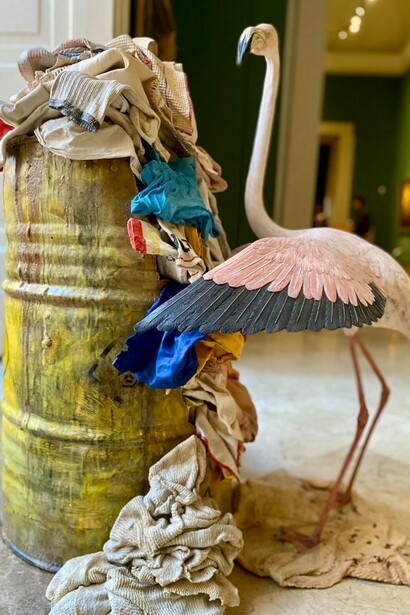
This sense of excess as a form of truth finds one of its most flamboyant expressions in Fenicottero degli stracci (2025), a polychrome ceramic reimagining of Michelangelo Pistoletto’s iconic Venus of the Rags, where the classical ideal collapses into a riot of discarded matter, feathers, fabrics, and debris, transformed into an exuberant, almost carnivalesque vision. Yet this excess is never gratuitous: it is always charged with meaning, with a sharp awareness of the contradictions of contemporary life, where accumulation becomes both desire and catastrophe, and beauty persists stubbornly within waste.
Throughout the exhibition, Bertozzi & Casoni construct a visual universe governed by hyperreal precision and surreal dissonance, a world where every detail is meticulously rendered and yet contributes to a sense of instability, of imbalance, as if the sculptures were caught in a perpetual state of becoming.
In works like Chicco House (2005), positioned provocatively at the center of the Sala della Culla, the clash between innocence and corruption becomes almost unbearable in its clarity: A brightly colored toy house populated by restless monkeys and surrounded by food remnants and a discarded cigarette pack stages a disturbing short circuit between childhood fantasy and adult disillusion, transforming the language of play into a subtle indictment of consumption, neglect, and loss.
This strategy of visual collision extends throughout the exhibition, as the sculptures engage in a continuous dialogue with the furniture, paintings, and objects of the historic apartments, creating moments of unexpected resonance that invite viewers to reconsider both the contemporary works and the historical setting through a newly sharpened gaze. Rather than isolating the sculptures as autonomous statements, the curatorial approach allows them to function as parasites and catalysts, drawing energy from their surroundings while simultaneously altering the atmosphere of the rooms they inhabit.
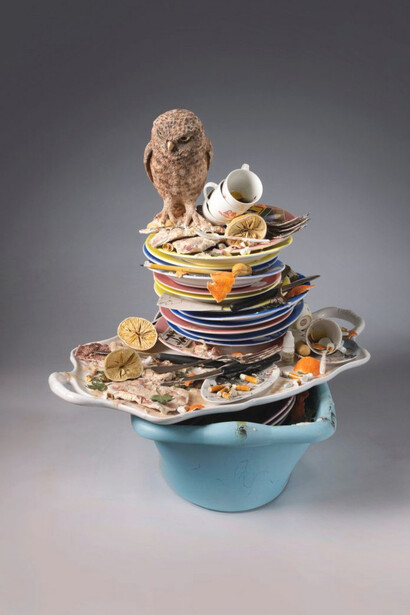
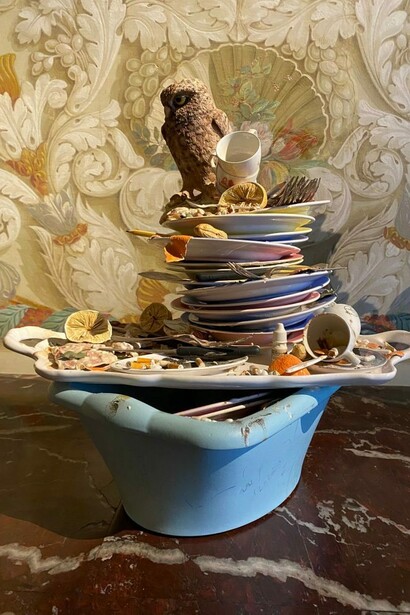
The unpredictability of Bertozzi & Casoni’s artistic trajectories becomes especially evident in works such as Sparecchiatura (2025), Grand Hotel (2025), and Vassoio (2005), where tables, trays, and domestic surfaces overflow with heterogeneous materials, food remains, objects, and detritus, frozen in a moment that feels both after and before an event, suspended between celebration and collapse. These scenes evoke the aftermath of rituals emptied of meaning, suggesting a world saturated with things yet devoid of orientation, where abundance masks a profound sense of disarray.
The motif of waste, however, is never merely denunciatory: in pieces like Disgrazia con orchidea rosa (2012), where clods of earth saturated with refuse cradle an improbable flower, degradation becomes the very condition for a fragile, stubborn beauty to emerge, echoing a vision of life that persists despite systemic decay.
This tension reaches a dramatic climax in Madonna scheletrita (2008), installed at the center of room 37, where the sacred icon is stripped to its skeletal essence, confronting viewers with a vision that is both blasphemous and profoundly human, a memento mori that resonates powerfully within the context of a museum steeped in religious and royal iconography.
The journey continues onto the second floor, where Grottesca (2013) is displayed alongside extraordinary examples of Southern Italian ceroplastic tradition, including the Decapitated Head from the second half of the eighteenth century and the decomposing female figure known as Vanitas. Here, the dialogue between past and present becomes almost uncanny, revealing how Bertozzi & Casoni’s work does not rupture tradition but rather exposes its latent radicalism and its historical fascination with decay, illusion, and the fragility of the body.
Within this visual cosmos defined by excess and accumulation, where obsessive detail coexists with the chaos of refuse, ceramics emerge as a privileged experimental field, capable of dissolving the boundaries between luxury and degradation, order and disorder, and beauty and bizarreness. What is at stake is not merely the rehabilitation of ceramic sculpture but a broader rethinking of value itself: what deserves to endure, what is discarded, and how art can hold these contradictions without resolving them.
As Eike Schmidt rightly notes, Naples and Faenza meet here in a felicitous convergence, uniting the history of Capodimonte porcelain with a contemporary practice that restores to ceramic sculpture its full artistic dignity and conceptual weight. Yet beyond institutional narratives, Metamorphosis operates as a deeply philosophical exhibition, one that invites viewers to recognize transformation as an unavoidable condition of existence, a force that acts on bodies, objects, images, and histories alike. In the hands of Bertozzi & Casoni, metamorphosis is neither redemptive nor catastrophic, but radically ambivalent, capable of generating wonder and discomfort in equal measure.
As one moves through the Royal Apartments, surrounded by opulence and ruin, refinement and excess, it becomes clear that these sculptures are not intrusions but revelations, mirrors held up to a world that oscillates constantly between splendor and collapse. In this sense, the exhibition does exactly what the most powerful art should do: it sharpens perception, unsettles certainties, and leaves us suspended in that fertile, disquieting space where meaning is never fixed but perpetually transforming, like matter itself under fire.