English
 Español
 Français
 Deutsch
 Italiano
 Português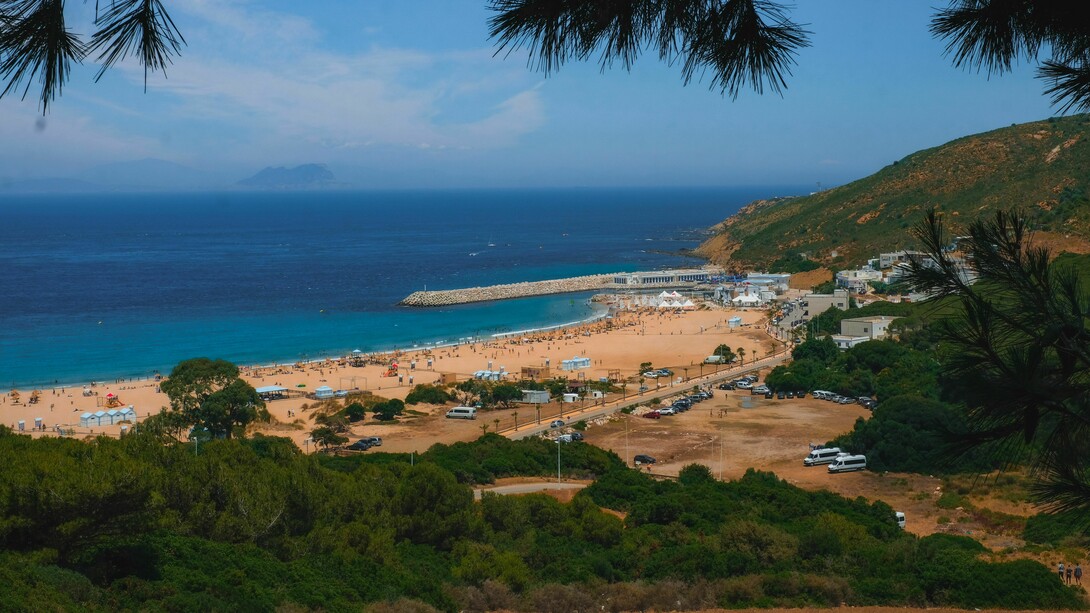
Been fighting the urge to leave. I tend to get smothered by the presence of others, or even myself, in the wrong setting with the wrong social dynamic. You give in, held by the shame of becoming the same as the left-behind loser that you once backed up. And I appreciate circles; I get them. I don’t love them. They make me dizzy. Circles, in their geometric sense, social sense, or psychotic one, make me throw up.
Thirty years ago, I was walking down the hill near home, taking the glaciers of the sun between my hands without knowing how easy it was to reach. Somehow, now it's not that easy. I learned my initial life lesson: the simplest dream is the hardest to reach. It visits you in your sleep when you're growing up, when you think you've lost the childhood hopes that you had back then—the type of hope that made you think everything was reachable, that made you not doubt anything or even think of doubting the world; that the world was an entity of gifts, physical and inner gifts, here for you and to you... to be.
So my first thought, the one that came to my mind, was 'I need to detach.' How? I don't know. Why? I am too drowned in being taken for granted. I am too eager, so I was treated like a fool. I am too much, but at the same time becoming less. I thought to my soul in the dark, rethinking my tears and my downs and rises: I need to detach. I have to detach.
I've been manifesting certain things for so long, and they came to reality suddenly. No, there is nothing sudden. I believe, and as I believe, I know that nothing is a coincidence at all.
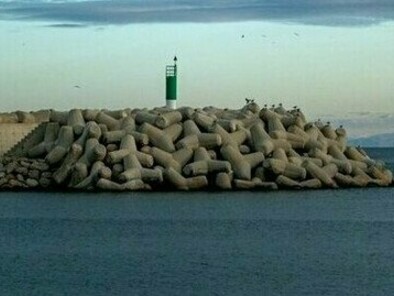
Martil Beach: Photo taken by Meryem Chagraoui
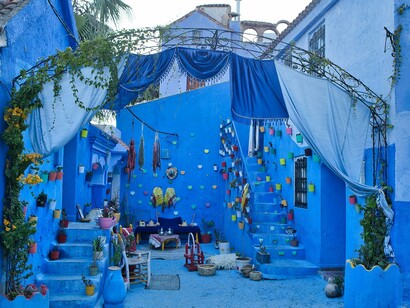
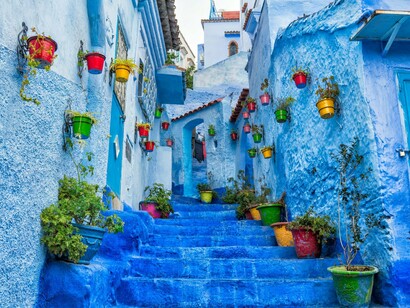
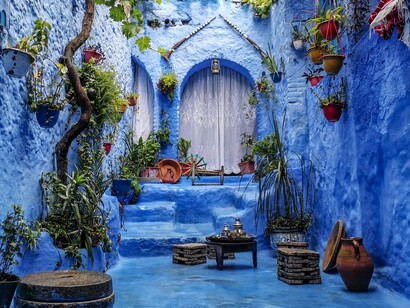
In the Blue Pearl of Morocco, the wind was the dream, the energy was fluidly seen, and the people were just like bending flowers. The crowd had sense and silky moves, sounding like a ballet dancer moving like an orchid to emotions, making colours a logic to understand and feel. I've been manifesting this place for so long. It changed a bit from ten years ago, but I still feel its energy, coping with who I was thinking of becoming. The crowd harmonised my trip to my feelings to find detachment. I forgot about it and stepped out a mile and more. I enjoyed what I found here. I knew I'd find this here. Everything is safe here. The clouds mirrored themselves against the walls of the bluish city. The sunset had a gold medal to give its people every evening, becoming the enlightening tool through which people could see beauty happening.
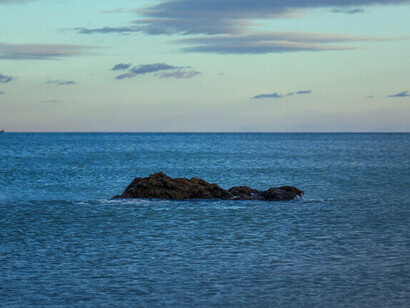
The beach of Castillejos was turquoise blue, yet pure and transparent. It had mirrored colours rooted in each small wave, yet it was calm—dense but not tense. You put your feet into the sand, and they comfortably drowned in a peaceful bed of warm sand that wasn't hot and didn't get affected by the wind enough to lose its temperature. It was out there, alive like a smooth snake swaying its way to my feet, and we don't know who hugged the other, who was in and who was out, or who needed the other.
There was a man quietly fishing. He said he came here every morning to contemplate the sea view, the fish, the emptiness, the fulfilment. He seemed content rather than instantly happy. And I remembered my dream of living by the beach, disconnected from everything. What happened to that? I don't know. I understand the man who is drowned in the turquoise blue and its loud secrets. I can live by that. Tetouan and the lost roads, the Yellow Church, and its people, who are the embodiment of culture and the intellectual soul. Passing near the house of Mr. Torres, Dar Abdelkhalek Torres, a famous nationalist coming from a very intellectual family back when Morocco was fighting colonial presence. He was one of the voices of Morocco, a journalist and leader, two in one, back in a time when he was the nephew of Sultan Abdelaziz of Morocco1.
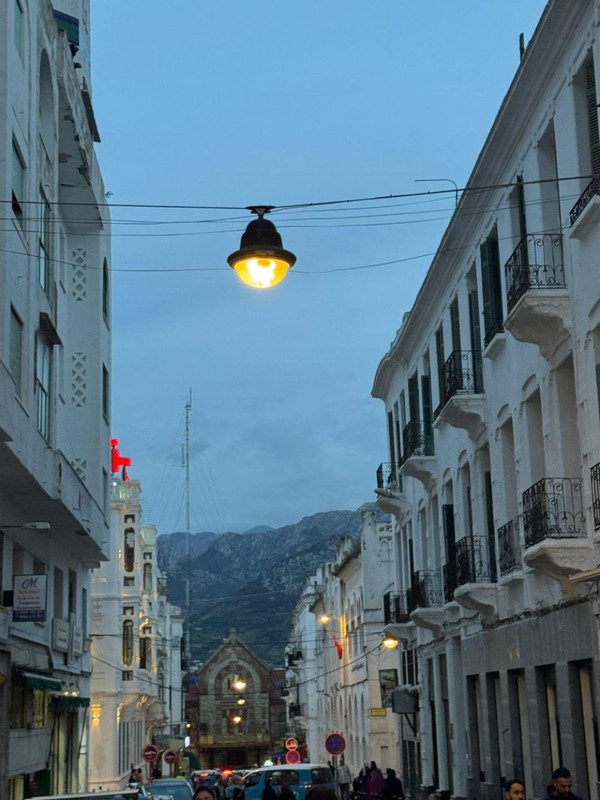
Church of Our Lady Victory of Tetouan at Place Moulay El Mehdi in Tétouan: Taken by Meryem Chagraoui
Even today, you understand the root value of the Moroccan royal mindset is not just about bling-bling and luxury. It is about intellectual leadership, principles, a free spirit, and the Moroccan soul's attachment to the country—a mix of modern thought and scholarship, like breaking the Infinity Stones at once. Inherently, values are inherited too: leading in a modern world, guided by vision while holding the magic of beauty, arts, and literature in one hand and political leadership in the other.
The Torres family is one of the well-known families in Morocco that signed the Manifesto of Independence in 19442. One of the most influential families back then, they were aristocrats of Morocco, of royal blood and intellectual drive, working to free Morocco from its colonial discourse. It was a pivotal event for the family, as it was for Morocco. Their smart tactics and strategy brought to mind Sun Tzu's philosophy on dealing with enemies; self-awareness is the key: "If you know the enemy and know yourself, you need not fear the result of a hundred battles."—Sun Tzu (The Art of War)3.
In the postcolonial era—now talking, we are in the neocolonial era—Morocco started to take hold of itself, its own identity, to be out there in the real world. Geopolitically, Morocco sits on a geographical goldmine, knowing its culture and asserting it without erasing its identity. Our history is our power. Being multilingual forced us mentally to understand the necessity of being open to others, to learn and understand them. For us, we grew to know, colonially, politically, and through war, that the other is not hell. But knowing your worth is golden, as is the vision others get when they hear your success and your roaring history. I tend to see colonial discourse as the psychology of countries that went through colonialism, except it affects a whole nation and its population.
On the other side, in between two cities, the high mountains are what make you question yourself, the space. How long does it take for pain to shape a rock into a towering mountain? How much grinding, reshaping—yet it doesn't let itself be moulded. Nobody gets to it. It stands out there, proud and upright. Whoever passes by it thinks, 'What a green mountain.' It must have cried a river to become such a vast carpet of attractive green.
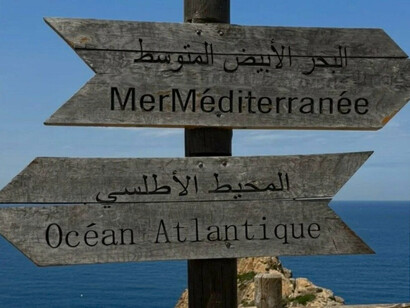
Every city built on the high tide of the ocean has a gloomy side, but where the Mediterranean and the Atlantic Oceans meet makes you think the city has a rhythm of ups and downs across the map. Hercules knew about its core and stayed in its cave, as it was believed in Tangier. According to Greek legend, one of the sons of Zeus, Hercules, visited northern Morocco while performing the Twelve Labours. The legend further says that he rested in what is now called the Cave of Hercules after completing his labours. In one version of the legend, he created an opening in the rock by striking it with his club, and through this opening, one can reach the Atlantic Ocean4. Another legend links the name to Atlas, the Titan who carried the heavens and whose name was given to Morocco's Atlas Mountains5.
Tangier is a city that gives you promises that stay in the waves and its art galleries between the old Kasbah (medina), where you start to think maybe losing is actually winning a new perspective. Trust me, I've been to Mediterranean countries before. You might say it's the Mediterranean waves or the weather, but it's not. This place where the Atlantic and the Mediterranean embrace in upper Tangier feels like where everything happens and goes away.
From north to south, from out there back to me, I get goosebumps. To the light, to the eyes, to a blink, because it's worth a life. It is worth the time. But then again, what is time but a stretch of many places, many states of the heart? It bends you in and out, gives you motivation, and makes you start to believe it is somewhere far away that you call your happy place. Whenever you lose your ground, you return to it—for your soul to revive, for your hands to feel free, for the crystals in your mind to shine.
Coming here, I realised time had passed. When they say "give it time," they mean give it another place. Switch your place. Your inner presence has to move on to create a difference between where Event A happened and where Event B can begin. That makes us feel safe, knowing it's behind us. We detached.
I detached...
Now that I am free...
Who am I?
Notes
1 Abdelkhalek Torres & Lineage: Abdelkhalek Torres (1910–1970) was a towering Moroccan nationalist leader, journalist, and minister of Moroccan Relations. Born into a prominent, intellectual Tetouan family, his lineage deeply connected him to the cultural and political elite of Northern Morocco during the Spanish protectorate era.
2 The Manifesto of Independence (1944): The Proclamation of Independence (Watiqat al-Istiqlal) was officially presented on January 11, 1944. It demanded the complete independence, unification, and democratic constitutional foundation of Morocco, backed heavily by key intellectual, aristocratic, and nationalist families.
3 Sun Tzu Quote: Sun Tzu, The Art of War, Chapter III (Attack by Stratagem): "If you know the enemy and know yourself, you need not fear the result of a hundred battles. If you know yourself but not the enemy, for every victory gained you will also suffer a defeat."
4 The Cave of Hercules & Greek mythology: Located in Cape Spartel near Tangier, local archaeological legend states that Hercules slept in this cave before performing his 11th labour (fetching the golden apples from the Garden of the Hesperides). The sea-facing opening of the cave, naturally carved by the Atlantic waves, resembles the outline of the map of Africa.
5 Atlas and the Atlas Mountains: In classical Greek mythology, the Titan Atlas was condemned to hold up the celestial heavens for eternity. He was historically associated with the Atlas Mountain range in Northwest Africa, located in modern-day Morocco, Algeria, and Tunisia.