English
 Español
 Français
 Deutsch
 Italiano
 Português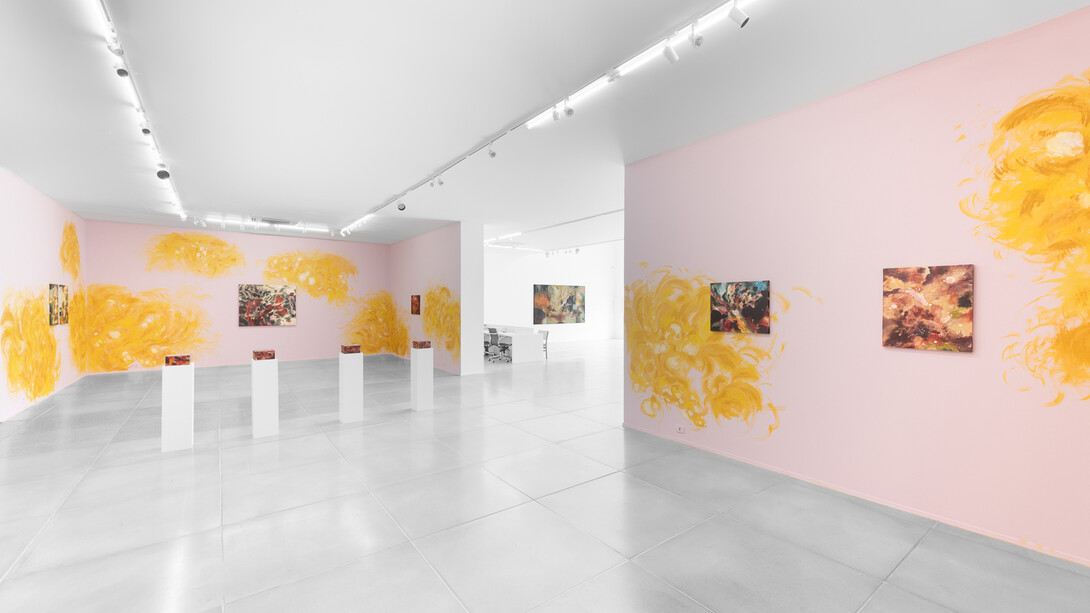
We don’t usually catch an umbrella when the sky wakes up clear, but it may be wise to distrust the calm of blue. Suddenly, even while the sun is still shining, a few drops slip through the clouds and fall upon us, as if the sky had decided to whisper water into the light. Some explain the phenomenon: it may be what is known as sunshower, winds from a distant storm carrying stray droplets to a place where there were no clouds. But there are also those who prefer another narrative, stories filled with legends and myths of popular origin, often rooted in Eastern cultures and in the beliefs of villages and cities. Such expressions are believed to have emerged as ways of assigning meaning – often through mystical or supernatural imagination – to events that seemed to escape everyday understanding, such as certain natural phenomena and coincidences of the world.
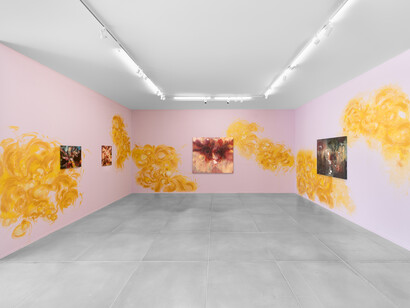
In Japanese folklore, it is said that when it rains while the sun shines, foxes are on the move. Kitsune no yomeiri is a silent procession of kitsunes crossing the day, illuminated by a long line of kitsunebi stretching across a vast area. The dialectic between sun and rain evokes the meeting of opposites in nature: opposing forces that coexist and complement one another, generating balance and renewal. This phenomenon runs through imaginaries in both the West and the East, carrying a rich constellation of meanings. It is precisely within this interweaving that Mika Takahashi operates, translating the tension of nature and poetics with delicacy and precision in the exhibition Sunshower.
It is between impermanence and fabulation that Mika develops her most recent pictorial research, experiencing the world through the senses and dreams. The artist departs from fiction as a way of approaching different realities, understanding the unconscious not as an escape, but as a tool for investigation and sensitivity. In this process, fabulation surpasses the dimension of literary research and asserts itself as a creative gesture, an opening to possible worlds.
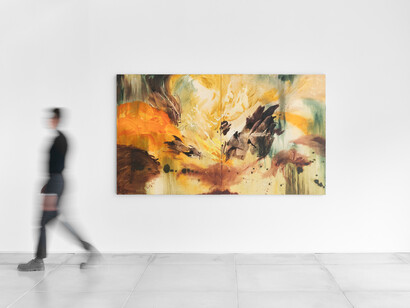
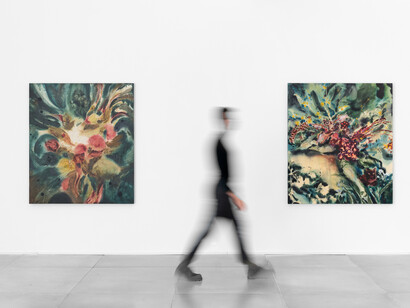
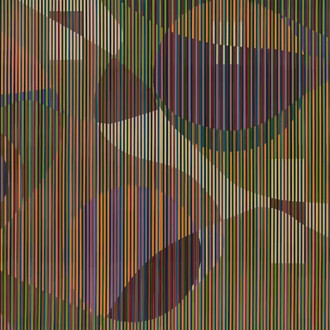
In her paintings, images, atmospheres, and chromatic rhythms seem to emerge as fragments of narratives in formation, suggesting unstable landscapes, organisms in transformation, or still-unnamed phenomena. Painting thus becomes a field of experimentation where perception, memory, dream, and imagination intertwine. It is in this intermediate space, between the visible and the intuited, that the artist constructs a poetic territory in which different layers of reality coexist, expanding ways of seeing, feeling, and fabulating the world.
As a third-generation Japanese-Brazilian (sansei), her ancestry constitutes a fundamental starting point for her research. From this perspective, she investigates how Japanese culture found in storytelling a narrative, poetic, and mystical means of making sense of often inexplicable phenomena. Preserving folkloric traces and the representation of entire universes is a way of valuing a kind of singular essence of “Japaneseness,” emphasizing a space untouched by Western modernity and it is from this place that Mika draws her strength.
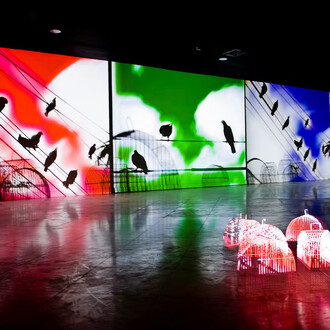
In Ritual (2026), kitsune no yomeiri appears in a nebulous form. The viewer contemplates the scene almost as if forbidden to do so, much like the boy in the film Dreams (1990) by Japanese filmmaker Akira Kurosawa. Filled with curiosity, he sees a mysterious mist arise and hides behind a tree. From this fog emerges a procession of wary foxes. They walk slowly, always looking around to catch any unsuspecting onlooker. After being discovered, he must seek the foxes’ forgiveness but it is all just a dream. Kurosawa shows that he, too, is capable of adopting a surrealist perspective to compose his work, offering the viewer narratives drawn directly from his unconscious. Likewise, Mika projects an expanded layer of communication: here, the fable emerges as creative and narrative potency, operating across different levels of elaboration and perception of a reality that reveals itself as both abstract and sensitive.
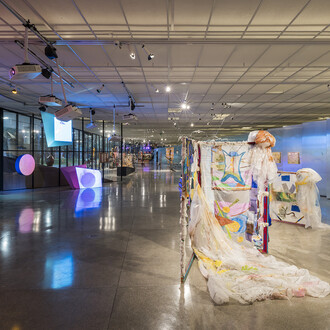
Mika also references the kakemono (?物), an ornamental element of Japanese tradition. Historically associated with reception and hospitality, these objects compose domestic and ceremonial environments as a way of welcoming visitors. In the Eastern imaginary, kakemono may also present representations of yōkai, scenes from kabuki theater, or illustrations of narratives and ancient tales. This type of scroll, usually a vertical painting or calligraphy on silk or fabric, is mounted on a flexible support that allows it to be rolled up for storage.
In dialoguing with this tradition, Mika resignifies it, working from a contemporary and regional perspective, affirming her identity by exploring the ambiguity between past and present. It is in this displacement that her production reveals one of the most sensitive tributes to the ancestral dimension of narrative, between cultural heritage and reinvention. Tradition thus emerges as both a fixed repertoire and a living field of displacements and translations, in which references transform as they traverse different times, territories, and generations. It is within this movement that her work brings forth layers of memory that persist, albeit in subtle and abstract ways. Whether in the atmosphere of dreams or in the use of foreignness as a creative tool, capable of tensioning belonging and distance, her practice constructs a space where the imaginary operates in an almost fable-like manner. Perhaps it is the foxes, after all, that make it rain while the sun remains lit, articulating a zone of indetermination in which nature and fabulation cease to oppose one another.
(Text by Luana Rosiello)