English
 Español
 Français
 Deutsch
 Italiano
 Português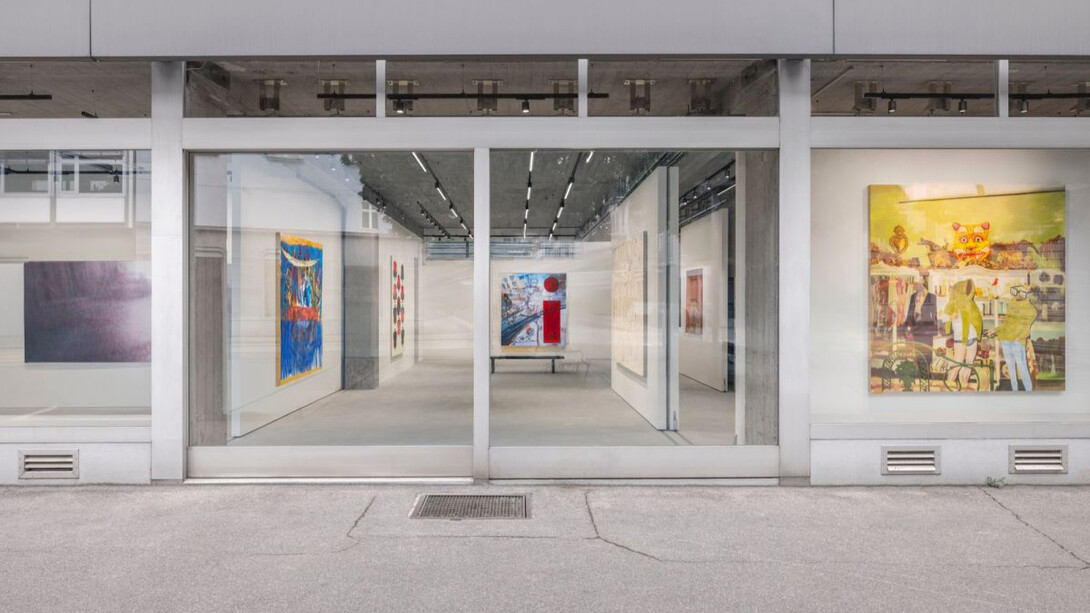
Figuration is not an imitation of the real, a copy of what exists, a reproduction of the visible. Rather, it is an evocation of that which should be, a means of rendering perceptible qualities, situations, and beings that matter to us.
(Philippe Descola, 2021)
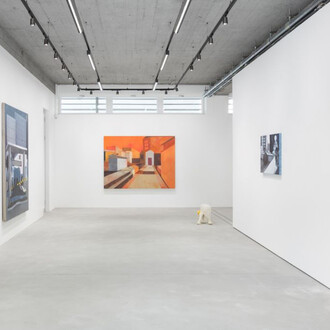
Fugitive figuration traces the practice of Xie Nanxing from his iconic works of the 1990s to his most recent paintings from 2026. The exhibition acts both as an introduction and an appraisal of the exceptional position he holds in contemporary Chinese and international art. For the first time, nine paintings from six different series are brought into conversation with one another. Together, they incite dreams and analysis in equal measure, revealing the different morphologies of figuration that have emerged in his practice over the last thirty years.
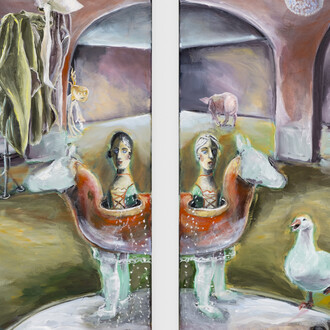
Xie’s paintings are essentially filmic even if he deploys no time-based media. With their scenic quality, they incite the viewer to submerge themselves in a multilayered, visual narrative. This effect is particularly pronounced in untitled (no. 5), from 2003, the last work in a seminal series in which he painted each member of his family, including himself, lying prostrate on the floor of his studio. Only, in three of these works, there is no one to be found. Sensory and panoramic in scale, Xie has painted the dissolution of figuration, its final escape. As with his paintings from 1994, and those of 1999 exhibited at the 48th Venice Biennale, we become witnesses to situations and dramas performed in the home in an atmosphere loaded with sinister potential. Xie’s figuration is hidden in plain sight, drawing the viewer into unexpected scenarios, at times tinted with supressed cruelty, but also romanticism and humour.
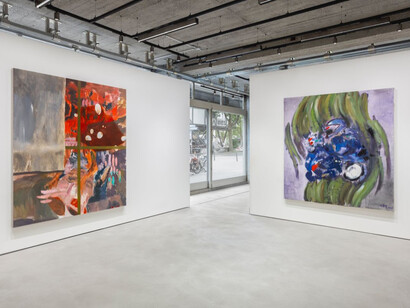
Take Portrait of an equal sign, no. 3, 2026 – it could be a scene out of Jules et Jim (1962), François Truffaut’s acclaimed film of the Nouvelle Vague. A figure in semi-undress – the artist – dialogues blindly with his second self, also headless, while a female mannikin stands nearby in a tailored suit, immobile and similarly acephalous. Xie melts the environment with the person. Roles are played out in a staged emporium of nineteenth century French paintings à la Gustave Courbet, Japanese tiger imagery, Victorian bedposts, silky dresses and decorative objects. It is a wry parody of the market and the art historical clichés that repeatedly flood the artist’s world. Xie gracefully spins the scene with urban drag so as to trigger sensations of desire in the viewer. He is a painter of ambiguity. If at times his figures are humiliated and debased, they can be equally camp and sexy, diffident and rough-edged. There is fast and dirty in his paintings too, like the scene with the motorcycle riders who jam through the camouflage of green undergrowth somewhere in a suburb of Beijing (Untitled, no. 8, 2025). Here, the fugitive in figuration offers a method for veiling and unveiling lived realities through painting.
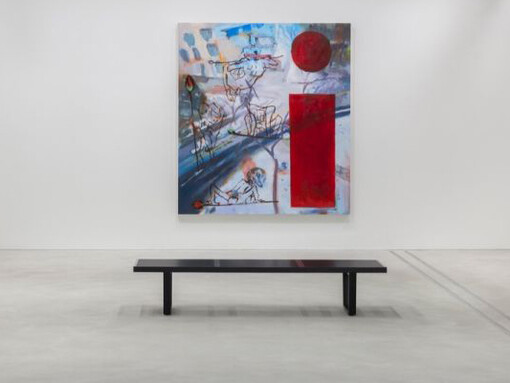
Placed side by side, the paintings from 1994 and 2026 not only exchange visual details but orbit around a fundamental question both then and now, “As an artist, a painter, how do I set out from the perspective of my inner eye? How do I seek out my subject?”1 In Portrait of an equal sign no. 4, 2026, a blood-red exclamation mark punctuates the canvas as if to suggest that renewed self-scrutiny is now an urgent call to action. Skeletal outlines of foreboding figures, first seen in the 1990s, return in 2026. Naked and irreverent, they squat and defecate onto the street scene below. Like spirits of incertitude, they jibe the status quo, insinuating that as an artist, one necessarily identifies with models of “counter-conduct” described by Michel Foucault as “the art of not being governed quite so much.”2 Painted with black diagrammatic lines, these menacing figures complement the crouching figures and chalky phalluses seen thirty years earlier in Old aged generation, no. 3, 1994.
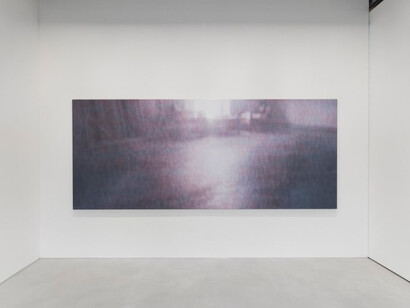
Born in 1970 in Chongqing, a futuristic industrial city in Southern China, Xie studied printmaking, a technique mirrored in the different ways he manipulates pigment. With Mug mat, 2011, he takes loosely woven cloth and fixing it onto a large canvas, paints figures or scenes onto it, only to peel it away at the end. The painting takes on a ghostly, forensic quality, with the remaining pigment creating a textured stratification of line and colour. With Untitled, no. 1, 2024, Xie deploys a different method. He begins by projecting strong light through an oil sketch that he has attached to the back of the canvas. With this intense rear lighting, a diagrammatic imprint of the source image appears on the front. Xie photographs the result, transfers it digitally, and then uses this new sketch to create a painting. Both the final work, in this case, Untitled, no. 1, 2024, and its prototype, can be seen in this exhibition.
While his paintings are grounded in the harsh realities of the global situation, each one is infused with a sense of timelessness and mystery. They lure the viewer into a game of light that both divulges and obscures the subject. Colours adhere to the surface, then are tarnished and layered until, for a fleeting instance, something entirely different appears in the mind’s eye. Like visually charged thought maps, these paintings arouse the imagination, inviting one into a world that is libidinal, conceptual, and occasionally ominous. Xie Nanxing’s paintings are made for contemplation, for looking at while seated over longer periods of time. Like a contrast-medium that flows through the veins, the configurations of subject and space in Xie’s paintings illuminate the other side of daily life and its archetypes, immersing us in new and vertiginous conversations about things that matter to us today.
(Text by Clémentine Deliss, June 2026)
Notes
1 Xie Nanxing in conversation with the author, Beijing, April 2026.
2 Michel Foucault, Qu’est-ce que la critique?, 1978.