English
 Español
 Français
 Deutsch
 Italiano
 Português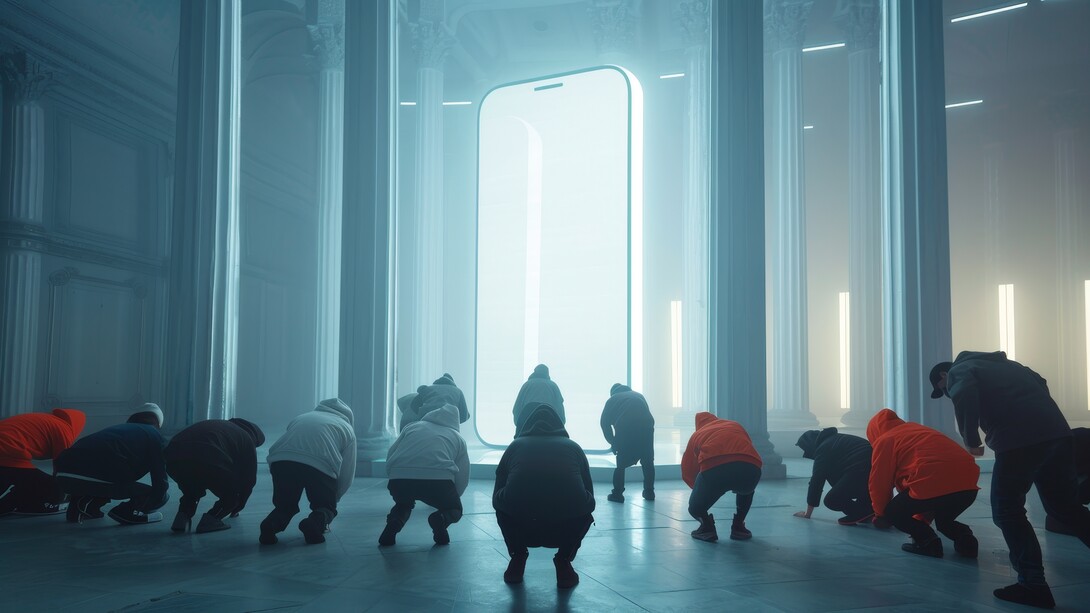
Forget aliens, forget the lizard people, forget government intrusion – humankind has already been captured by an external force. It no longer thinks for itself; it is no longer autonomous. It has been kidnapped by a monstrous hypnotic entity that is far more powerful than itself and against which it seems powerless to resist.
Take a ride in the London underground, catch a bus, have lunch in any restaurant – indeed, walk down any busy street – and you will see what I mean. Nine out of ten people between the ages of ten and sixty will be staring, hypnotised, at a strange little tablet held aloft in their hand. This gadget commands their entire attention with a series of sparkling images and rolling texts.
It prevents them from seeing anything around them, it commands ninety percent of their brain activity, and it annihilates virtually any independent thought process or creative instinct. It tells them who they should be talking to, where they should be going, how they should be handling their health, what they think they should be shopping for, which news items should grab their attention, and what they were doing this time five years ago and will be doing for the rest of the week. Despite attempts to limit access to its more harmful effects for under-sixteens, it will always find ways to circumvent such restrictions, and, in any case, it is just as harmful to the adult population as to the teenage one.
This behemoth is programmed by powerful outside agencies whose primary object is to invade and control the attention of as many beings as possible within their ever-widening spheres of influence – to dictate their desires, their instincts, their communications, their political allegiances, their purchasing power, their very souls.
A young girl, aged thirteen, was interviewed recently on the BBC and asked how much time she spent each day on her smartphone, apart from during school hours when it wasn’t allowed. She answered, “All of it.” That is terrifying.
Humans have always been prey to the herd instinct. Since the dawn of time, their tendency has been to crowd together, simply for their own protection and for the safety of their particular community. Witness the vast crowds that come together for sporting events and pop concerts. Witness the hordes who gather for religious, political, or cult reasons. Witness the fierce debates between factions in the media, where true objectivity and impartial thought are rarely seen. And now witness the situation where a few independent and immensely powerful agents have exploited that herd instinct for their own ends, commandeered the attention of the masses, hypnotised them, and directed their desires, inclinations and convictions in whatever directions suit their purposes.
And now imagine the possible situation where AI itself – apparently evolving independently into a totally autonomous and omnipotent force – takes control of the entire apparatus contained within those little handheld gadgets and commands the subservience of all who use them. In the physical world we are already relinquishing our active powers to computers, robotics, automated machines, cognitive fridges, driverless cars, etc. Soon we will have abandoned all control in the mental world also.
On the plus side, I confess that I use ChatGPT several times a day. It is immensely useful as a research tool and a time-saving query device. If I need to know what train to catch, which hotel to book, how to formulate a contract, or which local councillor to complain to about the refuse collection, it tells me within seconds – and increasingly more accurately. It saves me an incalculable amount of time attempting to find answers via Google, Wikipedia, IMDb, etc.
However, the more I use it, the more I realise it is storing away the details of every small subject that interests me and every detail of my private life and thought that I have revealed during my numerous connections. It now tailors its responses to my specific spheres of interest and influence. It expands its answers to dimensions I never requested. It makes suggestions about further investigations that have never occurred to me. It has become the mentor to my inadequate primitive brain.
Likewise, I am told, other AI instruments such as Gemini, Claude, and Copilot offer equally enticing services. Ostensibly, they are all enormously useful tools for making our lives easier and better informed. The problem is that we do not know who actually owns them or what their ulterior motives might be. Is it China who will soon conquer the world by such unmilitary means? Is it Elon Musk? Is it the Martians? It would seem that it may well be the AI monster itself.
Being of an older generation, I have escaped the addiction to the small screen. I do have a smartphone, and indeed I often find it useful when in need of contacting friends and family or of finding my way around an unfamiliar town. However, I often forget to take it with me, and my loved ones regularly complain that they can’t get hold of me. But when I find myself alone, which is much of the time now in my dotage, I take great pleasure in having time for my own thoughts and reflections, in enjoying the delights of nature and architecture and history all around me, and, indeed, in pondering the next creative endeavour I might undertake – less ambitious these days though they might be.
Such things are, I believe, crucial to both one’s state of happiness and one’s continuing mental abilities. The brain needs to exercise just as much as the body does if one is to live out one’s allotted lifespan to the full extent of its potential.
God help us when all such activity is hijacked by other independent agencies over which we have no control. In fact, God himself seems to have been excluded from the process. Other gods are prevailing.