English
 Español
 Français
 Deutsch
 Italiano
 Português
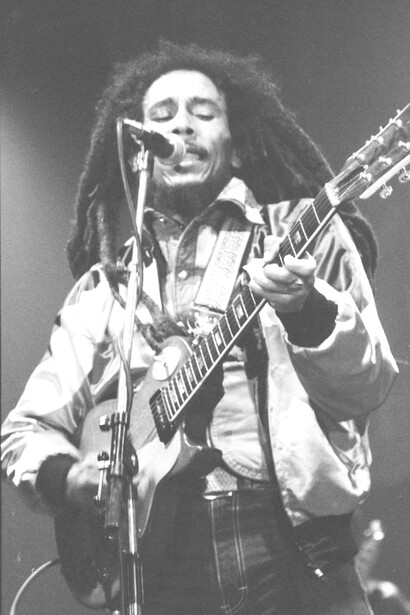
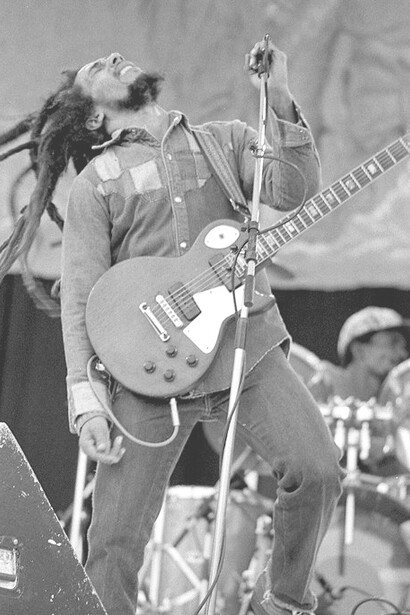
The world of reggae: beyond Bob Marley Bob Marley’s world—the one that matters—was never about comfort. It was a world of resistance, return, and the radical imagination—where chant is constitution, the drum is memory, and dance is the first act of freed movement. Going beyond Bob Marley points to restoring the genuine and authentic meaning of reggae in its original context. It enables us to place it back in its historical dimension of sonic and poetic insurgency, exploring the global context of decolonization and Third Worldism in revolutionary times—even if the 60s and 70s attempts failed irremediably.
It is this world that representatives of the global capitalist mindset have to try to bury beneath branding. Marley is sold as an icon, a fetish of the capitalist world; that is to say, a commodity. Songs by him are no longer pieces of art with their meaning but royalties. In a process of transformation into a mainstream and politically correct pseudo-alternative, record companies have pushed forward Marley’s hits that promote romantic love and apparently trivial matters. Thus, marketing strategies advertised Could You Play, Could You Be Loved, No Woman No Cry, or Jamming? There are, indeed, exceptions: "Get Up Stand Up," now the anthem of Amnesty International, and "I Shot the Sheriff," made more famous by the version by Eric Clapton (decontextualized from its inherent anticolonial meaning). The film industry made a biopic on him, too. But the movement of sonic resistance was never Marley’s alone. It was forged in fellowship. In the film, Peter Tosh and Bunny Wailer are barely mentioned, transparent.
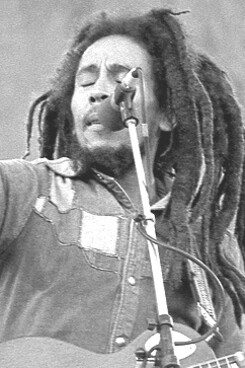
Bunny Wailer and Peter Tosh co-founded The Wailers with Marley. Tosh was the most radical of the three and rejected the global embrace of One Love as depoliticized. In a 1979 interview at the BBC, Tosh declared, “Bob, bless his soul, he’s singing ‘One Love’ to the people—but he’s forgetting to tell them who stole their love in the first place” (Tosh, BBC Radio 1 1979). For Tosh, assimilation was not liberation. He made the distinction clear: “I’m not for peace unless it’s on equal terms. I’m for justice” (Tosh, The Musician 1987). These considerations were put in the lyrics of ‘Equal Rights.’ To him, music that was welcomed by the system could not be revolutionary. As he later declared, “Some people rise by selling out the revolution. I’d rather stay poor and righteous” (Tosh, The Face 1983). In that light, the very fact that Bob Marley was celebrated worldwide did not prove success—for Tosh, it proved compromise.
It could be thought that fame softened Marley and led him to write mainstream hits; that would mean he forgot his political and ideological agenda of resistance. In reality, some of Marley’s softer tunes were composed before he reached the apex of his musical career. “One Love” began in 1965 as a modest ska tune by The Wailers. It is a simple, sweet, and non-revolutionary tune. It was its resurrection in 1977, as the crown jewel of Exodus, that turned it into a global brand. “Three Little Birds” also featured in Hyundai commercials (Team & Team, 2013).
The fact is that “the late reggae icon’s music is so infrequently licensed for ads (idem).” Surely, Peter Tosh’s continuous activism and rebel attitude, as well as many others like the Gladiators, were much less appealing for the advertising of a car, a t-shirt, or a pair of shoes. FIFA wanted to promote the soft message of One Love, rather than chants claiming rights (Get Up, Stand Up; Tosh’s “Equal Rights” and “Africa Unite”) and equality (“War”; “Rich Man, Poor Man” by the Gladiators). Few authentic reggae performers reached the same fame as Bob Marley, except Jimmy Cliff in a lesser measure.
Understanding the foundations of reggae implies taking a sincere interest in the fates of Jamaica during the twentieth century and giving a short account of the history of this country—the third largest Caribbean island, after Cuba and Hispaniola (Haiti and Santo Domingo)—since the time Columbus claimed the island for the Crown of Spain in 1494.
Sonic resistance to colonial oppression
The Taino lived in Jamaica. Their presence predates the invasion of the island by Spaniards after Columbus claimed Jamaica for the Spanish crown in 1794. The history of Jamaica during the Early Modern Times is evidently connected to the global economy and trade, for which the slave trade was a central feature. Tainos fled to the mountainous center of the island, and their use as slaves was forbidden by the Church after the Controversy of Valladolid and the successful outcome of Friar Bartolomé de Las Casas' defense of the ‘Indians.’ The traders replaced Indians with Africans. Thus began the Triangular Trade: slaves were “taken from Africa, brought to America” (The Wailers, “Buffalo Soldier”) to run the plantation of sugar cane, which grew prolifically in the Caribbean. In fact, Jamaica was, and still is, a major exporter of rum.
Global trade was a continuation of geopolitical rivalry and still is so. The seventeenth century saw the rise of England to paramountcy, to become the British thalassocratic empire prevailing over Spain. Santiago was taken and became a British colony that the latter renamed Jamaica. In essence, the island's economy remained based on the plantation of sugarcane. It was also an avant-garde in the war against piracy.
Jamaica gained independence in 1962, but political power quickly became concentrated in the hands of two parties—PNP and JLP—whose rivalry soon turned toxic. The 1970s and ’80s saw that divide explode into violence, especially as Michael Manley’s left-leaning vision clashed with Edward Seaga’s pro-U.S., market-driven stance during the height of the Cold War. Both sides used poor urban communities as political strongholds, arming local enforcers and creating systems of control that blurred the line between party politics and organized crime.
Economic hardship, IMF-imposed austerity, and foreign interference deepened the crisis, leaving lasting scars. And while open conflict has faded, the legacy lives on—not just in institutions, but in the music that kept testifying when everything else failed. Reggae didn’t just document the struggle; it stayed one of the few honest voices through it all. Many paid the price. Marley faced attempts on his life and had to go into exile. Tosh was assassinated, presumably because of his project of buying the National Radio. Tosh’s tragic end testifies to the radicality of the band’s lyrics and their message.
Of course, the topics chosen by the tunes reflect Jamaica’s history of slavery (examples: “Slave Drivers” and “400 Years” by the Wailers) and colonial ‘downpression’ (Tosh, “Downpressor Man”). Reggae tunes were most of the time about poverty and economic hardship of the urban poor (Gladiators, “Rich Man Poor Man”; The Wailers, “Them Belly Full (But We Hungry)”), and it is an active plea for equality and rights (Marley/Tosh, “Get Up Stand Up”). As is well known, reggae has close ties to the Rastafarian cult. Therefore, images taken from the Ancient Testament are recurrent in reggae. The opposition of Zion to Babylon is, however, metaphorical and has no link to Jewish Zionism. If Rastafarianism is devoted to the Ethiopian Negus, who is allegedly the descendant of the Queen of Saba, it is in no way an outcome of the Zionist claims on Palestine.
Rastafarianists identify themselves with the ancient Hebrews deported to Babylon (The Melodians, “Rivers of Babylon”), not with modern Jews. In the Rastafarian imaginary, Babylon is the symbol of all the evils and Zion that of salvation from oppression. For Rastafarians, this destination is the land of Jah Rastafari, Ethiopia (see the tunes by the Abyssinians). In political music like reggae, Babylon is not necessarily a physical place anymore. Zion is more the place where ‘the weak can become strong’ and get ‘ready to come over and take over singing and dancing (“Rich Man Poor Man”) and Babylon, whatever hell the downpressed should escape from with their loved ones. The modern capitalist world thus has many Babylons. For example, Babylon could be Wall Street or the City, and Zion could be a mental condition of resistance and hope rather than a hill on top of a city in Western Asia/the Middle East.
But if lyrics fuel the fire of insurgency, the instrumentation of the Sonic Rebellion tells a story on its own.
Sonic insurgency
The revolution didn’t just speak but sounded as well. And in a society where institutions were compromised, where politics became performance, and where literacy was weaponized through state-controlled education, reggae offered a different kind of knowledge: one carried in vibration, in cadence, in the body’s recognition of truth before the mind could name it. This was the “sonic insurgency”: a rebellion not announced in manifestos but encoded in rhythm, timbre, and silence.
At its core was the “one-drop rhythm.” That is to say, a drum pattern that defied expectation. While Western music typically emphasizes the first beat of the measure (the “downbeat”), reggae drops out beat one, centering the third. The snare or kick hits on beat three, creating a lurch forward that feels both behind and ahead of time. This inversion is not a mere figure of style but rather an epistemological breakthrough. It rejects the metronomic order of industrial capitalism and its industrial discipline: the rhythmic here refuses the punctuality, the efficiency, and the discipline imposed on colonized bodies to replace it with a ‘rhythm of refusal.’ To dance to the one-drop is to dislocate oneself from the colonizer’s clock, to enter a temporality rooted in African cyclicity and Rastafari consciousness.
Then there is the bass: it is not an accompaniment but a protagonist. Deep, rolling, seismic, the bass in reggae doesn’t just support the music—it carries memory. It vibrates through concrete yards and zinc fences, felt in the chest before it’s heard by the ear. This is no accident. In reggae, the bass takes the lead and retells stories in its own way. In African and Afro-diasporic traditions, sound is sacred; low frequencies are associated with ancestral presence and spiritual activation. In the hands of bassists like Family Man Barrett or Robbie Shakespeare, the bassline became a narrative force telling stories of exile, warning of judgment, and invoking the coming fall of Babylon. Its physicality makes resistance embodied. One not only just ‘overstands’ reggae but feels it in their bones. And feeling, in a world that demands numbness, is itself a radical act.
The guitar and keyboard play their part with a sharp, rhythmic precision: the “skank,” a staccato chop on the offbeat, usually on beats two and four, accentuating the “and” between the pulses. This offbeat emphasis destabilizes the expected metric order. It’s a sonic stumble that never falls—a constant disruption of linearity. The skank gives reggae its identity. It doesn’t march; it sidesteps to mirror the wit of the griot, the trickster, and the yard philosopher who speaks truth through irony and indirection. In a society where direct dissent was met with surveillance or violence, reggae’s offbeat became a coded language of evasion and endurance.
Then comes dub—the radical mutation of reggae born in the mid-1970s, pioneered by figures like King Tubby, Lee “Scratch” Perry, and Augustus Pablo. Dub strips the song down: voices cut in and out like transmissions from another world, drums and bass are isolated and amplified, entire sections are erased, and reverb is stretched into an abyss. Silence becomes as meaningful as sound. This is not just production; it is the kind of ‘psycho-spatial warfare’ that well defines the artistry of Lee Scratch Perry, for example. The studio is no longer a neutral space; it becomes a laboratory for sonic decolonization. By erasing the vocals, dub forces the listener to focus on the foundational elements: rhythm, bass, and echo. It deconstructs the song the way decolonization must deconstruct the state—not to destroy, but to reveal what was buried beneath.
Echo and reverb are not effects: they are theology. The long decay of a snare or a vocal fragment evokes the presence of the past, the return of the repressed. In Rastafari thought, history is not linear but cyclical; Babylon may reign today, but it will fall tomorrow, as it has fallen before. The echo is the voice of prophecy—repeating, returning, inevitable.
And then there is toasting: the rhythmic chant over riddim, a precursor to rap. Originating in sound system culture, toasting was performative, improvised, and confrontational. Deejays like U-Roy, Big Youth, or I-Roy didn’t sing; they declared. Over instrumental versions of hits, they delivered warnings, jokes, political commentary, and spiritual doctrine. The sound system, mobile and autonomous, brought the message directly to the people—no stage, no tickets, no state control. In the garrison yard or downtown Kingston street, the bass shook the walls of state power. Toasting turned the microphone into a weapon and the selector into a general.
And let us not forget the bongos, congas, timbales, and scrapers—the textures that fill the spaces between. The shaker (like the chimento or rattle) recalls Indigenous Taino presence, just as the kettle drum recalls Akan origins. These are not “color” instruments. They are memory keepers.
Reggae is not only for its lyrics but also for its form. It was dreadful in its very sound, like voodoo incantations; it possessed minds and bodies. And a baseline cannot be arrested. Nor a reverb be exiled. It is not possible to silence a rhythm that lives in the body of the people. As Frantz Fanon observed in Les Damnés de la Terre:
Le corps du fellah, le corps du paysan, le corps de l’homme du peuple commencent à se libérer. Il se met à sauter, à bondir, à danser… La danse des opprimés n’est pas une danse folklorique : c’est une danse de combat, une danse de libération.” (Franz Fanon, 1961, Éditions Maspero, pp. 189–190) (“The body of the fellah, the body of the peasant, the body of the man of the people begins to free itself. It starts to jump, to leap, to dance… The dance of the oppressed is not a folkloric dance: it is a dance of combat, a dance of liberation.
(Translation by Constance Farrington, Grove Press, 1963, p. 178)
Sonic insurgency is not a metaphor. It is material. The very structure of reggae—the inversion of beat, the sovereignty of bass, the politics of the studio, the autonomy of the sound system—was forged in the fire of historical struggle. It did not merely reflect resistance. It was resistance. And long after the speeches fade, the beat remains. We may ask, “Who controls the rhythm?” Because in the battle for consciousness, the first front is always sound.
Beyond Marley, beyond Jamaica: the reggae insurgency in the globalized capitalist world
Bob Marley’s face is everywhere. On t-shirts in Berlin, but also murals in Lagos and posters in Jakarta. “One Love” echoes through stadiums and shopping malls. His image has been smoothed into a global icon of peace, unity, and easy spirituality—a kinder, gentler face of rebellion. A rebel commodity, thus domesticated to fit in the consensual worldview like a tamed tiger in the zoo. It impresses and is exhibited as a ferocious and dreadful animal. Yet, the tiger is bound there in captivity, and his fierceness is pure exhibition. But this ubiquity carries a danger: the domestication of dissent. The system that once tried to silence him now sells his smile.
Yet beyond the commodification, beyond even Marley’s towering presence, something else has traveled with the music: the pulse of refusal. Reggae did not stay in Jamaica. It crossed oceans not only as a shallow ballet evoking summer and tropical farniente, but also as diasporic memory and militant transmission. And wherever Blackness has been policed, wherever poverty is criminalized, wherever the state declares war on the poor, reggae has been smuggled in—not as entertainment, but as instruction.
In 1970s London, young Afro-Caribbean Britons raised under the shadow of the "Sus laws" and Notting Hill riots found in reggae a language for their rage. Artists like Linton Kwesi Johnson did not sing—he declared, in patois and poetry, over dub riddims: “Bristol Road, under moonlight / Mi see a youth dem get a fright” (“Independent Intavenshan”). His work with producer Dennis Bovell turned dub into a tool of Black British consciousness, welding Caribbean rhythm to British injustice. Dub poetry became a courtroom, chronicle, and call to arms.
In France, reggae rooted itself in the banlieues—the marginalized suburbs where North and West African youth face systemic racism, police violence, and exclusion. Bands like Sacrifice, Dub Inc, and Tiken Jah Fakoly (an Ivorian reggae prophet in exile) have used the genre to denounce Françafrique, neocolonial debt, and the far right. “Plus d'armes,” Tiken sang—“No more weapons”—a direct challenge to the machinery of imperial war dressed as peacekeeping (“Plus rien ne m’étonne). Here, reggae is not imported; it is reclaimed, fused with griot tradition and Pan-African militancy.
Across Southern Africa, during the anti-apartheid struggle, reggae became the soundtrack of defiance. Mandela said, “Bob Marley and the Wailers gave us courage in Robben Island.” A later version of “War” was directed at the struggles for the liberation of South Africa from this “ignoble and unhappy” system, which “holds our (African) brothers” in South Africa by “subhuman bondages.” But it wasn’t just Marley. The teachings of Burning Spear, the spiritual resistance of Culture, and the militant basslines—these circulated in townships and underground radios, sustaining hope when information was banned. Reggae became the sound of international solidarity, proof that the oppressed speak the same rhythm, even in different tongues.
In Palestine, young militants and artists have turned to reggae as their sonic armor. Artists like DAM (though rooted in hip-hop) sample reggae rhythms; others explicitly invoke Marley—"Get Up, Stand Up" played at protests in Occupied Hebron, "Buffalo Soldier" echoing in Gaza as a mirror to military occupation. Why? Because the experience of being othered, surveilled, and displaced—of living under a state that claims your land in the name of religion and security—resonates across diasporas. Reggae names it: Babylon is not a metaphor—it is a structure.
And in Indigenous movements—from Aotearoa to Turtle Island—Māori, Kanaka Maoli, and Native activists have adopted reggae not as fashion, but as kinship. The parallels are undeniable: land theft, cultural erasure, and spiritual resistance. The nyabinghi drum echoes the powwow drum; the Rastaman’s dreadlocks mirror the long hair of the warrior. “So many things to say, but they won’t let us speak,” Peter Tosh once sang—a truth spoken in a thousand tongues.
But perhaps nowhere outside the Caribbean does reggae speak with such historical necessity as in Brazil—a nation built on four centuries of African enslavement, where over 5 million people were forcibly brought to work the plantations of sugar, coffee, and cotton. Abolition came in 1888—the last in the Americas—but the plantation logic never ended. Today, Black Brazilians make up the majority of the poor, the imprisoned, and those killed by police. The favelas, like the garrisons of Kingston, are both zones of abandonment and cultural invention.
It is in this context—in Rio de Janeiro’s Vila Isabel, a historically Black neighborhood deeply rooted in samba, Afro-Brazilian religion, and community resistance—that Ponto de Equilíbrio emerged in the 1990s. Far from being a foreign imitation, their reggae is a localized synthesis: a fusion of Jamaican riddims with the rhythmic force of samba, the spirituality of candomblé, and the political consciousness of Brazil’s Black movement. Their name—"Point of Balance"—is not a mystic abstraction. It is a direct response to a society tilted by racism, inequality, and state violence. To seek balance is to resist.
Affiliated with the renowned samba school Imperatriz Leopoldinense, Ponto de Equilíbrio uses carnival not for spectacle, but for instruction. Their parades are declarations: on the avenue, they honor Zumbi dos Palmares, denounce police brutality, and uplift African identity. Songs like "Sinais do Tempo" ("Signs of the Time") and "Gueto" invoke the same moral urgency as early roots reggae—divine judgment, Black dignity, and the fall of Babylon. But the voice carries a distinct accent: the memory of quilombos, the weight of favela life, and the resilience of samba schools that have long served as schools of resistance.
They are not alone. Chinatown, from Rio’s North Zone, fuses reggae with funk carioca, creating a hybrid language of the streets. Natiruts and Cidade Negra brought reggae to national radio, but even in their smoother sound, the message lingers: "Iê-iê-iê, liberdade" is not just a chant—it is a continuation of the call that began in the senzalas. And in Bahia, reggae flows into candomblé ceremonies, the drumming of Ijexá echoing alongside nyabinghi thunder. The gods remember the journey. So when a youth in the Maré slum wears a "Bob Marley" shirt, it is not fashion. It is an affiliation. It says, "I am not alone." My pain has a language. My resistance has a rhythm.
In recent years, the Playing for Change initiative has brought global visibility to reggae’s message, capturing street musicians in Kingston, Rio, Dakar, and beyond, weaving their voices into seamless, multi-location performances of songs like “One Love” and “Stand By Me.” On the surface, it appears to fulfill reggae’s promise of planetary unity—a sonic ummah rising from the margins, connected by rhythm and hope. And in some ways, it does: the project has amplified voices otherwise unheard, offered instruments and education in underserved communities, and reminded the world that music can cross borders. But this aesthetic of unity also carries risks. The seamless editing, the polished production, and the universalizing tone—these often flatten the specificity of struggle. A Rastafari elder chanting nyabinghi in West Kingston is not the same as a street performer in Barcelona covering Marley for tourists. When context is erased in the name of harmony, resistance becomes a feel-good spectacle. Playing for Change gives us a form of solidarity without always confronting the structures of power. It shows us the world singing together—but doesn’t ask who’s profiting from the recording.
And yet—this global reach is not only a path for liberation—it is also a machine for absorption. Global capitalism has learned to co-opt resistance. Reggae’s rhythms are now sampled by corporate pop, stripped of context, and turned into party anthems. The one-drop is used to sell rum—irony buried beneath branding—the very product of the plantations it was forged to resist. Sound systems, once mobile sites of autonomy, are now fixtures at mainstream festivals—curated, ticketed, and policed.
And yet—the rhythm remembers.
Because real reggae was never meant for comfort. It was forged in yards, not studios. It lives in illegality, in unrecorded sessions, in underground radio, in the voice of the unnamed who toasts on a corner in Nairobi, in Paris, and in Kingston, Jamaica, and Kingston, London.
So when we say “beyond Marley, beyond Jamaica,” we do not mean to diminish the source. We mean to honor its spread—because true insurgency cannot be contained.
It travels. It adapts. It survives silence.
And wherever it lands, it asks the same question:
Who are you? Babylon or Zion?