English
 Español
 Français
 Deutsch
 Italiano
 Português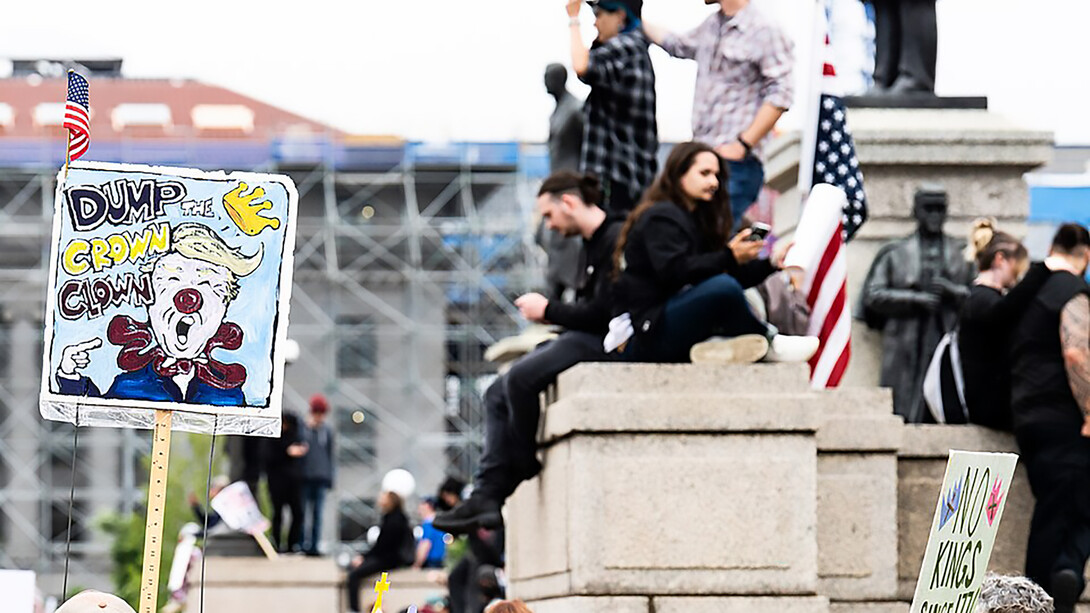
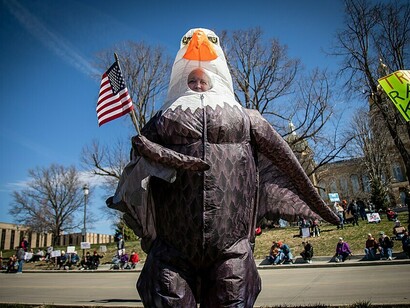
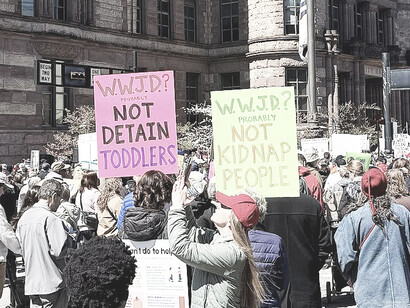
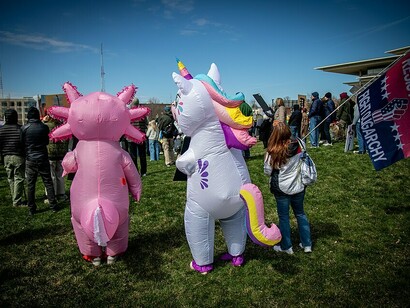
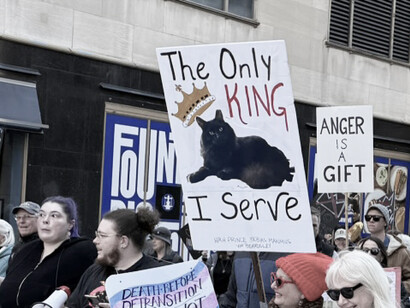
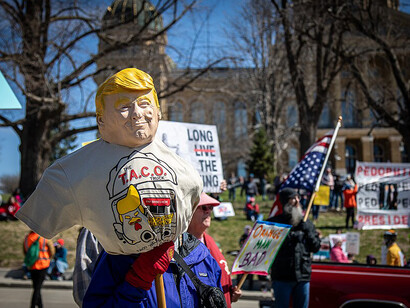
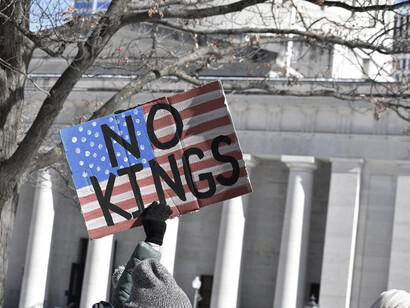
On March 28th, millions of people took to the streets across the United States under the banner of the “No Kings” protests. Thousands of events took place across all 50 states, with especially large crowds in Minnesota, where recent immigration enforcement actions had already drawn national attention (Paquette et al. 2026).
The protests were aimed at a familiar set of concerns: immigration raids, executive overreach, and war, particularly the ongoing US-Israeli attacks on Iranian infrastructure that had so far threatened tens of thousands of lives, millions of dollars’ worth of buildings, ammunition, and vehicles, and the project of American imperialism abroad. Across news and social media, the protests also raised another question: what do we expect to happen after public mobilisation at this scale? What does it change?
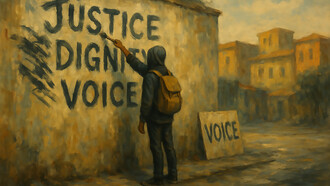
That question sits at the centre of a longer debate about the relationship between performance, participation, and political action. For years, artists and theorists have argued that performative action can both represent politics and function as a form of intervention. The No Kings movement suggests both the appeal and the limits of that idea. This article explores the intersection between performance art and revolution, examining what insights can be drawn from the former to guide political action in the current moment.
Art historian Grant Kester describes political transformation as requiring two things: spontaneity and consciousness. Spontaneity comes from the crowd – essentially, the instinct to gather, design signs, march, and share commentary. Consciousness, he argues, needs to be produced (Kester 2011).
That logic helps explain why moments like the No Kings protests feel so groundbreaking. They are highly visible, widely shared, and grounded in direct participation. But visibility alone doesn’t resolve the problem Kester points to; it only addresses half of it. The other half – what people do with that awareness, essentially what impact the protests have – is less clear.
In 1968, Argentine artist Graciela Carnevale locked visitors inside a gallery and forced them to break a glass door to get out. The work, titled Accion del Encierro, was staged under the military regime of General Juan Carlos Onganía, who had overthrown the elected ruler of Argentina in a coup d’état two years earlier. Considering the political context, the message was quite straightforward: repression persists until it is actively resisted. But the piece also exposed something more unexpected in that people didn’t immediately act. They hesitated, and many didn’t understand what was expected of them. Unsurprisingly, no one wanted to be the one who smashed the door because they didn’t want to get punished for what we all agree is typically an illegal act. While they had the element of spontaneity, Carnevale essentially took on the role of revolutionary, providing the call to consciousness that was missing in order to affect change.
Kester describes the revolutionary as “resolute and responsible, each of them knowing the meaning and goal of this armed class struggle through its leaders, fighters like themselves whom they see daily carrying the same packs on their backs, suffering the same blistered feet and the same thirst during a march” (Kester 2011: 184), effectively romanticising them as freedom fighters of a shared consciousness. Oftentimes, these revolutionaries consist of people like Carnevale, who simply seek to incite change by making visible certain social or political inequities. However, they tend not to consider the differences in ideology among those who comprise the same movement, assuming a single shared consciousness that is absent in much grassroots political activism and which limits radical action. Even with a clear antagonist, shared values, and an aversion to repression, members of the same revolutionary movement frequently disagree on the best course of action to achieve the common good.
That gap between exposure and action defines much political engagement today.
Already in 2006, critic Claire Bishop was blunt about this disconnect, arguing that art had shifted toward participation in the context of workshops, performances, consultations, and collaborative projects. These kinds of activities are often described as politically meaningful simply because they involve people, but participation isn’t the same as political engagement (Bishop 2006).
The same dynamic can be seen in the circulation of protest imagery. The No Kings demonstrations produced a flood of visuals showing crowds of unprecedented size, witty protest signs, Pulitzer Prize-worthy photos (I’m sure we all saw that picture of Lady Liberty in handcuffs, surrounded by police), and other performances of dissent. But this influx of images can actually have the opposite impact of what protestors wanted: it can dull the impact on a public already numb from years of powerful images from other, still unaddressed, political issues.
Organisers themselves have acknowledged this. They are deliberately framing the protests not as the result of revolutionary political action but as a starting point for it. The act of gathering is not in itself sufficient to address the problems of the current moment; it is just one tactic among many, alongside strikes, legal challenges, and other grassroots campaigns that create what the No Kings movement founders call “a tapestry of defiance” (Cineas 2026).
Artist Tania Bruguera has argued that politically engaged work needs to redefine the role of the spectator. Not just as someone who witnesses, but as someone who is implicated and who must decide what to do next.
Some artists have taken that literally. It calls to mind, for example, the long-term performance work of the artist Vermin Supreme, who ran in 2012 for the Democratic nomination for US president. The artist asked his ‘spectators’ (i.e., voters) to express their support for his work by voting for him in the Democratic primary in New Hampshire, in which he placed fourth. The gesture, while a little absurd, was effective in demonstrating that the work only exists if people act.
Tania Burguera’s Culture as a Strategy to Survive concludes the discussion on this topic, in which she questions the existence of and need for art and culture in a society that desires its own survival. She creates a very direct series of commands and conditions to ensure the efficacy of this art, one of which includes “the building of a new role for the spectator” (Bruguera 2009).
That’s the standard most protest movements are now measured against, whether they adopt the language of art or not.
However, the No Kings protests were large enough to feel like a turning point. In Minnesota, where recent ICE operations and killings had already triggered demonstrations, they were also rooted in specific grievances rather than abstract ones (Parrado 2026). This also highlights the limit of comparing performance art to political action. While insights can be drawn on general trends or motives, performance art is temporary, while political action is attempting to achieve lasting justice for conditions that have become so inherently unjust that one’s instinct is to abandon their home and take to the streets. Ultimately, art for social change becomes appreciated primarily because it exists as art for social change, when it needs to be appreciated because it causes us to see things we could not see before, rather than just commenting on a social issue we know already exists.
Many of us hope that the No Kings movement will have deep and lasting political impact. Moments of mass participation such as this create the impression of momentum, but it’s a momentum that needs to be leveraged by complementary legal action, strikes, boycotts, and other radical actions.
What art and protest share is a tendency to compress uncertainty into a single moment. Both a performance and a million-strong march stand in for a longer process that hasn’t happened yet.
If anything, the current moment suggests that the harder part isn’t getting people to show up. It’s figuring out what showing up is supposed to do.
References
Bishop, Claire. “The Social Turn: Collaboration and its Discontents.” Artforum 44, no. 6 (2006).
Bruguera, Tania. “Culture as a Strategy to Survive.” Mar. 2009.
Cineas, Fabiola. “So You Went to a No Kings Protest. Now What?” The Guardian, The Guardian, 29 Mar. 2026.
Kester, Grant. “The Sound of Breaking Glass Part I: Spontaneity and Consciousness in Revolutionary Theory.” e-Flux Journal 30 (2011).
Paquette, Danielle, et al. “No Kings Protests Draw Crowds, with Record Number Taking Place across U.S.” The Washington Post, 28 Mar. 2026.
Parrado, Diego. “No Kings Protests: Bruce Springsteen, Jane Fonda, and Robert de Niro Turn out against Donald Trump.” Vanity Fair, 29 Mar. 2026.