English
 Español
 Français
 Deutsch
 Italiano
 Português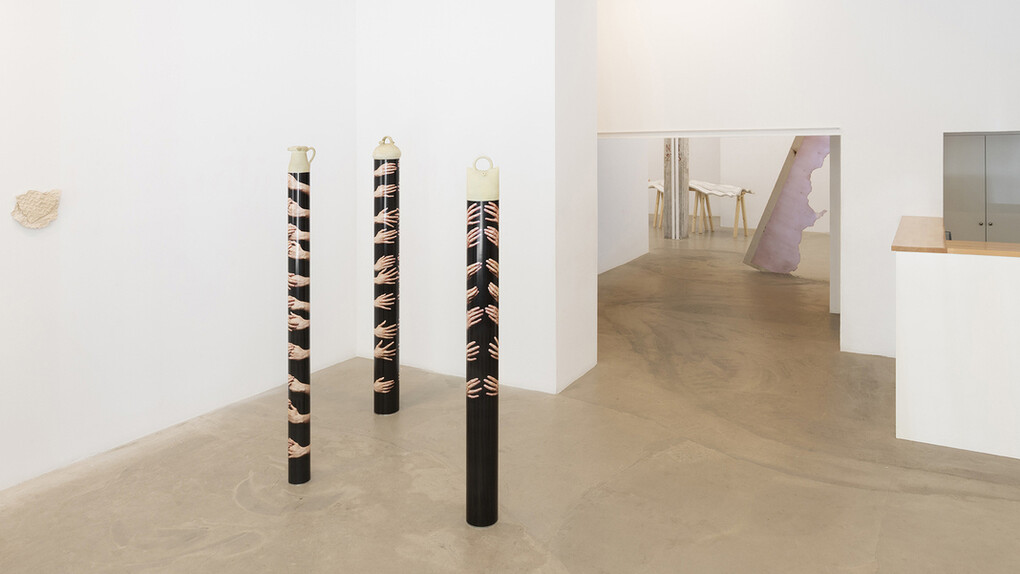
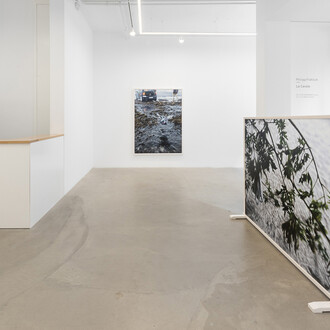
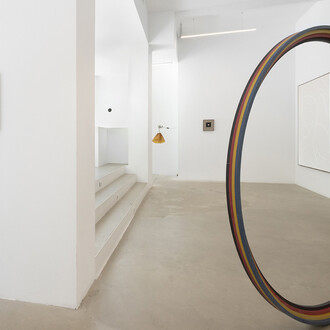
Galería Juan Silió is pleased to present Umbrales y rellenos (Thresholds and fillings), the first exhibition at the gallery by artist Carmen Arias (Santander, 1999). Her work stems from a primarily sculptural approach, focused on the relationship between the city and those who inhabit it. She seeks to challenge the memory embedded in objects and spaces, proposing encounters in which the urban and the corporeal overlap. In this project, the idea of reproduction, which is capital in her work, focuses on the relationship between water, the city, and the body.
All the sea in the passage de l’Opéra.
(L. Aragon)
Those beautiful fossils of duration, concretized through long stays.
(G. Bachelard)
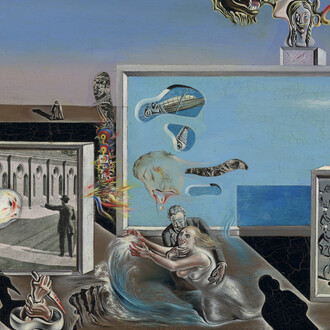
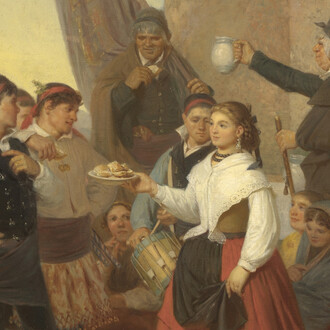
Hogarth’s tour by William Hogarth is a 1781 painting that formed part of the exhibition Fantastic art, dada, surrealism, organized by Alfred H. Barr in 1936. It is composed of fragments out of scale set against a pre-metaphysical landscape, where one can already perceive a spatiality later developed through the attraction to transitional zones in Surrealist Paris, some of them marked by a kind of inertia toward the subterranean. It is an exhibition universe that resonates with Louis Aragon and his collage-novel Paris peasant, where, in the register of an urban passage, he writes: “What was my surprise when, drawn by a kind of monotonous mechanical noise that seemed to come from the cane seller’s shop window, I saw that it was bathed in a green light, somehow underwater, whose source remained invisible. It resembled the phosphorescence of fish […] although the canes might possess the luminous properties of sea creatures, it did not seem possible that a physical explanation could justify that supernatural clarity and, above all, the noise that astonishingly filled the vault […] All the sea in the Passage de l’Opéra.”
The city, at once practical and symbolic, constitutes an anthropological space of enduring stimulation for the imagination, as well as a discourse in itself. J.-J. Wunenburger states that the city “extends the logic and balance of forms by means of sensations, perceptions, or fantasies that broaden its spirit.” Carmen Arias turns to metaphor as a gateway through which the street enters sculpture, carrying out—according to the artist herself—an act of defiance “against the memory contained in objects and spaces, proposing encounters where the urban and the bodily overlap, and where the viewer should be able to feel a physical relationship with the sculpture beyond contemplation.” Inside and outside allow Arias, through her body in motion as a form of access to the world (M. Merleau-Ponty), to perform a kind of acupuncture through which she detects which “organs” interest her enough to be duplicated.
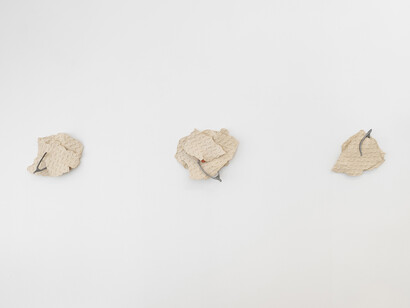
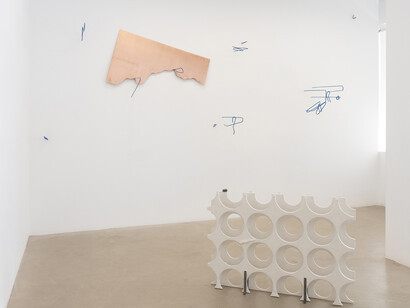
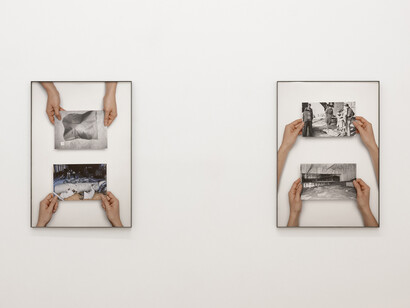
This idea of reproduction had already appeared in a previous project in which the artist addressed the first replica made of the Altamira Cave for the exhibition Frühere chemie (Ancient chemistry) at the Deutsches Museum in Munich. The piece emulates that copying process through stucco work intervened with tools (displayed in the gallery), made of copper and assembled with wood to prevent bending while combing the material. The recreation of the cave in Munich, destroyed in 2022, generated documentation that Arias has used to approach its rockiness as a quality suspended between nature and ornament, referring to those mouldings that adhere to urban space. The cave replica speaks of the tactile distances separating it from the original, of the possibility of touching the material, and of the distance imposed by conservation itself. The material used in the reproduction, while overturning our habitual perception, establishes a meeting point between replication, conservation, and banality, while also bringing the museum-worthy closer to the decorative. The piece is accompanied by copper molars, displaced elements that evoke Paleontology and dental records in the human relationship with the environment (a motif she returns to in another work in the exhibition). Also part of the work is a kind of blue text spread across the space, a “translation” of the structure that once supported the cave replica in the German museum.
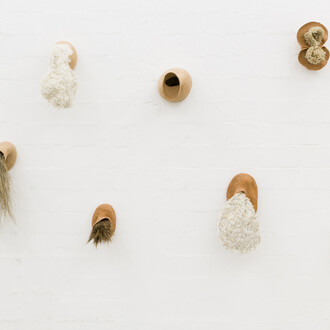
During her urban exploratory walks, Carmen Arias lingers on water, a historical element connecting public space and the home, linking the collective and the intimate, and capable of referring both to architectural aspects and to smaller tactile scales. The artist uses botijos—in their particular condition as “vibrant matter” (J. Bennett)—which she inserts into tin columns similar to those found in the paintings displayed in the Madrid shop where she acquired one of them. The bases are covered with imprints of her hands adapted to the width of the metal, which offers different diameters for a gesturality resolved in the clay vessels crowning the structures.
In her analysis of these found objects whose function is to carry water, Arias also redirects attention toward accumulation, mass production, and the loss of form through storage. This idea takes shape in a piece through which the artist suggests an artificial reef while documenting an aquatic duality. On the one hand, water guided through pipes and channels; on the other, water acting as an active agent affecting other materials, whose transformations can generate new entities such as rocky landscapes or caves. This is articulated through a three-layered work interconnected by plaster pieces resulting from scans of corals and stalactites, once again directing our gaze toward the ornamental while speaking of the passage of water through the landscape. There are also holes that allude to the plaster-working process, like an exercise in remembrance, when air escapes.
In anticipation, there had simply been a vacuum between the airport and my hotel. Nothing had existed in my mind between the last line on the itinerary (the beautifully rhythmic ‘Arrival BA 2155 at 15:35’) and the hotel room.
(Alain de Botton)
Careri argues that urbanism is born through walking, in a labyrinthine and participatory manner, and that it is an ambulatory method that allows us to read and transform cities. In her exploration of the urban environment, Arias is also interested in the negative space of the unseen underground, which she understands as a place of projection. It is a matter of understanding the city not only as a setting for everyday life, but also as an entity of interaction through the constant tools it provides.
After a process of analyzing the connections between different urban levels, the artist made an alginate cast of a Parisian manhole cover after discovering that it concealed an underground passage, approachable as a subversive body. The alginate from which the replica is made possesses the quality of losing flexibility, deforming itself, and creating volumes. The artist applies clay to it, in a chance encounter with the material’s imperfections that ultimately causes it to break during the journey home. At the same time, this produces a contrast between an everyday urban object and an abstracted version of a kind of tool that Arias herself has made in steel using her own hands.
These elements resemble wishbones, but also objects trapped along their logical route toward the drain, as though resisting being pulled into a pipe by the force of water.
If the previous piece submerged itself in “infra-urban” cavities, the next points toward the place where the habitable ends, through roof tiles touching the gallery ceiling and pressed upon by oversized molars. It marks a return to the paleontological realm, as the artist addresses our past alimentation and the relationship with the environment through food.
Threshold and filling, as currents running throughout the exhibition, seem to invoke that “absent structure” referred to by Umberto Eco when he writes: “If I draw the silhouette of a horse on a sheet of paper with a pen, using one continuous and elementary line, everyone will be able to recognize the horse in my drawing; nevertheless, the only property the horse in the drawing possesses (a continuous black line) is the one property the real horse does not have.” Thus, within the constant exchange between body and space pointed to by E. Grosz, does not each visual piece function like a mould—in the sense of the hollow left by an intuited experience—and also as that into which the material of the viewer’s aesthetic experience may be poured?
And continually, the soft, reassuring murmur of the water jets sprinkling the lawn. I remembered the Jardin des Tuileries of my childhood.
(P. Modiano)
(Text by Francisco Ramallo)