English
 Español
 Français
 Deutsch
 Italiano
 Português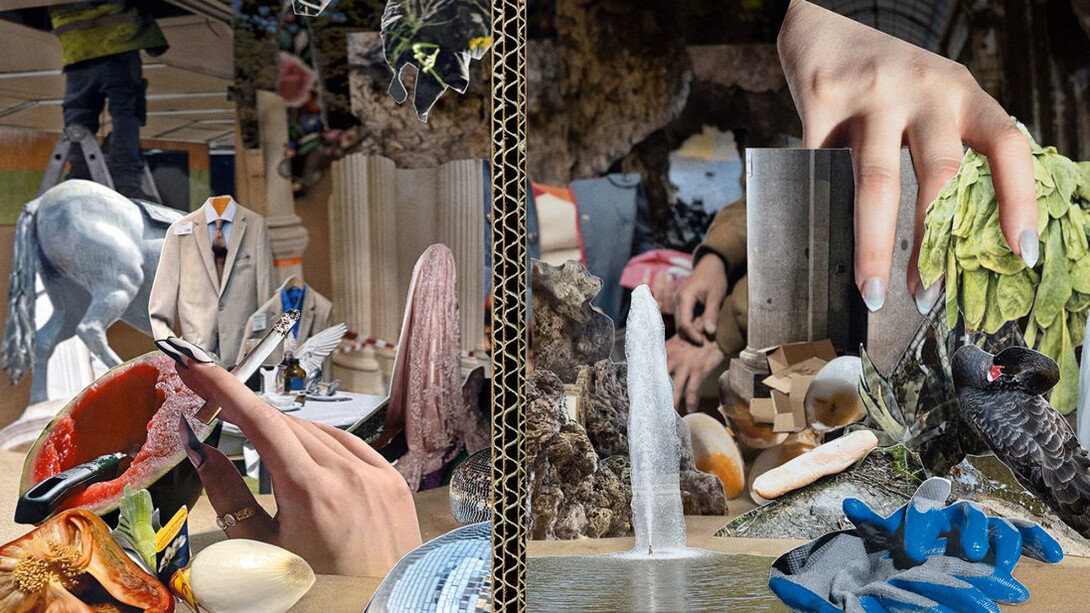
2.0272. The configuration of objects produces states of affairs.
2.0272. Die Konfiguration der Gegenstände bildet den Sachverhalt.
(Ludwig Wittgenstein. Tractatus logico-philosophicus)1
In the essay What do pictures want?, the American theorist W. J. T. Mitchell (Anaheim, 1942) recounts an anecdote that highlights the picture’s agency2. To those who think that images are inert things, Mitchell recounts the following: ‘when students mock the idea of a magical relationship between an image and what it represents, I ask them to take a photograph of their mother and cut out her eyes’3. This brief account suggests that images do not merely remain confined to the innocuousness of their two-dimensionality but can forge a path towards a truth of their own. A question like the one Mitchell poses as the title of his essay is the one Miguel Ángel Tornero asks of his own images: if a photograph were asked what it would like to be, what would it end up becoming?
To capture the initial moment of an image, Tornero uses his iPhone within his everyday surroundings—whether urban or rural—recording what emerges in the flow of daily life with the intuition of a visual sketch. The aim here is not a sterile photograph—there is a conscious choice for the lightness of the .jpg format—but rather to encounter the city by participating in the living image of what is alive, of that which can still be seen. The result is a series of images that carry the material density of lived experience—at times approaching the ‘poor image’ of which Hito Steyerl speaks4—. The immediacy of digital recording finds its weight and a more polished finish in the printing process. It is from the physical format of the images that the small-scale montage begins: one starts to answer the question of what the photographs wish to be. From the 10×15-centimetre prints, typical of home development, fragments are cut out from which the objects emerge—which until a moment ago were digital and now take shape—and the practice begins: affinities, polarities, friendships and dialogues are sought and found. Afterwards, these pieces are assembled as one might set up a stall at the Rastro.
The ‘Rastro affect’ is an issue that Tornero highlights: images—objects—take on meaning in the company of others. Through this arrangement, configured with the various objects, the ‘state of affairs’ (the things, the objects) is formed. But what is this ‘state of affairs’? One might, then, ask what it is that we can see in these images:
“The feet of a Christ from which hangs a label with a barcode,
next to half a watermelon half-eaten against a background
featuring an aeroplane window and, behind it, the sky.
Some oversized clams rest on the steel bar of a bar
where there is a pink cloth, with an aloe vera plant
acting as a barman in front of a tiled wall and,
next door, the window display of a haberdashery shop”.
These descriptions—which could just as easily be prompts fed into an image-generating AI or the lyrics to a Jorge Drexler song—capture the visualities of our age, that which can be seen today. As Deleuze noted, explaining the concept of Foucauldian archaeology: ‘every historical formation sees everything it is capable of seeing; it sees everything it can see’5. The ‘state of affairs’ is, therefore, a visuality of our age: that which can be seen, and nothing else.
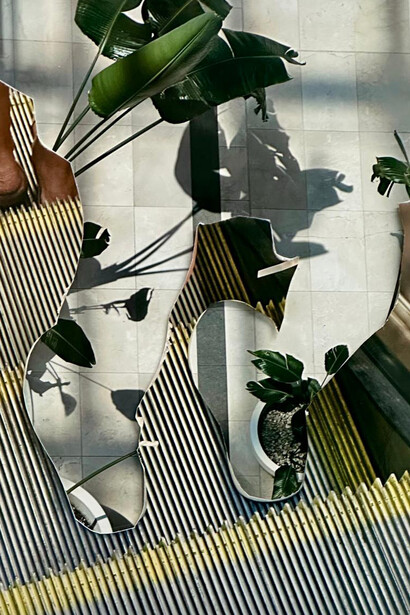
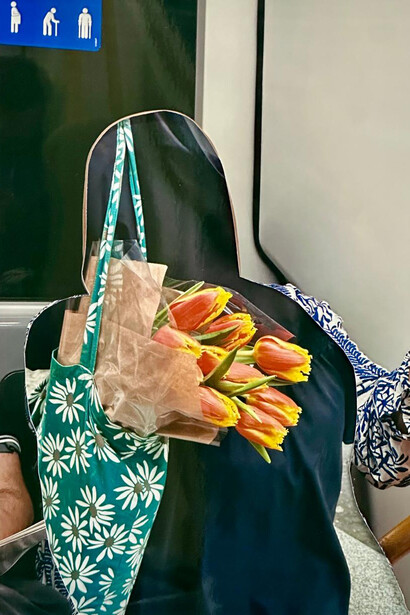
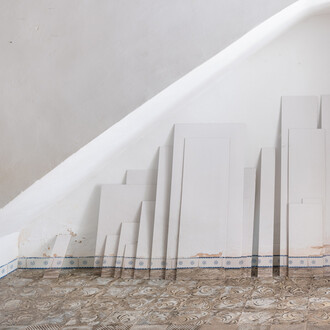
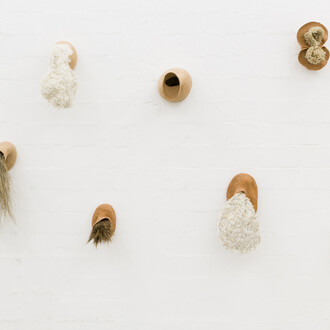
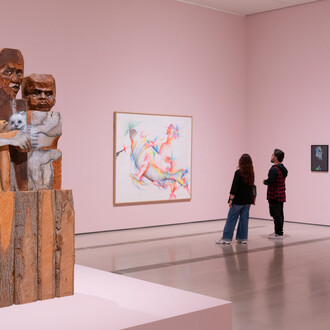
From these small montages based on printed photographs, the sections are digitally reproduced—using software—to enlarge the pieces, which ultimately become a sculptural object. This shift in scale from the small and tangible to a human scale —or even a superhuman one, recalling the installation Gran friso del Palacio de Cristal— ultimately answers the question of what a photograph might wish to be and opens a further series of questions concerning the object itself and the ‘state of affairs’ that emerges from the montage.
The photographic image becomes a sculptural form. Objects that are arranged in space as if they were elements of augmented reality: they appear on the floor as if someone had placed them there with a click of a mouse or a tap of a finger on the screen. One wanders through the installation as if surveying an object being scanned in 3D. It is in this journey around the photographic montages—which become sculptural objects—that we can stroll through the visualities of our time, through the state of our affairs.
Such are the ways of things, and this is how Tornero has shown them to us.
(Text by Juan de Andrés. Madrid, April 2026)
Notes
1 Wittgenstein, L. (2007). Tractatus logico-philosophicus (3rd ed.). Tecnos. (Original work published in 1921).
2 Following Bruno Latour, agency is understood as the capacity of any entity—whether human or non-human—to produce effects and transform a ‘state of affairs’, acting as an active mediator that modifies reality rather than being a mere passive receptacle.
3 Mitchell, W. J. T. (2017). What do pictures want? A critique of visual culture. Sans Soleil Ediciones, p. 32.
4 “The poor image is a moving copy. It is of poor quality and substandard resolution. It deteriorates when sped up. It is the ghost of an image, a miniature, a wandering idea distributed for free, travelling under pressure over slow digital connections, compressed, reproduced, ripped, remixed, copied and pasted onto other distribution channels. […] Poor images are the contemporary Damned of the screen, the detritus of audiovisual production, the rubbish washed up on the shores of digital economies […] they reveal the extraordinary, the obvious and the incredible, provided we are still capable of deciphering them”. Steyerl, H. (2014). The damned of the screen. Caja Negra, pp. 33–34.
5 Deleuze, G. (2013). Knowledge: a course on Foucault. Cactus, p. 24.