English
 Español
 Français
 Deutsch
 Italiano
 Português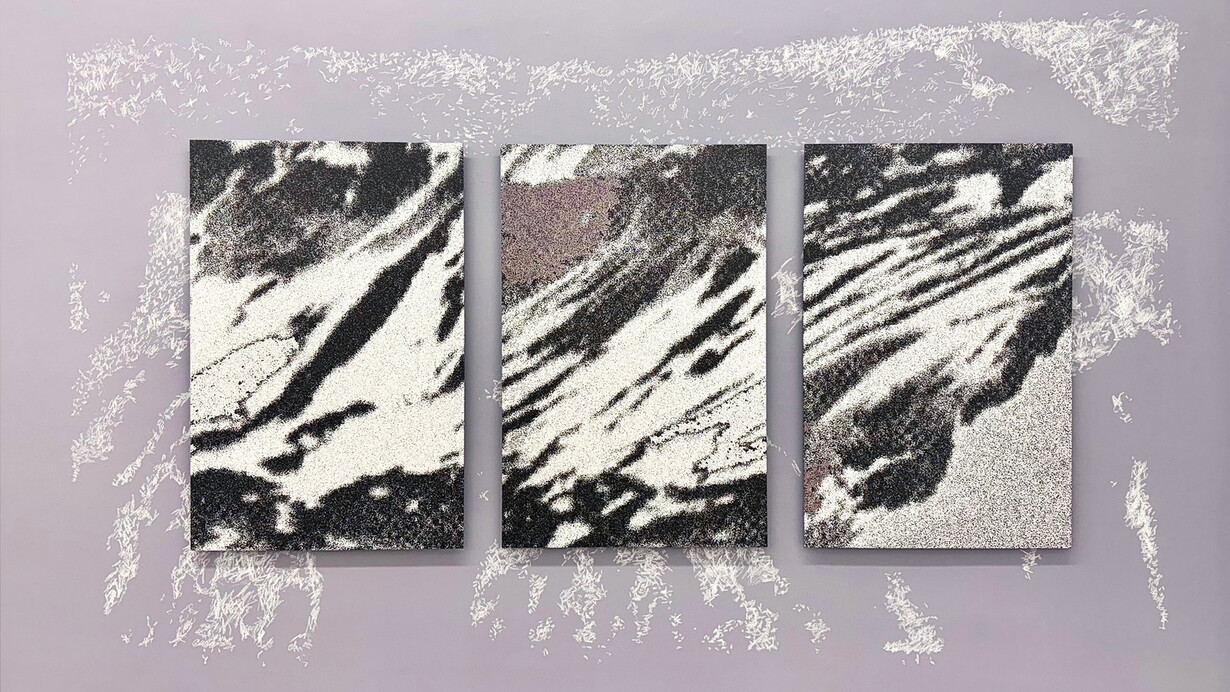
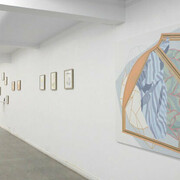
In his first exhibition at the Gallery, Fisura y aliento (Fissure and breath), Manuel Diego Sánchez proposes an open-ended process of approaching landscape through fragments, traces, and displacements of the image. The exhibition presents a series of works that emerge from the artist’s encounter with the territory of Iceland, understood as a space in which what sinks into the earth and what emerges from it coexist in constant tension. This landscape, shaped by active geological forces and overlapping temporalities, becomes a field of research from which to consider image and landscape not as stable representation, but as process, trace, and possibility.
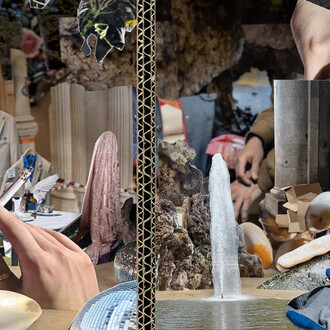
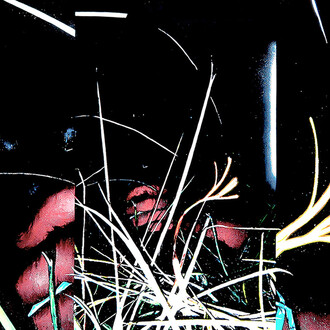
The exhibition unfolds as a narrative that speculates on place through the introduction of fictional elements, with the aim of constructing landscapes within the imagination and activating a sustained reading grounded in observation and an analytical relationship with the territory. This process is articulated through ephemeral interventions in the landscape carried out with minimal elements, and the documentation of these actions using analog media, later transformed in the studio through digital processes and artificial intelligence tools. The resulting imaginary oscillates between the familiar and the strange: places we believe we recognize are revealed as displaced and transformed.
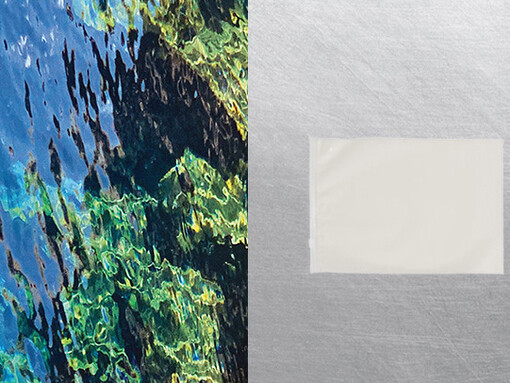
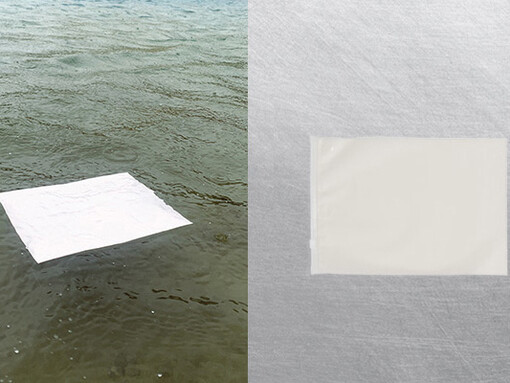
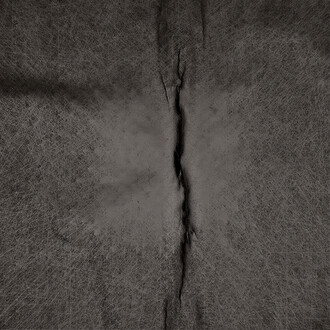
In the Fisuras series, the artist submerges absorbent papers in different natural fractures through which underground waters emerge—geothermal or originating from glacial melt—and subsequently seals them in airtight bags. This practice of attentive observation of the territory, akin to an indexical reading of the landscape, attends to minimal signals, clues, or vestiges from a gaze close to the forensic, generating changing and unstable images on delimited surfaces through direct contact with hidden flows and sediments.
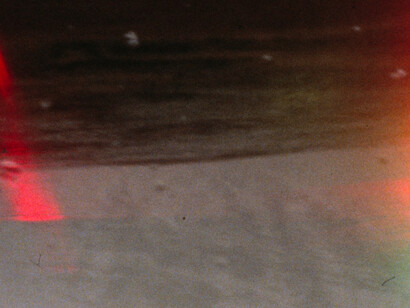
Intento de engelar una imagen en un rectángulo (Attempt to freeze an image in a rectangle) is a Super 8 film of the reflection of a glacial landscape on a specular surface, insisting on the impossibility of fixing that which, by its very nature, resists remaining still. The reflected image, always unstable and dependent on light, movement, and the position of the body, cannot be “made into ice” or solidified without losing its condition. The title refers to the etymological origin of engelar, from the Latin gelāre: to freeze, to harden, to stop the flow. Against this desire for immobilization, the work embraces failure as method and allows the image to remain in transit, suspended between appearance and disappearance, between reflection and memory.
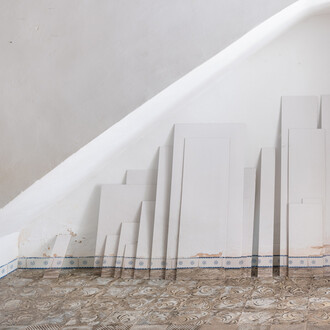
Starting from archival photographs of the Icelandic landscape, the series Posibilidad de aliento (Possibility of breath) activates a space of visual speculation. The images—intervened through artificial intelligence processes that incorporate fictional elements and whose dimensions refer to measurements taken by the artist on site—move away from their referential condition and propose unstable forms, traversed by variations, distortions, and misalignments. The archive is presented here as an immeasurable territory, where the image ceases to assert and instead rehearses: a space in which languages shift, narratives deviate, and the landscape is offered as hypothesis rather than as evidence.
Herðubreið occupies a central place in this project due to its symbolic condition within the Icelandic landscape and the persistence with which it has been represented over time. Isolated and recognizable, this volcano has circulated as a shared image, accumulated in personal, cultural, and visual archives, to the point of becoming integrated into everyday life and the collective imaginary of the island. This repeated presence displaces the landscape toward the margins of representation: Herðubreið ceases to be solely a place and becomes a malleable image, susceptible to transformation, reinterpretation, and displacement. The work situates itself in this in-between space where the image no longer responds to a descriptive logic, but to an intuitive process of approach, in which naming, pointing, and looking again become generative acts.
The works centered on Herðubreið test different ways of activating this accumulated image. Through variations, repetitions, and displacements, the volcano appears again and again without ever becoming fixed. This constant return does not seek to clarify form, but to keep it active and open to new readings. In this movement, the breath of the landscape and that of the artist himself become manifest: a latent energy that runs through the images and holds them in suspension, allowing each one to function as yet another possibility within an ongoing process.