English
 Español
 Français
 Deutsch
 Italiano
 Português
Grief is a fundamental part of our lives. Everyone on this planet has or will be struck by loss at some point in their lives. For some, unfortunately, it will happen multiple times, and it will look different each time. Loss and grief bring out some of the most intense human emotions, yet impacted individuals often feel the least alive while living with them. But, looking at it more intensely, it makes sense. Losing someone means a part of those staying behind, left along with the deceased. It can take a lifetime to learn to live with such a loss, and sometimes not even that time is enough.
When coming across grief in the media or when talking with someone else about it, words like “going through” or “getting over it” frequently occur. Which would indicate that there is an "after" – getting over the loss and returning to one's old self. The truth is, for most people, there is no going back, which does not necessarily have to be a terminal point. Growing and moving forward alongside grief is maybe a more appropriate description – something that lies ahead after the loss and does not set expectations that cannot be met.
After the death of a loved one, grief comprises a wide range of feelings, thoughts, and behaviours that differ greatly between individuals. It is neither characterised exclusively by physical expressions such as tears or agony nor is it restricted to feelings of rage or devastation. Grief is a complicated mixture of emotions in which individuals may experience extreme anger or feel an inescapable numbness, while many experience both in different stages. The nature of grief cannot be described with a single definition or reduced to one specific path. While similarities do arise, each experience, each loss, each life is still fundamentally different. The beauty lies within the ability to form a connection with others while going down different pathways.
Grief takes a big part in human culture, and it is closely associated with death, which has played an important role in religion, philosophy, and cultures for many centuries. There is not one “right” way on how to deal with it, and it certainly varies from individual to individual but also within cultures and philosophies. For example, explanations for the death of the loved one, or what happens after death, can shape a big part of the grieving journey. Humans have always been curious creatures, so trying to find an explanation and make sense of the situation is only natural. Philosophers have had different approaches to this as well.
The philosophy behind it
Philosophers have frequently used grief as a window into what we value, with interpretations ranging from doubt to genuine appreciation. Grief has been viewed as irrational, culturally formative, existentially enlightening or even a fundamental aspect of how humans interact with the environment across cultures. Different philosophical traditions view mourning as reflecting what we value yet prescribe different responses. Stoics, for example, consider it a cognitive disturbance to be reframed, while Buddhists see it as an attachment to be consciously released.
Stoicism and Epicureanism believe that procedures like reappraisal and belief correction may successfully lessen unpleasant emotions. Stoic philosophers proposed evaluating judgements that make loss painful and practising premeditation to lessen shock. Contemporary scholars point out that Stoic methods are similar to cognitive reappraisal, an adaptive emotion-regulation approach linked to fewer symptoms of sorrow and extended grieving. Epicurus and Lucretius contend that pathological sorrow is fuelled by dread of death; eliminating these beliefs and cherishing memories restore tranquillity.
Clinical research has shown that Buddhist practices, which emphasise mindfulness and compassion, are associated with improved emotion-regulation networks. This implies that practising mindfulness can be an effective strategy for controlling emotional reactions in stressful circumstances. According to Buddhism, grieving is an inevitable feeling of loss, as well as a manifestation of love and connection. It is not something to be suppressed or ignored. Grief stems from our deep connections, memories, and attachments. Understanding it leads to the comprehension of the fragility of life.
From a neuroscientific perspective, mourning is thought to include intricate connections between the brain’s reward, memory, and emotional circuits. Interestingly, certain patterns of connections within these circuits are linked to extended or complex grieving, indicating that neurobiological foundations of grief are just as important as the philosophical and emotional components. The brain, hormones, the immune system, and large-scale networks alter following a loss, making grief both biologically active and emotionally unbearable.
Grief across cultures
Death, loss, and grief are often a quite unpleasant topic to talk about for some. Many people do not know how to deal with being around someone grieving; it is uncomfortable, and the fear of saying the wrong thing sometimes leads to not saying anything at all. Grief being a taboo topic can typically be found in Western cultures, where death is not talked about a lot, and it is considered something private with which outsiders do not intervene much. However, this does not necessarily represent the philosophy behind grief for all cultures around the world.
Various cultures have unique rituals around death that reflect different perspectives. This can be observed from early human history. For example, in ancient times, the Greeks organised burials, but the Egyptians constructed tombs. Treating the dead is a part of the grieving journey and essential for later emotional processing. Based on the beliefs one has, the proper funeral tradition can help ease the mind of the griever and ensure that the deceased is “at peace", a state that everyone might imagine differently, based on culture and religion.
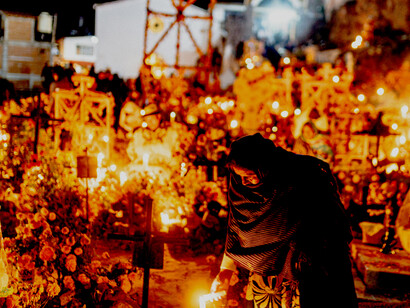
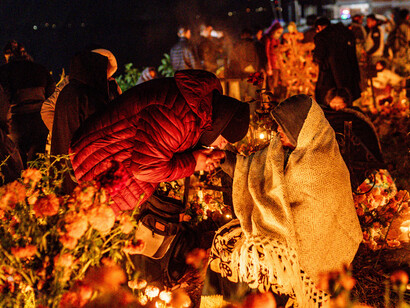
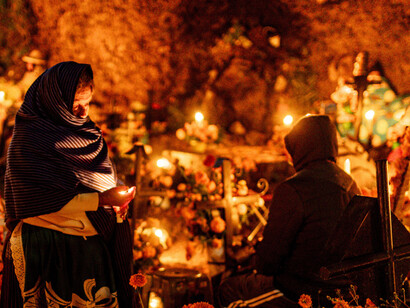
In contrast to cultures where death is celebrated, such as Día de los Muertos in Mexico, which promotes acceptance via a pleasant memory, Western commemoration is frequently silent. In Ghana, death represents a passage to endless life, a transition to ancestorhood, social status and lineage continuity. Hindu communities view death as a shift in a cycle of rebirth. Immediate rites, cremations, and post-funeral rites are important for guiding the deceased and comforting the living. In Japan, every year, households clean graves, give offerings to home altars (butsudan), float lanterns, and participate in Bon Odori dances. Obon is a seasonal return of ancestral spirits that combines filial duty and community celebration. Obon’s mix of individual offerings and public festivals encourages people to show respect while also strengthening social solidarity.
Across many countries and cultures, ancestor worship or continuing bonding practices serve emotional, social, and moral functions, helping people make sense of death and maintain social continuity. Understanding these various mourning customs helps increase empathy for people grieving across cultures, stressing the importance of raising knowledge and discourse about death. There can be found many customs, across cultures, in relation to grief, and with those come also societal expectations and sometimes judgement. What matters most, though, is how the people grieving choose to mourn and support their decision. Strong community bonds can be a great support in those difficult times.
References
Burke, S. A. (2025). The Science and Experience of Grief: Psychological, Neuroscientific, and Cultural Perspectives. International Journal of Psychiatry Research, 8(4).
Clarke, L. (2024). The Stoicism of Śāntideva: Comparisons between Stoic and Buddhist philosophy. Theoria, 90(4), 377–399.
Gill, C. (2009). Stoicism and Epicureanism (P. Goldie, Ed.). Oxford University Press.
Rosenblatt, P. C. (2017). Researching Grief: Cultural, Relational, and Individual Possibilities. Journal of Loss and Trauma, 22(8), 617–630.
Skrozic, A., & Kijamet, D. (2022). Definition of grief, gender differences and religious and cultural differences in dealing with death and grief (M. Böhmer & G. Steffgen, Eds.; pp. 13–27). Springer Berlin Heidelberg.