English
 Español
 Français
 Deutsch
 Italiano
 Português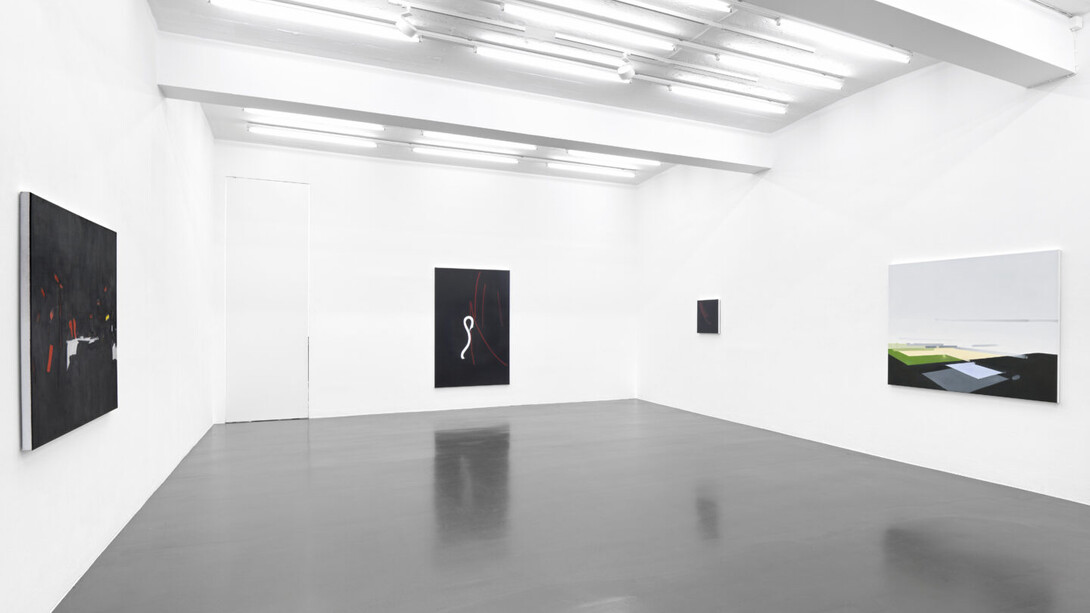
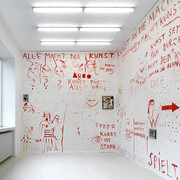
Sies + Höke is proud to present Michael van Ofen's ninth solo exhibition with the gallery.
Recently, Michael van Ofen has been making paintings that interweave processes of revision, quotation, and self-editing to engage selectively with iconic registers from the history of painting. Around four years ago, the artist began modifying and reworking paintings he had made in prior years: a practice he has termed “supplementation and improvement” (Ergänzung und verbesserung). This act of self-scrutiny and deliberate reworking can be read as a quasi-method of self-appropriation, one that resists the mandates of finality and completion and instead focuses on recursion, self-analysis, and process—ways of re-engaging with a medium that has repeatedly been pronounced gone, but which always seems to become new again.
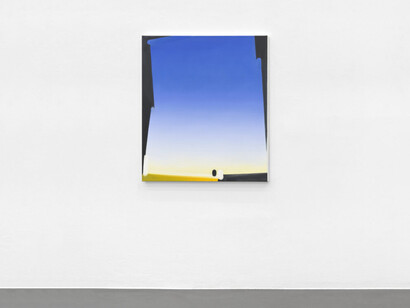
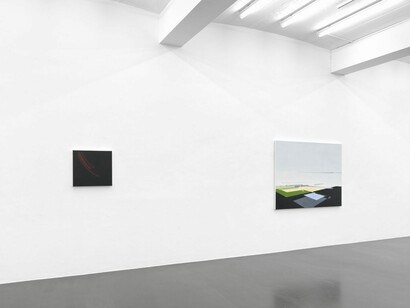
The landscape works on view extend van Ofen’s interest in historical painting and its afterlives. The sky in Carl Blechen’s Morgendämmerung, 1826—first quoted by van Ofen in 2015 and newly reworked in an oil painting on view here—allows Romantic solemnity, with its promise of atmosphere, depth, and transcendence, to appear simultaneously as feeling and as reference: a borrowed pathos made newly visible through irony. Van Ofen treats painting’s past not as a stable archive of images but as a repertoire to be transferred, cropped, masked, and reactivated. Combining self-revision with historical selection, these paintings hover between abstraction and figuration, probing painting’s role as both visual plane and vehicle for historical consciousness. To make two of the present works, van Ofen drew on late Gothic devotional paintings, extracting details or icons and transferring these selected elements while rendering the remaining areas in black, like negatives or voids of their original referents. Die Spur des Blutes in “Der heilige Franziskus empfängt die Stigmata,” Meister der Kölner Schule um.
1500 draws from the Christian iconography of the stigmata as it appears in a triptych of the Franciscans by the Master of Saint Severin and the Master of the Saint Ursula Legend, now in the Wallraf-Richartz-Museum in Cologne. In the original oak-panel painting, Francis receives the wounds of Christ, who appears in the upper corner of the central panel while rays of blood extend from Christ’s wounds toward Francis’s wounded hands and feet. In van Ofen’s reworking, he isolates this stigmatic mechanism, retaining the blood’s original red and transforming a devotional symbol into a formal and symbolic trace. Van Ofen preserves the metaphysics of transformation while abstracting it into an optical event: marks that recall beams of light, photographic traces, or a historical afterimage.
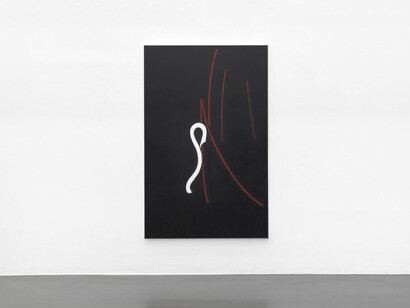
Similarly, in Die Spur des Blutes und das Wort in “Christus als Schmerzensmann und die Stigmatisation des heiligen Franziskus” vom Meister der Lindauer Beweinung, Fichtenholz 111 x 68 cm, um 1420/1440, van Ofen draws from another pictorial account of stigmatization, here based on a fifteenth-century fir-wood panel, likewise at the Wallraf-Richartz-Museum. He combines the lines of blood reaching into Francis’ feet and hands with a white mark, almost typographical in its iconicity, derived from the shape of a writhing, seemingly blank sheet of paper at the center of the source image. In van Ofen’s painting, a symbol that once functioned within a legible religious narrative is put into question by isolating the forms and mirroring those forms back to itself, bringing out their inherent instability.
In another new work, van Ofen turns to Anton von Werner, the Wilhelmine-era painter known for his first-hand depictions of historical events, including the proclamation of the German Empire in 1871. Authority and Regalia in Anton von Werner’s “Kriegsrat in Versailles” (November/Dezember 1870), 298 x 400 cm takes as its source von Werner’s depiction of the war council at Versailles. In 1870, the twenty-seven-year-old painter was sent to Versailles, where he observed the leaders of the German war effort as they debated the siege of Paris, making visual depictions that culminated in a 1900 painting. In the original image, Wilhelm I, Crown Prince Friedrich Wilhelm, Roon, Moltke, and Bismarck are gathered in tense deliberation. Van Ofen crops this scene of near-mythical statecraft down to a few fragments, stripping away the primary historical narrative to focus on symbolic residue: documents, regalia, fabric, and the apparatuses of state power.
At their core, van Ofen’s paintings stage a tension between icon and form, between private experience and the construction of public consensus, between the historical image and the systems of meaning that gather around it. Masked or obscured as they are, his referents— drawn from scenes of religious or state power—undergo recursive processes of distillation. Symbolic authority is rendered visible, but also reduced, estranged, and partially emptied of aura. In this sense, the works reflect on a condition in which painting found itself after modernism: overdetermined by discourse, reconstructed as an image that must be explained, framed, captioned, or converted into a textual substrate.
Against this, van Ofen does not propose a specious return to painting as pure image. Rather, he recovers a painting that allows the tension between text and image to remain suspended. Revision, including self-revision, inverts the usual understanding of completion as painting’s natural telos and instead activates possibility itself as an artistic plane. The result is a body of work that moves between historical quotation, painterly study, irony, and commitment to generating new questions. By absorbing the textual dimension of discourse into the work itself, as iconic quotation, van Ofen recenters attention on a form of painting fully aware of its contested role in shaping historical and conceptual self-consciousness, and whose self-questioning has become its method of survival.
(Text by Pablo Larios)