English
 Español
 Français
 Deutsch
 Italiano
 Português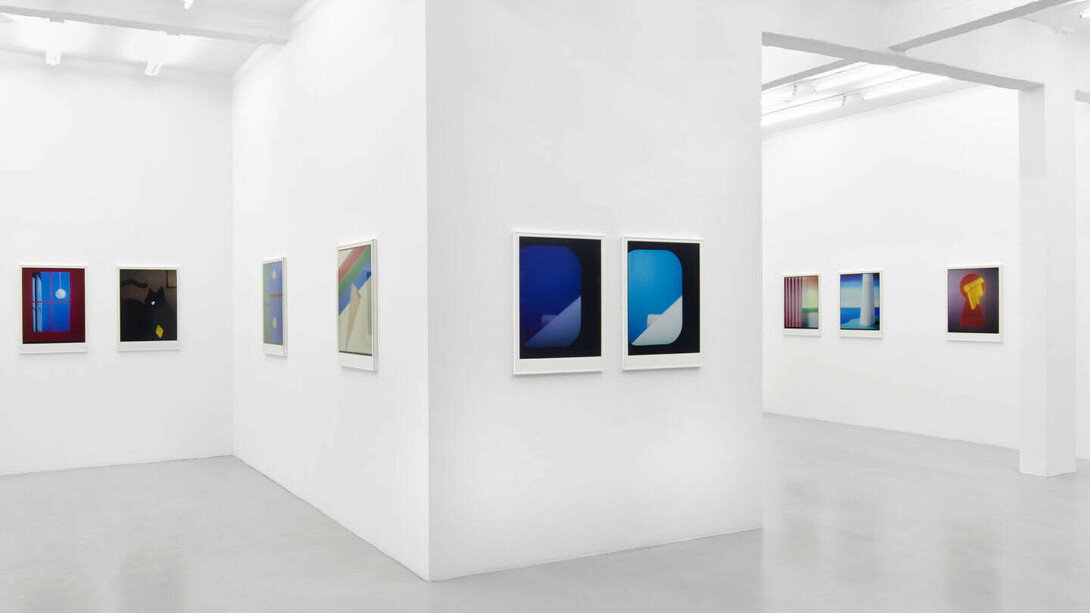
Over the many years he has been working as an artist, João Maria Gusmão has adopted a number of stances or personas. He has been described as operating in the guise of a naturalist or scientist, or even an explorer, but also as a magician, shaman, alchemist and joker.1 In this new series of work shown at Sies + Höke, there is a sense he has become someone, who Deleuze might recognise as the Exhausted.2 Oh, he is tired, you say? One too many long nights, perhaps? But no, this is not what I mean at all. The exhausted person is not tired because things have happened to them, but because exhaustion is a task they have embarked upon, which has both physical and meta-physical dimensions and consequences. The exhaustion of which I speak, is the exhaustion of the possible as such.3
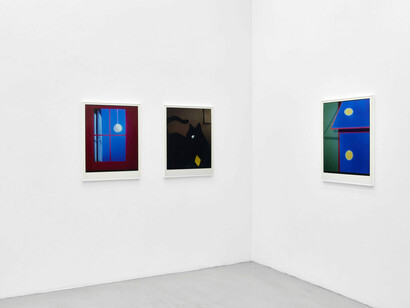
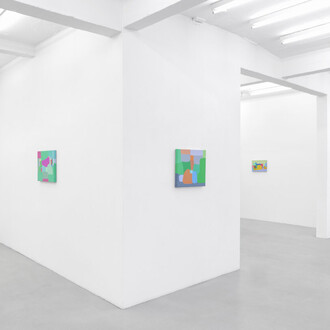
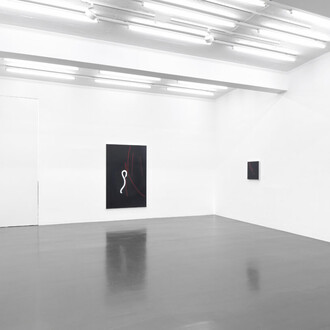
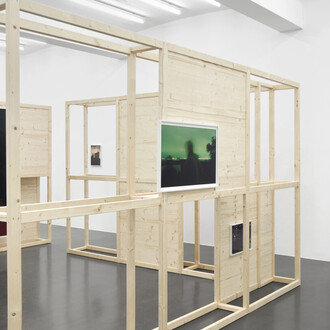
See here, the series of chromogenic prints Day for night, depicting a number of familiar, everyday little scenes. I can see moonlight falling in through an open window and over there, light shining out onto the street outside. That white ball up here is a street night. But over there it is a lamp hanging down from the ceiling. It is also sometimes the moon. With these images it might seem that João Maria Gusmão is playing with the world of appearances, where one thing can look like this or the other depending on the circumstances, its platonic ideal remaining steadfastly the same. But such a reading would ignore the elaborate set-up required to produce these scenes. These reverse “polaroid” prints are staged studio photographs of coloured cardboard dioramas, engaging with the “day for night” technique sourced from classical cinema. To overcome the difficulties of shooting in low-light conditions, filmmakers would simulate these conditions instead, through a combination of colour filters and underexposure. The night-time that appears in João Maria Gusmão’s images - the darkened rooms and saturated shadows - is thus as staged as the depicted scene. There is, in fact, no moon, no lamp, no night. It is all appearance or not appearance at all, more like a diagram of its own making, where each scene carries with it the mechanism of its own construction. And João Maria Gusmão likes to remind us for this fact: in “Additive colour essay valdai factory logo,” the stages of the filter process are rendered visible in the sequence of symbols of the soviet lens manufacturer.
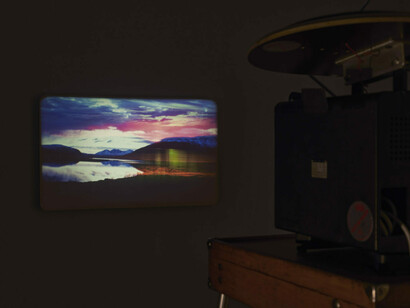
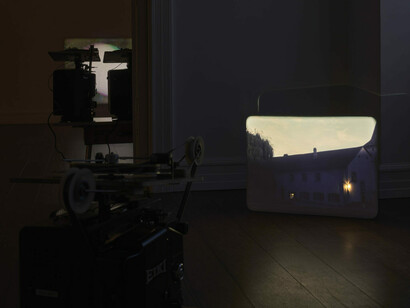
As per Deleuze, the problem with the notion of appearances is that these require us to judge, according to the degree they reflect the ideal, which is always somewhere else, at some future time, in a beyond we cannot reach.4 It is not that the image, whether this is understood as the appearance, the imitation or the copy, is problematic in itself, but rather the degree to which it is faithful to its model.5 Indebted to an ideal which can never be repaid, a faithful appearance is judged as good, a fickle and treacherous one, bad.6 This is the purpose of exhaustion, the renouncing of judgement: to have done with judgement as Beckett and Artaud had all those years before.7 In Beckett’s television plays, figures go out during the day and stay in at night, but are also out during the night and in when it is day. Slippers on and off, off and on. This one or that, they have no preferences – Murphy and his five biscuits, with their hundred and twenty permutations in the order of eating.8 In João Maria Gusmão’s earlier 2023 film Day for night, it is day outside, but night inside, and we can see João Maria Gusmão go into the building to switch on the lights. Lights are on - it is night, but it is day as well. In the photographic work, that a streetlight can be either moon or lamp, hanging up or shining down, again alerts us, not to a play with appearances, but precisely this process of exhausting the possible, and with it, the renouncing of judgement. In these images, studio light is used to present darkness. In the light, it is dark, an inclusive disjunction. All possible sunsets are included in Pale Horse, colour slides taken from the archive of a Scottish photographer, who obsessively documented the sun setting over a number of years. João Maria Gusmão juxtaposes these slides, one on top of another, using the overlaid effect of six projections, and recording the resulting transitions on 16 mm film.
But as we renounce judgment and its beyond, we become immersed, in what exactly? One word, which has been used in relation to João Maria Gusmão’s work before, especially in partnership with Pedro Paiva, is the “abyss.”9 Beckett’s Murphy is again a reference I like to think of here, with his mind being divided into three zones: light, half-light and dark. The light zone is the world of perceptions, for you and me, our world of appearances, filled with people and things, our immediate physical environment. We get tired in this world. The dark zone is what we seek in exhaustion: a world in which all forms are in flux, continually becoming and falling apart, with no governing principle of change. Through this world I could travel, a point in the “ceaseless generation and passing away of line,”10 a mere “mote”11 tossed there and back in the darkness. There is no judgement in this world, because that would require forms and stability and the building of relations. There are only connections made and lost, constructions that do something and then stop and disassemble. This is an ethical world which requires participation.
I think in these new works by João Maria Gusmão, the abyss is less of a focal point than previously, even if it occasionally bubbles up from beneath, as in the 16mm film Fermented foam, a multicolour fountain consisting of three superimposed RGB projections, where again, the concern is the construction of appearance, the shimmering colours a consequence of the film projecting process. The world this exhibition inhabits is the world of twilight, the second zone of Murphy’s mind, which is the zone of “forms without parallel,”12 appearances without a model. I also think of this world as a world of images, providing these are nothing more than an image, like some of João Maria Gusmão’s photographs, a bit of white and a bit of blue. In the mud blue sky and scamper of little clouds. Blue and white of sky April morning in the mud.13 But it is not a memory that Beckett is describing in “The image,” always intruding as in “Eh Joe.”14 “These little scenes in the light yes but often no”15 of João Maria Gusmão’s photographs, though very relatable - most of us have looked through binoculars at the moon or out of a plane window - are also curiously impersonal. They are not memories, no.
If the works in the exhibition seem to linger among the images in the twilight of Murphy’s half-light zone, hesitant to enter the “absolute freedom”16 of the darkness beyond, it is because there is a new-found wariness of the abyss here. There is now an awareness of the devastation left behind by the task of exhausting the possible and the renouncing of judgement. For to construct an image to appear can be a destructive process. The “pale horse” of João Maria Gusmão’s film is already a reference to the Apocalypse, the horse of death, spreading death and decay as one sunset haemorrhages into another, other-worldly and alien. But it is in the film Clownwork where this destructive threat is most visible.
Clownwork is unlike the other work in the exhibition, because it adheres to a straightforward narrative. Three clowns enter the empty circus ring and attempt to fix a statue high up on a plinth. Mayhem ensues. Clowns slap and kick each other as buckets of paint fall around them. Unusually as well, the camera - and the artist - are participants in the scene, together with the clowns in the ring, rather than in the stands where the audience sits. There is a strong sense of physicality as the camera is handheld at waist level, looking in onto the action or backing away when it is all too much. The camera, the artist, us, we are all involved, committed to the performance, the mockery of the possibility of fixing things and also its violence. The clowns, they also renounce, maybe not as mathematically as some of Beckett’s characters but still, the structures associated with judgement. Look there - ha! A clown is hit as the wooden plank spins left. The other one ducks - once, but not twice, and is also hit, ha ha! Move away, move away, I push it back! Oh no you do not! Plonk, it goes on a clown’s head. Bam, it falls to the ground. Left and right, up and down - all possibilities are affirmed, yet also, never realised. The plank doesn’t serve its purpose, nothing ever gets fixed. There is only a semblance of work, a descent into chaos sternly disapproved by the statue looking down from above and beyond. Gone are the values he represents! There is no judgment here, only the immediate Nietzschean justice,17 one clown taking revenge on another. The abyss they operate within is ugly, violent and irredeemably destructive.
In this exhibition, João Maria Gusmão presents the image at a tipping point. When the image is constructed as an appearance - when the possible is exhausted and judgement is renounced - things can go either way. There is undoubtedly a freedom to be had in the darkness of the third zone, everything in flux and becoming and connections made and lost. But equally, the threat of a perpetual cycle of destruction is ever present. So we stay, exhausted, among the images, watching one sunset disappearing into another on a loop.
(The twilight zone. Text by Magdalena Wisniowska)
Notes
1 Many of these personas are described in the artist catalogue, João Maria Gusmão and Pedro Paiva, Terçolho, Serralves Museum (Fundação de Serralves): Mousse Publishing, 2021.
2 This text makes use of Gilles Deleuze’s essay on the late television work of Samuel Beckett, “The exhausted” found in Essays critical and clinical, trans. Daniel W. Smith and Michael E. Greco, London: Verso, 1998.
3 This is Deleuze’s definition, as presented in “The exhausted.”
4 Deleuze, Gilles “To have done with judgment” in Essays critical and clinical, trans. Daniel W. Smith and Michael A. Greco, University of Minnesota Press, 1997, pp. 126-7.
5 Gilles Deleuze, “Plato and the Simulacrum,” October, Vol. 27 (Winter, 1983) as translated by Rosalind Krauss.
6 Ibid., pp. 46-7.
7 Beckett is described by Deleuze as having done with judgement in "The exhausted,” a similar claim is made for Artaud in Deleuze, Gilles, and Félix Guattari, A thousand Plateaus, trans. Brian Massumi. Minneapolis: University of Minnesota Press, 1987.
8 Beckett, Samuel, Murphy, London, England: Pan Books Ltd., 1973, pp. 56-7.
9 See the essay “Entropic vision and meteorism” written in 2008 by the artist and Pedro Paiva as part of the catalogue Abissology: horizon of events and reprinted in Terçolho. While their definition of the abyss has different reference to mine - Descartes rather than Deleuze - nevertheless there is a shared concerned with the indiscernible as a kind of material ground, ever present but at the limits of visibility, hidden by human structures of perception.
10 Murphy, p. 66.
11 Ibid.
12 Ibid., p. 64.
13 Beckett, Samuel, ‘“The image” reprinted in Journal of Beckett Studies, Vol. 4, no. 2 (Spring 1995), pp. 1-4.
14 1966 BBC recording of “Eh Joe”.
15 Beckett, Samuel, The collected works: how it is, New York: Grove Press, 1964, p. 97.
16 Murphy, p. 66.
17 See Deleuze “To have done with judgment,” p. 127.