English
 Español
 Français
 Deutsch
 Italiano
 Português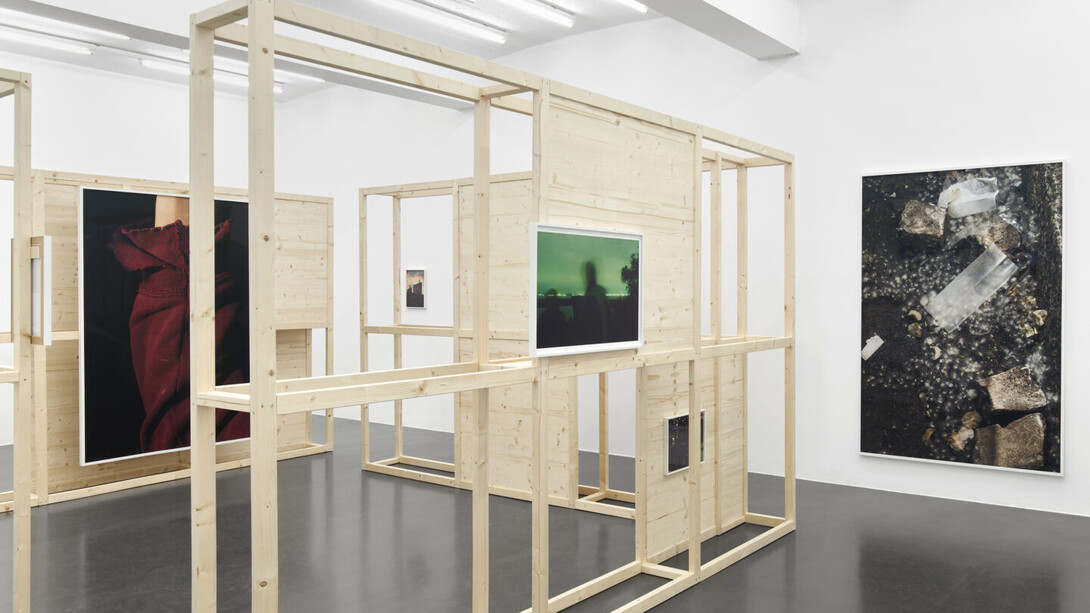
Graffiti reading Stadt für alle stretches across a chimney in large white letters. “City for all” is the phrase visible from Paul Hutchinson’s Berlin studio window that he encounters almost daily, almost ritualistically. And yet it remains aspirational, suspended between declaration and reality. What does it mean for a city to belong to everyone? It is a promise that suggests universality compared to a lived experience that suggests otherwise. Because, indeed, some citizens are worth more than others.
In The right to the city (1968), French philosopher and sociologist Henri Lefebvre argues that urban space should not be governed by market logic alone – not reduced to a commodity, not carved into exclusive zones of access and ownership – but should be shaped by those who inhabit it. Instead, today's urban life has increasingly been downgraded into a product with aestheticized governance and uprooted social interaction. The promise remains universal, but the reality is selective.
Paul Hutchinson’s Selected citizens unfolds inside this contradiction. The exhibition marks a thematic continuation of his practice, which has long circled the phenomena of contemporary urban life: social mobility, the oscillation between intimacy and exposure, fragility and inner-city roughness, personal vision and collective structure. But Hutchinson’s work is not overly political; it is political in the same way a scar could be considered political – a mark that tells of pressure, friction, healing, and the impossibility of returning to what once was. The exhibition title operates as a double gesture. On one level, it refers simply to a selection of works from Hutchinson’s new work cycle citizens. On another, it alludes to the persistent discourse surrounding social mobility and participation – the uneasy question of who, in practice, gets to inhabit the “city for all.”
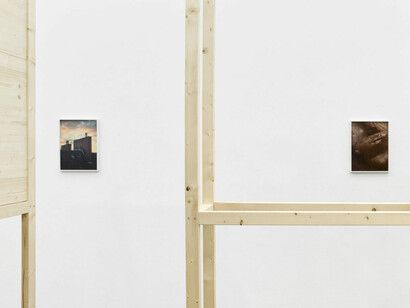
The artist’s new body of work citizens plays a crucial part in the exhibition. The so-called sculptural experiments are deliberately photographed in transitional states. citizens, wet clay (2025), for example, shows the image of an abstracted face in the form of a (still wet) clay sculpture, making its surface seem slightly unsettled and vulnerable. These figures, however, are not merely images. For the first time, Hutchinson presents sculptures, which exist alongside their photographic representations. This deliberate doubling creates a tension between the staged image of the sculpture and the sculpture as material body.
Hutchinson’s works exist not as monuments but as beings in flux, where temporality becomes subject. The sculpture is both object and image, both physical and staged. There is a quiet radicality in this decision. Here, sculpture, historically associated with permanence and authority, is rendered provisional. The image of the sculpture becomes as significant as the sculpture itself — a consciously constructed representation that sits in tension with its material origin. What we see is therefore always slightly fictionalized. The artist understands sculpture as another way of fantasizing – as worldbuilding. His practice consistently intertwines the fictional and the political — not through direct statement but through atmosphere and mystification. In Selected citizens, figures appear as if emerging from a half-formed urban mythology: archetypes of belonging and exclusion, of visibility and disappearance.
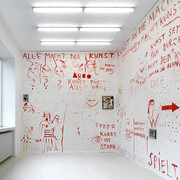
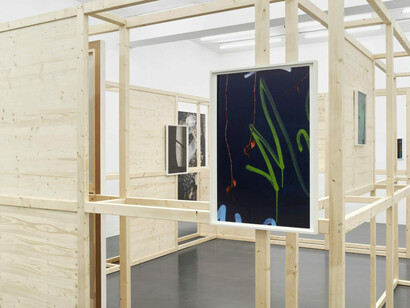
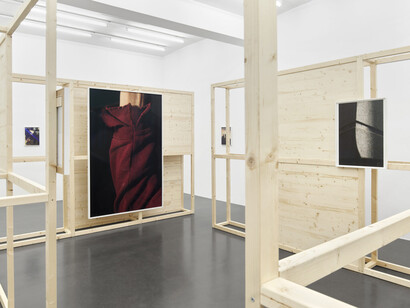
Urban experience runs through the exhibition like a nervous current. There is something of Großstadtlyrik here, a metropolitan poetics that echoes early twentieth-century reflections on overstimulation and fragmentation. Hutchinson’s works evoke the attempt to orient oneself within the endless flow of impressions that define modern life. A kind of stream of consciousness rendered spatially. Surfaces accumulate gestures; forms appear half-remembered, as if glimpsed while moving too quickly. This sense of overwhelmedness, however, is not chaotic but composed. The exhibition architecture, consisting of a central wooden structure onto which some works are hung and that viewers are able to enter, plays a decisive role. It functions as a conscious tool, integrating the sculptural works and interweaving different image groups into a single spatial rhythm. Movement through the exhibition produces shifts in perception, and the kind of simultaneity that exists within metropolitan spaces becomes tangible. Language, image, sculpture, and architecture do not sit apart but blend into one another. Two smaller works also incorporate short texts, reading phrases such as “indeed some citizens are worth more than others,” extending Hutchinson’s ongoing dialogue between writing and image. Here, text does not explain the work; it destabilizes it. Words hover like internal monologue — fragments of orientation within a city that rarely offers clear coordinates.
If Lefebvre demanded a right to the city, Hutchinson stages the contemporary condition in which that right feels abstracted. Yet he resists didacticism. Instead of announcing an explicit social or political position, he constructs a space in which fiction and reality converge. The political dimension emerges through tone, absence, and through what remains provisional. “Selected Citizens” ultimately proposes an urban imaginary that is both intimate and estranged. It reflects a world in which inclusion is promised but rarely neutral; where visibility is currency; where even vulnerability can be aestheticized.
(Text by Claire Koron Elat)