English
 Español
 Français
 Deutsch
 Italiano
 Português
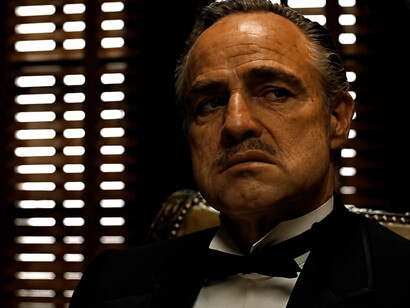
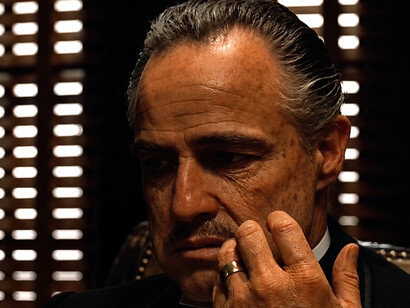
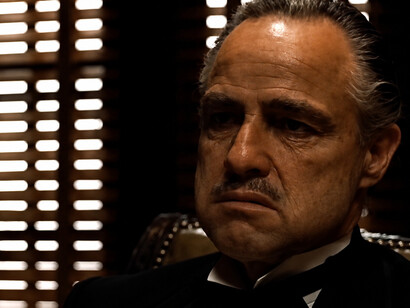
“I believe in America." So starts the first monologue introducing the masterpiece by Francis Ford Coppola, The Godfather (Part 1). The speech is made by an Italian-American undertaker named Amerigo Bonasera. The man retells his daughter’s misfortunes to the Mafia boss, 'Don' Vito Corleone, who is masterfully interpreted by Marlon Brando. This rather humble man begs Corleone for justice, and this represents a powerful deconstruction and questioning of the myth of the American Dream. Bonasera began his tirade stating how two young boys, among whom her boyfriend (he expressly states, ‘not an Italian’) savagely beat her once they failed to abuse and take sexual advantage of her.
Bonasera trusted in America’s justice system. In his view, hard work was the key to success. Vito Corleone ironically stated that the undertaker had “found paradise in America, (that he) had a good life, (and that he) had a good trade.” Bonasera trusted the police to protect him. The scene is set around 1945/46. It was the moment in which the US could assert the superiority of moral values and attitudes in a model with which middle-class citizens were expected to conform. The negative image of this ideal was that of the Soviet Union’s abhorred "Communism". Amerigo Bonasera believed in America as the land of law and order. Protecting and favouring honest citizens who confidently relied on the institutions to perform their duties of protection against evil and wrongdoing.
Bonasera believed in retributive justice and the actual punishment of crimes and felonies. To him, the United States was imagined as the paradise of individuality, a cove where self-made men would somehow be nurtured and cherished. Business would thus go without any major intrusion or disruption. Enlightenment core values like 'equality before the law' could be confidently relied on. After all, it is for these values that Michael Corleone (Vito’s youngest son and the eventual second Godfather) fought during World War II.
Therefore, the undertaker appealed to justice and went to the police “like a good American”. But the court “the judge condemned them to three years but suspended the sentence", and “they were free that very day.” Bonasera stayed in the court like a fool.” And "those two bastards, they smiled” at him. Bonasera was a quiet citizen who always obeyed the rules and respected the law. He always stayed away from troubles and always kept his distance from criminality and the Mafia. However, Bonasera figures that courts are nothing but a puppet theatre, where cops and judges are attached to wires that make them move to play an appearance of actual justice. In substance, this is a film about someone pulling the strings behind the scenes, and this statement is recurrent throughout the story of the first two parts of the Godfather trilogy.
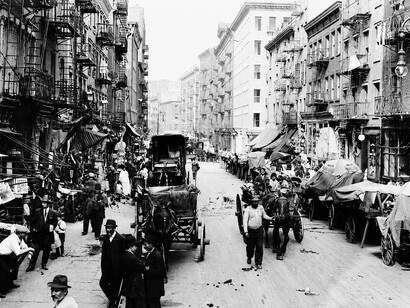
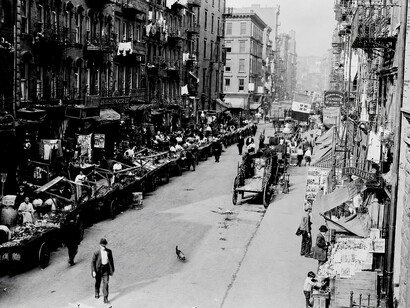
After the court's indulgence, Bonasera decided to find other ways to get his revenge. Thus, Bonasera said to his wife, “For justice, we have to go to Don Corleone!” In other words, ‘private’ justice is thus more effective than public justice, and it supplants it when it is unable to deliver what it promised. According to the book by Joseph Sciorra, Building Italian America: Constructing Homes, Narratives, and Identities (Sciorra, 2016), Italian Americans created a space of belonging which is somewhat similar to the fictional parallel society ruled by the Corleones. In this perspective, it can be argued that the Mafia was seen as a substitute or a shadow civic institution.
Even though Mrs Corleone was Godmother to Bonasera’s unfortunate daughter, he avoided Corleone's (all too compromising) company. Bonasera steps into the underworld of criminality to express his initially poor idea of the concept of justice. Mafia retribution was, in his view, all about paying for violence and murder: "How much should I pay you to do what I beg you to do?” And the Don rebuked him: "When was the last time you invited me for a cup of coffee?” In the realm of interpersonal relations, the undertaker has a mistaken view of the Mafia compared to the institutional ideological features of the modern state. Bonasera steps into the underworld of criminality to express his initially poor idea of the concept of justice. Mafia retribution was, in his view, all about paying for violence and murder. And the Don rebuked him: "When was the last time you invited me for a cup of coffee? Don Corleone’s response – "What have I ever done to make you treat me so disrespectfully?"
The delusional promises of the American dream to Italian-Americans
The American Dream promises agency, yet justice (in the don’s own definition of the term) is a personal thing, a relationship between people in a somewhat biblical way: an eye for an eye. Therefore, he refused to take the rapists’ lives because Bonasera’s daughter is still alive, and – as he stressed to his Consigliere and adopted son, Tom Hagen – the Corleones are not murderers, in spite of what the undertaker believed. As a good American, Bonasera did not initially conceive justice as a human agency subject to bribes and corruption, pressures and blackmail. He then figured that justice is what you gain if one pays for it. Roughly put, it is also a 'business', and he came to the conclusion that Don Corleone is able to deliver what the State was not able to. Personal networks work; formal procedures (in this case) do not. At this level, the Corleones own the power, and it would take three films to highlight how real power goes beyond both national and international institutions that are also made of interpersonal networks within which people play dangerous games of power.
In effect, this introduction to the film’s plot illustrates several paradoxes. First of all, the Bonasera arc highlights the contradictory context in which Italian-Americans lived at this time, that is, at the end of the 1940s. Bonasera did a lot to fit in the dominant model of American society while trying his best to keep the presumably ‘Italian’ values of honour intact. An economically successful man like Bonasera suffered marginalisation nonetheless. Thus, his figure well fits in the issues that scholars like Steven Ricci discussed, elaborating on the theories of Bakhtin and Edward W. Said. Bonasera was marginalised, and he sensed he had been fooled. He felt he had been mocked by the powerful WASP because of his immigrant background. Given that his tragedy did not matter to non-Italians, he turned to Corleone.
There are many cases of ‘subaltern’ figures of Italian-Americans that attempt to point out this discriminatory life, felt on the protagonists’ skin. An example of that could be the character of Rocky Balboa, interpreted by Sylvester Stallone in the 1976 film by John G. Avildsen. This film launched Stallone’s career as a blockbuster star of the Hollywood cinematic industry. Rocky is an underdog boxer who was initially making a living as a debt collector working for a loan shark called Gazzo. It may be worth mentioning that the latter character was interpreted by Joe Spinell (Joseph Spagnuolo, 1936-1989), who was Willy Cicci in the 1974 film ‘The Godfather, Part II'. The first Rocky motion picture did not portray a classical model of upward mobility.
Thus, it was not a fairy tale of the American Dream. The film told the story of a man who reclaimed his dignity and found ways to regain it outside of a system that had already failed him. Rocky’s chance at success happened when he was given an opportunity that was indeed aimed at presenting him as a clown who would partake in some kind of ‘student joke’ which the sport and spectacle industry attributed no real stake to nor figured any social consequences from. But Rocky’s aim is to show that he ‘can go the distance’ and fight toe to toe with the heavyweight champions of the world, Apollo Creed. In fact, Rocky is not a clown; he is a real fighter, and he intends to prove it with gloves in hand. In light of the current political situation of the United States, some see this story as one of the revenge of the white American male from the working class against a wealthy Black one.
This interpretation may have some relevance. However, this may fit less into this model if one casts the film into the context of the late 1970s. Especially because the story may have been inspired by the match of April 23, 1975, between Muhammad Ali and Chuck Wepner. Raging Bull’s Jake La Motta is a good counterpoint to Rocky’s figure on this theme. Jake LaMotta is the man who gets everything the Dream promises — fame, money, title — and destroys it all through internal violence. He is, in effect, the dark double of Rocky Balboa. Though Raging Bull is ulterior to Rocky, the real La Motta and his story preceded Stallone's protagonist and is thus a good point in case to match the critique of fiction to that of social and political reality.
Like Bonasera, the Rocky Balboa character finds validation without the mechanisms of institutions. Nevertheless, Rocky is the strong and rather optimistic man who personally struggles and fights his way out of misery through the rituals of violence that America’s Society of the Spectacle sets before him. In comparison, there are nihilistic components in the composition of La Motta’s character in Raging Bull.
Amerigo Bonasera is much more of a modest man. Yet he, like Balboa, endures pain, and each of them goes through some kind of agony, on the one hand physical and, on the other hand, moral and emotional. Bonasera could seem to be a coward if one does not pay due attention to the context. Indeed, he looks timid, erases his personality by submitting to the power of, first, institutions and, second, the Mafia embodied in Don Vito Corleone. Bonasera is frozen, paralysed by the fear of losing what he gained through hard work and voluntary servitude to the State. In sum, the character is that of a man who has internalised fear to the utmost point. The difference is that Rocky wants to get out of the criminal underworld. In a quite egotistic thirst for vengeance, Bonasera turns to the Mafia – therefore, to crime – to beg for what he believes is justice. Bonasera only sees the Don as a provider of criminal services, not a kinsman. Only when he feels in dire need does he remember his Italian/Sicilian origins and his belonging to a community that was apart from the mainstream society.
Bonasera thus sought invisibility instead of seeking to tie deep bonds with his community. This was the main reproach Corleone had for him. The film depicts the godfather as a family man. In the second part/film, the younger Vito (Robert De Niro) is placed within the 1920s Italian-American community, and his concerns for his neighbourhood are longly emphasised. This aspect of the character’s personality is more a way to romanticise the figure of a mafia boss while also making a point about the relation of immigrants to the state. In a state of subalternity, interpersonal relations based on common language, culture, and social habits are also a refuge and a protection. At the same time, these features also form feudal rapports in sharp contrast with the ‘capitalist’ or ‘modern’ definition of transactional relations represented by Bonasera.
Coppola and Avildsen — along with Sylvester Stallone, who co-wrote and embodied his own myth — crafted cinematic legends. They have become deeply embedded in American and global cultural memory. Over time, the romanticism surrounding figures like Vito Corleone and Rocky Balboa has grown so powerful that it risks overshadowing the very wound they expose: that the American Dream, for all its promise, is not equally accessible. It can be achieved — but more easily and more often by those who find a way outside the formal institutions of law, economy, and legitimacy.
Paradoxically, both The Godfather and Rocky simultaneously criticise and reaffirm the American ideal. On one hand, they depict men rising from the margins through sheer will, loyalty, and sacrifice — ultimately attaining power, recognition, and success. The Corleone family builds an empire and access to the legitimate world of international business (only to realise that it did not differ from the underworld mob). In that sense, they “live” the dream of success and the wealth that goes with it. But on the other hand, these victories are hollowed by context: the dream must be seized, not earned, and often, for the second godfather, through means that betray values of legality, fairness, and equality of opportunity. These films thus reveal an ambivalent vision — one that dances between critique and complicity.
In Gramscian terms, these protagonists emerge from conditions of subalternity. In simple terms, a subaltern is someone who exists in society but is not truly heard or valued — like Bonasera, who is respected as a worker but ignored as a man in pain. Amerigo Bonasera occupies a position of subalternity: though economically stable and formally integrated into American society, he is structurally excluded from full agency — especially when it comes to justice and protection. His belief in the system — “I believe in America” — is not naïve but the faith of someone who has followed the rules. Yet like many subaltern figures, his voice only becomes powerful when it enters a counter-system, embodied here by Don Vito Corleone. In this way, The Godfather does not just deconstruct the American Dream — it reveals how the marginalised can only gain recognition through alternative, often illicit, forms of power.
The sad thing is that instead of collective resistance, the reliance on criminality and embracing alternative violent systems do not really challenge the existing order: the aim is to profit from the system, and Bonasera thus gives his implicit consent to something he has hitherto sought to avoid. Turning to the Mafia is individualistic in essence, despite Don Vito’s Corleone apparent care for cultural, somehow ‘ethnic’ boundaries with the Italian American community. Indeed, the mafia, like the sports entertainment industry, never aimed at putting an alternative project of society forward. But it is necessary to concede that the films’ structural critiques and subalternist outlooks were put aside by a promotion of personal triumph, transforming systemic failure into mythic individualism.
The Godfather was a step toward a genuine effort to question the myth of the American Dream. The Rocky series, instead, ended up obliterating the initial intent to deconstruct the same myth. Perhaps this outlook was unintended, and this may explain why the social critique was subsequently abandoned to make space for pure spectacle. With Part III of The Godfather, Francis Ford Coppola delivered a more superficial film. It was more stereotyped, and Andy Garcia was not able to challenge the powerful and unforgettable performances delivered by Brando, Pacino, and De Niro.
The third Godfather film (which did not draw inspiration from the original novel by Mario Puzo) was more a gangster movie than a film addressing the dramatic history of Italian-Americans since the early twentieth century. The feeling is that both stories, the Corleone saga and the Rocky series, have been swallowed by the culture industry and become standard products in line with the canons of the American cinematic industry. This is more crudely evident for the Rocky series: subalternity is a question that is secondary if not absent from the storytelling. Even though to different degrees, all three opuses of The Godfather address the Gramscian concept of subalternity in different ways.
Subaltern speech and the delusion of the American dream
As Antonio Gramsci – and his Indian followers – later observed, the subaltern cannot speak within the dominant discourse. How can one, as asked by Gayatri Spivak, “the Subaltern speak”? When the subaltern then does appear, it is often through mediation, myth, or spectacle. Corleone and Balboa are such mediated figures: icons who are ultimately contained by the narratives that elevate them. Their power is personal, not political — and in that, the system remains intact. This is due to, as said, these myths integrated into the American yet globalised culture industry.
Nevertheless, The Godfather remains powerful for the relevance of its critique. It is an example of a masterpiece like Citizen Kane. In this film directed by Orson Welles, Charles Foster Kane (interpreted by Welles himself) is quite similar in many regards to the late Michael Corleone in The Godfather Part III. Both are the heads of multinational empires and own considerable wealth but die alone and isolated. The characters differ in that Kane accumulated wealth and power in legal and legitimate ways, while Michael Corleone’s ascension was made within criminality and underground mob violence. What The Godfather and Citizen Kane share is this claim that the American Dream is an illusion. The achievement of paramount power is fraught with distancing from their closer relatives and isolation from family bonds.
The second opus of The Godfather contrasts Michael Corleone/Al Pacino’s coldness with a warm-hearted, loving Vito/Robert De Niro: the latter worries for his son Freddo, who is weak and ill, and is seen whispering to child Michael, "Michele, tuo padre ti vuole ben assai!” (Michael, your father loves you so much). The films also have in common that they expose media and political manipulation as a central feature of contemporary American society. In effect, America is seen as the stage of a nexus of corrupted power relationships. Already in the first film, Vito Corleone laments that mob life was not what he hoped for his prodigal son. He wanted his son to be the one who ‘pulled the strings’, thus moving the Puppi (the Sicilian wired puppets) as ‘governor Corleone, Senator Corleone…’
Because they are part of this world, Michael Corleone and Charles F. Kane lost their souls, and this is emphasised by the choice the directors made to close their story with silence and shadows. The tragedy of the American Dream is not that it fails, but that it corrupts those who achieve it. This argument finds one of its earliest and most haunting expressions in Orson Welles’ Citizen Kane, and this statement is repeated in Coppola’s parts I and II of The Godfather. As said, Vito managed to preserve the family until he passed away. Just like Kane, Michael Corleone ends in cold solitude; in the third installation of the story, he is surrounded by armed guards in the third film. Kane’s Xanadu could well have been Corleone’s villa, where Michael replaced Kane on his chair under the sun. Indeed, both figures are interchangeable at this point. Xanadu and the Villa in Sicily are not metaphorical thrones or seats of power: they are tombs of their ambitions.
The tragedy exposed in The Godfather is not isolated — it echoes across American and global cinema. In Rocky, the working-class dreamer finds dignity not through social mobility: He rises through the painful rituals of the boxing ring — a trial by combat experienced in a spectacle — that rewards endurance, not justice. The film There Will Be Blood (2007) strips away all illusion: the protagonist Daniel Plainview claws his way up through greed and violence, only to die in grotesque isolation, celebrating his own moral void. Another powerful case is that of The Deer Hunter (1978).
This film traces how the American Dream collapses under the weight of war and trauma — the steel mill, the wedding, the brotherhood, all shattered by a nation that requires sacrifice but has no substantial thing to offer in return. And in Bong Joon-ho’s Parasite (2019), the ladder is revealed as a trap: the poor can infiltrate the world of the rich but never escape the basement. Each film, in its own language, returns to the same truth — the dream is not broken. It is designed to be unshareable. Thus, while Rocky emphasised the acquisition of dignity through spectacle, There Will Be Blood stressed the destructive nature of power. But it is The Deer Hunter that better places the sufferings and pains of the working class under the spotlight. Just as in the beginning of The Godfather, Part I, and Bonasera’s monologue, Parasite is about the systemic, structural exclusion imposed by the institutions. In a nutshell, the system is not flawed; it works as intended.
Conclusion
The American Dream is not a promise — it is a test. It promises justice to the man who obeys, dignity to the man who works, and power to the man who rises. The Godfather, Rocky, and Citizen Kane are oeuvres that seek to evidence how the test is rigged: the institutions meant to uphold fairness — courts, politics, and the economy — fail Bonasera, distrust Corleone, and discard Kane. The dream is attainable, yes — but only through exile, violence, or self-erasure. In its name, Bonasera abandons his community; Rocky bleeds in the ring just to be seen; Michael Corleone murders his soul to keep his family; Kane builds a palace only to die whispering for a sled.
They all climb — but what they gain is not freedom, but solitude. Whether it is Coppola, Avildsen, or Welles, they do not destroy the myth: they rather expose its cost. And in doing so, they reveal a haunting truth: the American Dream is not for everybody — and for those it does reward, it often demands the very thing that made life worth living: the right to love, to belong, and to be forgiven. In short, the American Dream is a Faustian pact.