English
 Español
 Français
 Deutsch
 Italiano
 Português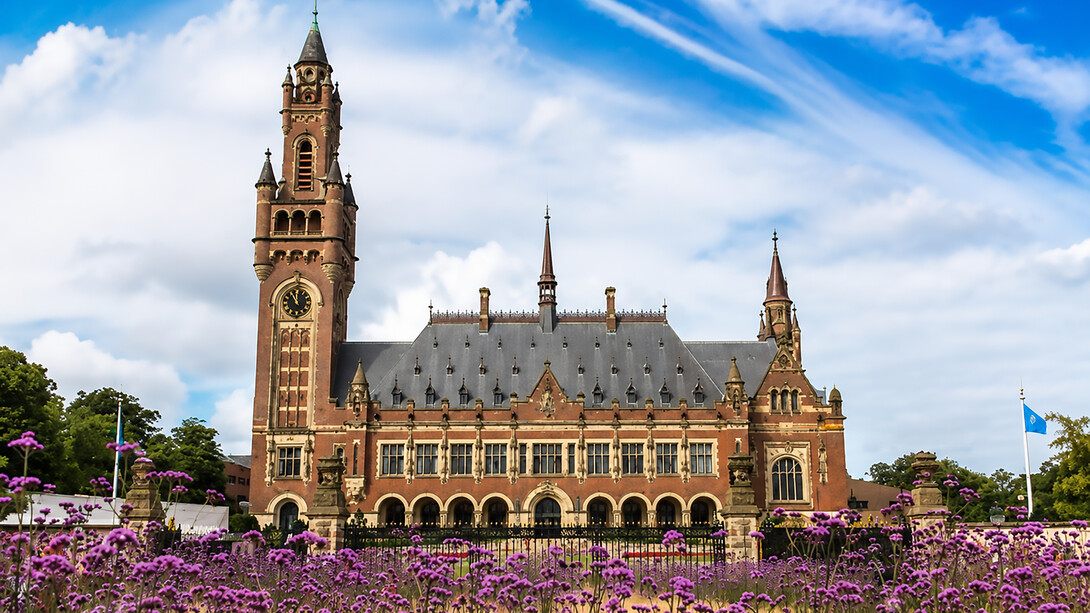
The Hague, or Den Haag as it is known in Dutch, exists in a fascinating contradiction. It is the political heart of the Netherlands, the residence of the Dutch royal family, and the judicial capital of the international community, yet it is not officially the nation’s capital. Amsterdam may hold the constitutional title, but The Hague possesses the gravity of governance and diplomacy. Here, ministers debate national policy behind historic facades, ambassadors move between embassies shaded by chestnut trees, and international courts deliberate on questions of war, peace, and justice that shape the modern world. Yet despite this immense geopolitical significance, The Hague never feels intimidating or austere. Instead, it carries itself with remarkable composure and understated elegance, softened by broad boulevards, expansive parks, and the ever-present winds drifting inland from the North Sea.
The city’s atmosphere is immediately distinct from the frenetic energy of Amsterdam or Rotterdam. The Hague feels spacious and dignified. Streets are wider, traffic calmer, and the architecture more refined. Elegant mansions stand beside embassies and ministries, while tramlines glide quietly beneath rows of linden trees. There is a sense that the city was designed not merely for commerce, but for governance, diplomacy, and contemplation.
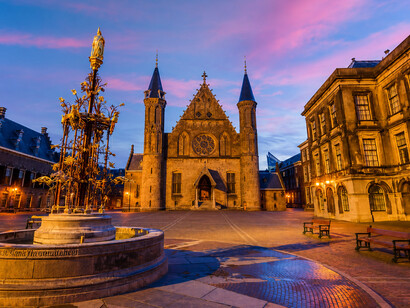
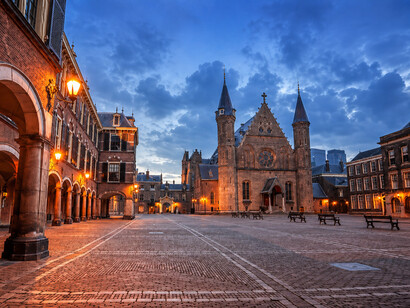
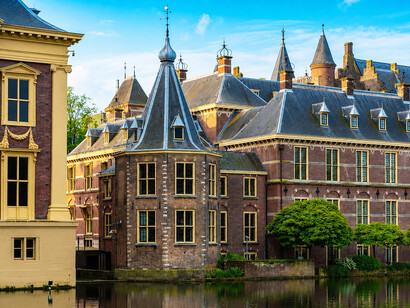
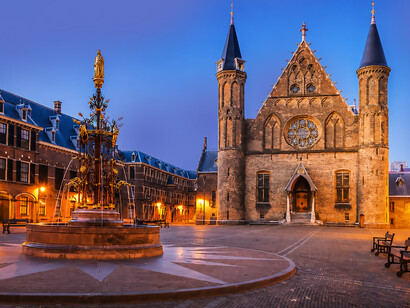
At the centre of this political and historical identity stands the Binnenhof, the ancient complex that has served as the nucleus of Dutch politics for more than eight centuries. Emerging unexpectedly from the surrounding modern cityscape, the Binnenhof feels almost mediaeval in spirit. Passing through its stone archways into the enclosed courtyard is like stepping into another era, where Gothic facades and pointed towers evoke the atmosphere of a royal court rather than a modern parliamentary centre.
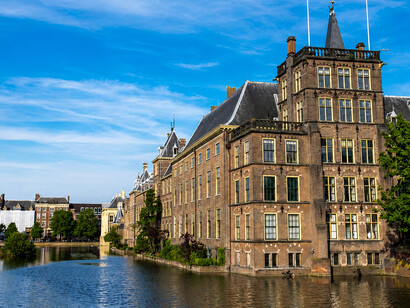
Dominating the courtyard is the Ridderzaal, or Knight’s Hall, with its twin towers and richly ornamented Gothic architecture. For centuries, this hall has played a ceremonial role in Dutch political life, including the annual Prinsjesdag speech delivered by the monarch. Yet the true beauty of the Binnenhof reveals itself from across the Hofvijver, the tranquil Court Pond that mirrors the complex in its still waters. Here, mediaeval stone buildings are reflected alongside the sleek outlines of modern office towers rising in the background. The contrast is striking yet harmonious, embodying the Netherlands itself: a nation deeply conscious of its history while firmly orientated toward the future.
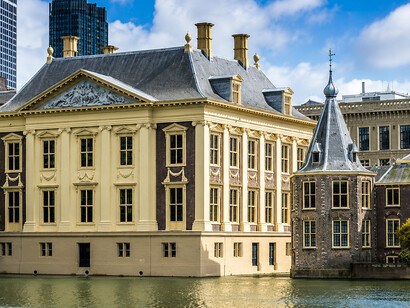
Adjacent to the Binnenhof lies one of Europe’s most extraordinary art museums, the Mauritshuis. Housed within an elegant 17th-century mansion, the museum possesses an intimacy rarely found in the world’s great galleries. Unlike sprawling institutions that overwhelm visitors with endless corridors and monumental collections, the Mauritshuis invites slow and focused contemplation. Its softly lit rooms feel almost domestic, allowing viewers to encounter masterpieces at a human scale.
Within these walls hangs the essence of the Dutch Golden Age. Rembrandt’s dramatic use of shadow, Frans Hals’ lively portraiture, and Jacob van Ruisdael’s luminous landscapes all find a home here. Yet the museum’s emotional centrepiece remains Johannes Vermeer’s Girl with a Pearl Earring. Standing before the painting is an unexpectedly personal experience. The girl’s enigmatic gaze, suspended somewhere between innocence and melancholy, possesses a quiet magnetism that no reproduction can truly capture. In the stillness of the Mauritshuis, art ceases to feel historical and instead becomes profoundly immediate.
Beyond the compact historic centre, The Hague unfolds into sweeping avenues and gracious residential districts that reinforce its reputation as the most elegant city in the Netherlands. The Lange Voorhout, often regarded as the country’s most beautiful boulevard, epitomises this refined character. This broad avenue, shaded by rows of ancient linden trees, is lined with aristocratic mansions and cultural institutions that reflect centuries of wealth and political influence. In spring, carpets of crocuses bloom beneath the trees; in autumn, golden leaves drift slowly across the pavement, transforming the boulevard into a living painting.
Walking along the Lange Voorhout encourages a slower pace of travel. Cafés spill discreetly onto the sidewalks, diplomats cycle past government officials, and locals stroll with an effortless calm rarely associated with political capitals. Among the avenue’s cultural treasures is Escher in Het Paleis, a museum dedicated to the Dutch graphic artist M.C. Escher and housed within a former royal palace. Inside, impossible staircases, distorted perspectives, and visual illusions challenge the viewer’s perception of reality itself, offering a surreal counterpoint to the city’s otherwise measured elegance.
Yet The Hague’s identity extends far beyond national politics and artistic refinement. It is also one of the world’s most important centres of international law and diplomacy. More than 150 international organisations are based here, earning the city its title as the “International City of Peace and Justice". This global mission finds its architectural expression in the Peace Palace, or Vredespaleis, perhaps the city’s most symbolically powerful landmark.
Constructed in the early 20th century with financial support from Andrew Carnegie, the Peace Palace houses the International Court of Justice and the Permanent Court of Arbitration. The building itself is an extraordinary example of international cooperation. Nations from around the world contributed materials, artworks, and decorative elements, turning the palace into a monument not only to law but also to shared human aspiration. Its Neo-Renaissance towers rise above manicured gardens with solemn grandeur, embodying the enduring ideal that conflicts between nations can be resolved through dialogue and justice rather than violence.
Yet for all its diplomatic prestige and royal sophistication, The Hague harbours a final and surprising dimension: it is also a seaside city. A short tram ride from embassies and ministries leads to Scheveningen, the Netherlands’ most famous coastal resort. Here, the atmosphere changes completely. The polished quiet of the city centre gives way to the raw energy of the North Sea. Waves crash against the shore, seagulls wheel overhead, and salty wind sweeps across vast stretches of sand.
Scheveningen’s broad beach and lively promenade have attracted visitors for generations. At its centre stands the Kurhaus, an opulent 19th-century hotel whose grand facade recalls the golden age of European seaside tourism. In summer, fashionable beach clubs fill with music and candlelight as the sun sinks into the horizon. In winter, the coastline becomes something entirely different: windswept, austere, and deeply atmospheric, ideal for long contemplative walks through the dunes beneath stormy skies.
This relationship with the sea gives The Hague an emotional balance that few political capitals possess. The city can be formal without feeling rigid, intellectual without becoming detached, and international without losing its Dutch character. The constant presence of the coast softens the weight of diplomacy and history, reminding visitors that beyond the halls of power lies the elemental rhythm of wind, water, and sky.
The Hague ultimately reveals itself as a city of remarkable dualities. It is royal yet democratic, historic yet globally orientated, sophisticated yet deeply grounded in nature. It offers travellers not only museums and monuments but also a richer meditation on governance, culture, and coexistence. In The Hague, art, politics, and the sea exist side by side, creating a city whose quiet confidence lingers long after the journey ends.