English
 Español
 Français
 Deutsch
 Italiano
 Português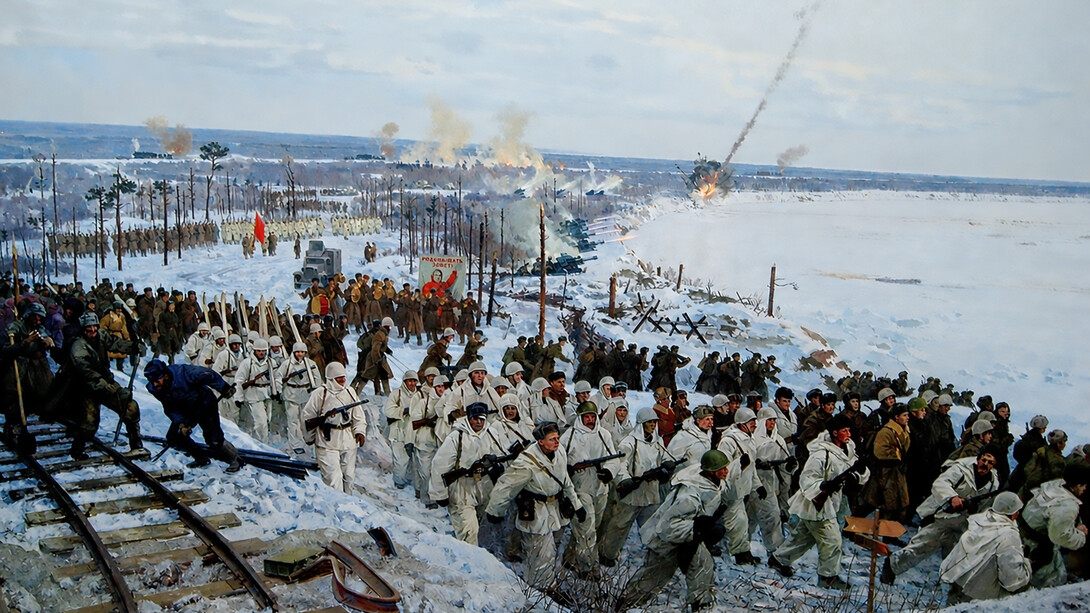
Throughout history, the siege of populations has been widely used as a strategy to force the surrender of the political and military forces defending the besieged territories. The fundamental reason for believing in the effectiveness of the siege was the starvation and disease inflicted upon the civilian population. Some sieges lasted months, others lasted years. All caused untold suffering to the populations, especially the civilian populations—those not directly involved in the fighting. The military and all the service personnel on whom they depended, as well as political leaders, always enjoyed certain privileges.
The history of the success or failure of sieges is fascinating. While it is true that many besieged populations succumbed, in many other cases they resisted and forced the attackers to retreat. In times when populations were self-sufficient, the siege was literal, encircling the walls, preventing entry and exit, and often resorting to the “scorched earth” tactic: burning crops, slaughtering livestock, and poisoning wells. Since the modern era, with the globalization of capitalism and the liberalization of international trade in goods (and people), so many forms of interdependence have been created among peoples that new instruments of encirclement have been made available to the attackers (ghettos, blockades, embargoes, sanctions, anti-immigration policies, closed airspaces, international criminalization of political leaders, etc. ). Conversely, such interdependencies have made new tactics of resistance possible for besieged populations.
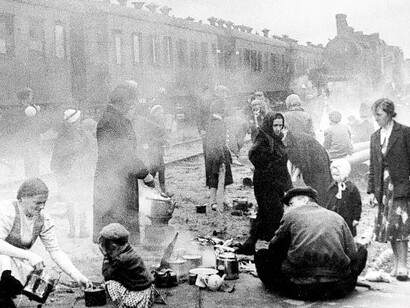
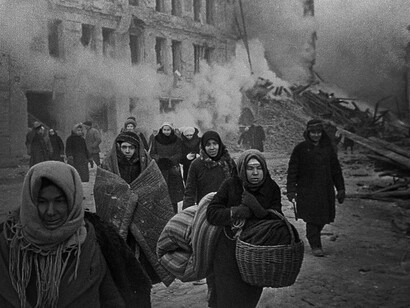
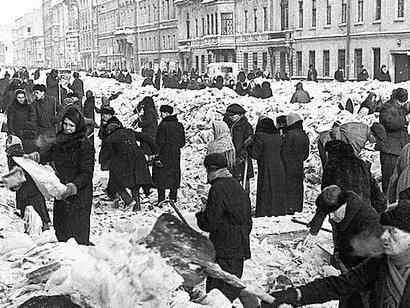
It is not the aim of this text to analyze the military potential of sieges. I focus exclusively on the human suffering that sieges inflict on besieged civilian populations. To illustrate this suffering, I choose the most brutal siege in contemporary history: the Nazi army’s siege of Leningrad between September 1941 and January 1944. I choose it for its brutality, but also because it illustrates a case of the attacker’s defeat—an enemy considered all-powerful at the time of the siege. I do so with Cuba and Palestine in mind. Above all, bearing in mind that the media has played the nefarious role of trivializing suffering, even when it appears to dramatize it. For this reason, a global population horrified and mobilized against unjust human suffering is not created. Instead, the burden of conscience is delegated to small groups of courageous activists who, by their very nature, reveal both the possibility of resistance and the inevitability of their defeat.
Since I focus on human suffering, I draw on descriptions of the siege by those who lived through it. Their descriptions are more powerful than any abstract analysis. Among many descriptions, I have selected that of Constantine Krypton (pseudonym?) published in 1954 in the journal Russian Review, vol. 13:4, pp. 255–265.1 It is a long quotation (with adaptations):
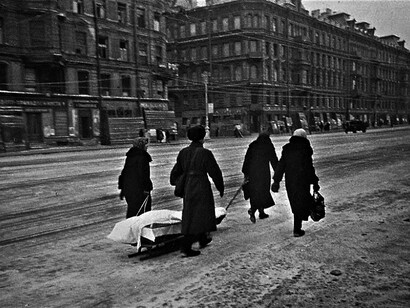
The enemy failed to destroy the stone buildings; what it did achieve was a terrible annihilation of the life within them. The main cause of destruction among the population was starvation. According to the official 1939 census, the population of Leningrad was 3,191,304 inhabitants. The process of annihilating the population began in late November 1941. Its outward sign in city life was the appearance on the streets of all kinds of sleds, mainly children’s sleds tied together with corpses on them. Later, the dead were often transported in individual sleds, especially if they were longer. They wrapped the corpses in sheets, blankets, rugs, sacks of all kinds, and all sorts of rags. Day after day, the number of these sleds increased, creating, during a certain period in late December and early January, an endless procession along the main streets.
The death process of the Leningrad population received in medical parlance the name of "dystrophy." Dystrophy had three stages. Dystrophy of the first stage was characterized by a general weakening of the system and a great loss of weight. Dystrophy of the second stage brought still greater weakness and loss of weight together with a series of illnesses bearing in particular the following symptoms: scabious gums, the quivers ("ants") in the upper parts of the abdomen, ulcers, swelling, numbness, stomach trouble, and the like. These symptoms were already present in part in the first stage. In the second stage, people began, as the saying went in those days, "to devour their muscles." Dystrophy of the third stage, lasting two weeks on average, was characterized by a complete breakdown of the person, then death. It was said that those who passed into the third stage of dystrophy could not be saved. I happened to observe two cases in which relatives of a bedridden dystrophic person obtained butter and other nourishing foods, but it was absolutely impossible to give any real relief.
People who had entered the critical period remained indifferent to everything around them, in a state of complete apathy. People would collapse and die unexpectedly while walking down the street, standing in line, at work, or at home.
Once, upon arriving at the institute, where in the chill, unheated rooms classes of three or four persons were still going on, I was literally attacked by a rather short man. To me, as a dean of faculty, he very emphatically expressed his indignation that so few students were coming to the classes. It seems that this man was a teacher of mechanical drawing, whom I had not yet met. In the coming semester, he was to give a course. As to the number of students, he was to have seven. Then I said, "The fact that you have seven students, instead of the usual four or five, shows notable progress, which can only be explained by great interest in your subject." This pacified him somewhat, but moving toward the group of students, he shouted with all his might, "Yes, but I want to have 25 students. I want to strive for one hundred per cent." Thirty or thirty-five minutes later, a young woman student came running to me to report that the teacher of mechanical drawing was dead.
An exceptional death rate was established in the ranks of those who were completing their studies. Here, competition took its toll. These people, despite all the obstacles, wanted to complete their graduate work and complete it well. Without food, in chilly dormitories, they stubbornly labored and wrote their papers. They didn't live long after that, some ten to fifteen days. Too much serious intellectual effort on an empty stomach had sapped whatever reserve strength they had.
In the opinion of physicians, at the beginning of December 1941, a great percentage of the Leningrad population was in the second stage of dystrophy. The month of December was the transition period into the second stage for the great mass of the population. Living conditions contributed heavily to this. The food distribution for December became utterly insignificant. Workers received 200 grams of bread a day; civilian employees and dependents received even less. The ratio of cereal made it possible to prepare soup only three or four times a week. Potatoes had been distributed for the last time in September. The number of workers' cards (first category) providing more bread and cereal was strictly limited. One holding a professorship in the higher schools of an institute received these cards only in January 1942, but docents, graduate students, and others had the cards of civilian employees (second category).
Private supplies belonging to the population, which played such a large role in the succeeding months, were exhausted toward the middle, or at the latest, toward the end of November. During this month the people were eating cats in the city. Standing in line for ration cards for December, I involuntarily overheard the conversation of some students. They had found that the meat of cats was very palatable; it was something like rabbit, and only one thing about it was unpleasant—killing the cat. Cats defend themselves desperately. But soon I heard no more such conversations—there were no more cats to be killed. In December, people began to eat rats, mice, and pigeons. To an elderly woman who was dying, her young niece brought half a rat, which she had succeeded in catching, and gave it to her. Nevertheless, the dying woman and her niece, together with their relatives, died soon thereafter. Next came dogs. But these were few in number, too.
The muscles were the basic source of life. Doctors specifically recommended that people walk less and use this resource more sparingly, since they would not be able to replenish it.
Under special conditions, NKVD (People’s Commissariat for Internal Affairs) workers, war staff personnel, leading party cadres, and most responsible workers received food rations. These people, of course, did not know hunger. Party members had certain privileges. However, apart from extra portions of soup without ration cards and one or two additional cards, these privileges did not exceed the legal quota. Those who had some connection to food supply, such as a meal service at an institution, fared a little better. The food situation for some much-needed members of the engineering technical staff was better. They were required to live in government facilities, where they were fed in special dining halls and received some food to take with them. However, when one of the engineers took his mother to share his food with her, he received a reprimand from the director. The better food was intended to ensure their maximum work capacity. The mother had to go straight home to share the common fate of the population.
In late November and early December, the German air raids came to an end. This, it seemed, might facilitate the implementation of medical advice on conserving physical energy. The population could sleep peacefully at night; there would be no need to rush to air-raid shelters or put out fires. However, instead of the bombings that had exhausted their physical strength, life took on something new and more arduous. First of all, the trams had completely stopped running in the city. While a succession of sleds carrying corpses moved along the pavement, on the sidewalks—and sometimes in the streets—there were large numbers of people walking, since they lacked any other means of transportation. Wherever one went, one had to go on foot: to work, to run various errands, or simply to visit neighbors’ homes. Everyone had to make a colossal effort and expend an extraordinary amount of energy. A great misfortune was the onset of the cold and, later, the extreme cold of winter, reaching minus 58 Fahrenheit.
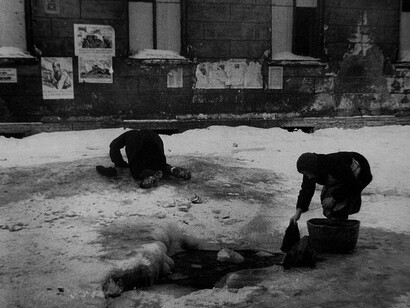
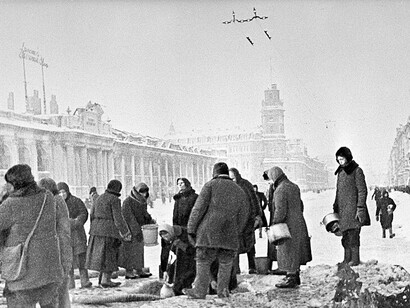
All efforts to save the water system were in vain, and the entire population of the city began to head to the nearby pumps that were still in operation. For a long time, a hole in the street caused by an artillery shell, an eight- or ten-minute walk from our house, saved me. There was always water there, which people from nearby apartments came to fetch. Many people, having neither a pump in the neighborhood nor holes in the street, had to walk long distances, sometimes all the way to the river, to fetch water. The bathroom problem was solved by dumping everything into the snow in the backyard.
It was impossible to heat those rooms. One had to sleep fully clothed, wearing every piece of clothing available to stay warm. Due to the cold and the lack of water, many people stopped washing altogether. Irretrievably frozen kitchens and guest rooms were turned into storage areas. Bathrooms were often built here. An extremely difficult circumstance was the complete lack of electric light. Small, smoky lamps from the Civil War era cast just enough light to allow someone to move around the room.
In Leningrad, meanwhile, at the end of December and in January, the situation took on a catastrophic character. The number of those dying each day jumped to between 25,000 and 30,000. Possibly for the part of the population that was dying, this was the natural transition into the critical period with its inevitable consequences. The administrative powers, literally overwhelmed by the increasing death rate, gave orders to open the morgues. These sprang up in the yards of Leningrad houses. One yard of large dimensions was chosen for every seven to ten houses, depending on the number of residents. A sign was hung out, and through the house manager, a suitable notification was made. Everyone could now take their dead to the morgue.
Trucks were assigned to remove the bodies from the streets, but these were often in poor condition. It was hard work for the truck loaders. Often, in the middle of their tasks, they would drop dead, and it was necessary to find replacements. On average, ten or twelve trucks loaded with corpses passed through our street every day. On the main streets, their number was much greater.
Although most people, regardless of their suffering, remained remarkably composed, reports of particularly aggressive behavior were occasionally heard2. In the middle of December, an acquaintance of mine, an old woman, whose daughter was in a concentration camp, came onto the street, holding her beloved dog on a leash. The dog had been with her for a very long time. Before the old woman knew it, several men rushed at her. Some wanted to grab the dog; others tried to snatch the leash from her hand. They all vied with one another, shouting, "It's my dog." At this point some other pedestrians came up just in time to stop the attackers and drive them away. The old woman returned thankfully to her home with the dog, but even so, in three or four weeks, she ate the animal herself.
People were advised to walk cautiously on the dark stairways in the early morning. Cases occurred when on the assumption that a person was going for bread, someone would hit him on the head and would take away his ration cards. Usually, it was necessary to be cautious on these dark stairs once the bread was procured. Bread had to be carried, wrapped, and hidden. Sometimes, in the lines on the premises of the store, boys ventured to snatch the bread from the owners. They watched for a suitable moment and then dug their teeth into a piece of bread in someone's hands, trying to bite some off. One such scene I happened to observe myself. The owner of the bread into which the little boy had sunk his teeth grabbed him with great violence by the throat and wouldn't let him swallow; then, bursting into tears, she said that she had a little boy like him who was dying at home.
All these things were individual excesses, resulting in a certain increase in lawlessness. One could even speak of new types of “crime.” One of them was called “hiding corpses.” By keeping the corpse at home for about a week and concealing the death, some people managed to accumulate enough bread on the deceased’s ration card to pay for the digging of the grave. Others did it to keep the deceased’s bread and other ration cards for personal use. Preserving a corpse in the freezing apartments of that era was no difficult task.
I knew a civil servant who managed to hide her dead aunt for nearly a whole month. Later, she regretted not having done the same with her mother, who had died two or three days before her aunt. Later still, she herself died, and a neighbor managed to hide her as well for five days. In practice, it was difficult to use a dead person’s ration cards for more than twelve or fourteen days. Moreover, only a small percentage of the population engaged in this practice.
During the second half of January, it was said that the death rate had dropped to 9,000 or 10,000 per day. This may have been due to the fact that the weakest people had already died or, possibly, to a change in the quality of the rationed bread. In any case, the improvement in conditions was short-lived. A new misfortune descended. The heavy frosts and the general run-down condition of the city's buildings led to a breakdown of work in the city bakeries, and the greater part of the stores remained without bread. In some stores where bread was received, tremendous lines formed and stood from early morning until late evening.
Masses of people, after waiting ten or twelve hours in the freezing temperature, left empty-handed. In about a week, only a very small amount of rationed bread came on sale. The lack of bread, together with the extreme exhaustion caused by waiting in the cold, shot the death rate up at once to the former figure of 25,000 to 30,000. Some people died in line; many died on the streets after running desperately from store to store to inquire whether there was any hope of a bread delivery.
At the beginning of 1942, some events occurred that were very embarrassing to the military and civilian powers of the city. Crowds of people who had been standing in line robbed several bread stores. More far-reaching than the pillaging of a few food stores, considering the particular conditions of Soviet life, was an occurrence of political significance.
Two organizations of women (technical engineering workers) joined together and presented a petition in which they requested, for the sake of the dying children, the surrender of the city. They pointed to the general practice of international relations and especially to the recent announcement that Paris would be declared an "open city." Whether this petition succeeded in reaching any representatives higher than Piotr Popkov, the chairman of the Leningrad Soviet, I have never learned. In the city the petition did not make much of an impression, though many people knew about it. Some women party workers actually discussed the matter with me, though I was not a party member, and, what is more surprising, they did not condemn the women who had drawn up the petition.
The brutality of the human suffering during the Siege of Leningrad—one and a half million dead—is not qualitatively different from the many colonial and imperial genocides between the 16th and 20th centuries: the various genocides of indigenous peoples of the Americas and Africa by European colonizers and their descendants, the genocide of the Herero and Nama peoples of Namibia by the German Empire between 1904 and 1908, the genocide of the Armenian people between 1915 and 1923 by the Ottoman Empire, the genocide of the Jewish people by Nazi Germany, mainly between 1941 and 1945, the genocide of the Tutsi people by the Hutu elite in Rwanda in 1994, the genocide of Bosnian Muslims by Serbian forces between 1992 and 1995, and the genocide of the Rohingya people by the Myanmar army and police over the past two decades.
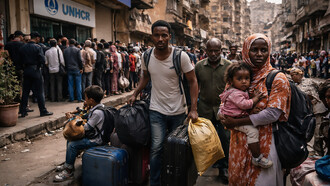
What distinguishes Leningrad is the siege strategy taken to the extreme. The same siege strategy is underway, in different ways, in Palestine and in Cuba. Despite its extremism, the siege of Leningrad was repelled, and I am confident that sooner or later it will also be repelled in Palestine and in Cuba. For this, international solidarity is essential. If Cuba and Palestine do not break the siege, we will all be defeated, waking up too late to the fact that the siege around Palestine and Cuba is already taking root around us, multiplying like the Lernaean Hydra, thanks to our passivity. It is beginning to be too late for Hercules’ intervention!
Cuba will prevail! Palestine will prevail!
Notes
1 This is an abridged translation of two chapters from the author’s book, Osada Leningrad, N.Y., Chekhov Publishing House, 1952. This account has its limitations, especially in light of the official documentation and diary archives that came to light later. It makes the history of the siege even more dramatic. For further reading on this subject, see Sarah Gruszka, “L’historiographie du siège de Leningrad,” Revue des études slaves, Vol. 83:1, 2012, pp. 269–281.
2 According to Gruszka, op. cit., there was a great deal of crime, some of it very serious. This includes cannibalism and the trade in human flesh. These crimes were severely punished. The punishment for political crimes was equally severe.