English
 Español
 Français
 Deutsch
 Italiano
 Português
Have you noticed how every influencer sounds exactly the same now? It's not just what they say; it's how they say it. The pauses, the tone, the way they frame emotions—it's all weirdly uniform. You hear it most in podcasts. That soft, intimate voice that sounds spontaneous but is actually completely calculated. What feels natural is actually learned behaviour.
Influencer speech exists in this tiny corridor. It has to sound personal without getting uncomfortable. Emotional without being unstable. Ironic without being political. This is why the same words keep coming back: delulu, brat, unhinged, healing era. These aren't just words describing feelings. They're pre-approved ways of expressing those feelings. They're linguistic safety nets. When an influencer uses them, they're signalling that whatever comes next will be relatable, readable, and ultimately harmless.
Take "delulu". It started as a self-aware joke about living in fantasy. But by 2024, it transformed into something more insidious: the idea that delusion is actually a strategy. "Delulu is the solulu" spread everywhere, not because it was clever but because it fit perfectly into our moment. When real stability feels impossible, delusion gets repackaged as optimism. And optimism gets framed as your personal responsibility. If things don't work out, it's quietly your fault for not believing hard enough.
The same thing happened to "brat". That word used to mean something. It meant excess, refusal, and social friction. But in June 2024, Charli XCX released an album with lime green cover art and the word "brat" in a blurred Arial font. The album became a phenomenon. Summer 2024 was suddenly "brat summer". It was positioned as a reaction to the tyranny of the “clean girl aesthetic”—that hyper-curated, poreless, wellness-coded femininity that had colonised Instagram. Brat was supposed to be messy. Chaotic. Unfiltered. The opposite of the controlled perfection everyone was suffocating under. For maybe thirty seconds, there was an actual moment where something felt like resistance. But then the algorithm noticed.
The moment "brat" became searchable, it got productised. The lime green became commercial. Everyone performing their own version of messiness for content, their phones already out, their captions already written. Authenticity became another aesthetic to monetise. And the word itself, which briefly promised refusal, just became another way to say, 'Here's my curated version of being uncontrolled.' " It got absorbed not because it was dangerous but because the infrastructure of platforms is designed to turn everything into content.
But the most revealing transformation is "unhinged". That word was about instability, loss of control. It got briefly reclaimed online as a way to mock emotional norms. But now? In the influencer ecosystem, "unhinged" is a genre. Emotional outbursts are timed, edited, and packaged. Vulnerability isn't something that happens anymore—it's something you produce. What gets rewarded isn't honesty. It's legibility. You can be vulnerable, but only in very specific, manageable ways.
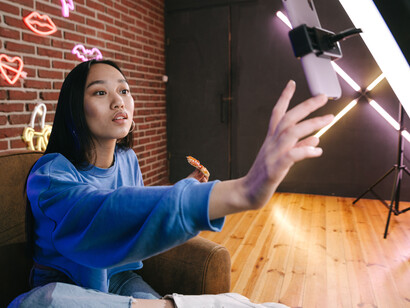
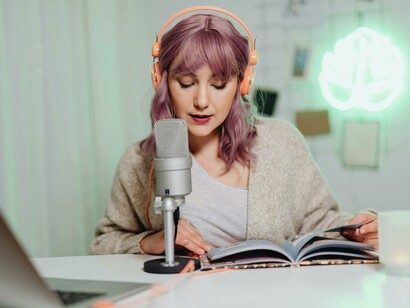
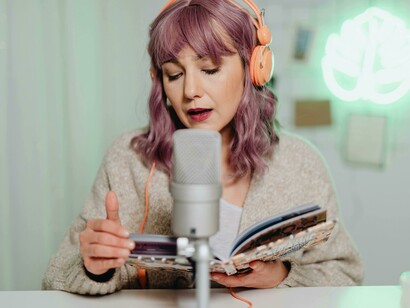
I've been listening to podcasts about influencer culture lately, and one thing keeps coming up: this way of speaking creates the illusion of closeness without any of its obligations. Influencers talk like they're confiding in a friend, but the relationship is completely one-sided and monetised. Their voice is warm but never uncertain. Open but never actually at risk. It's designed to hold your attention without demanding anything real in return.
This is why the language of 2024 and 2025 feels so soft. The dominant words don't confront instability—they cushion it. They don't name power, they name mood. Instead of conflict, they offer atmosphere.
Look at what's circulating right now: "low effort era", "emotionally offline", and "background peace". These all describe the same thing—withdrawal without absence, detachment without refusal. Nothing breaks. Nothing escalates. Everything just drifts.
Even the whole "Word of the Year" thing feels pointless now. What defines 2025 isn't a single word. It's a tonal consensus. Language is used less to explain the world and more to make it tolerable. Words become ambient. They soothe instead of clarifying. They help you adapt, but they don't help you understand.
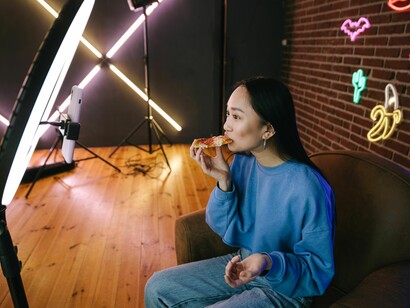
What's really happening here is this: influencers aren't just speakers anymore. They're interfaces. Their language has to satisfy the algorithm as much as it satisfies you. It has to be endlessly repeatable, emotionally legible, and commercially safe. Over time, this creates sameness. Different faces, different accents, but the same rhythm, the same expressions, and the same carefully neutralised emotions.
This isn't about creativity dying. It's about meaning getting compressed. Language still moves fast, but it moves within tighter boundaries. Slang used to be a way to escape dominant narratives. Now it gets absorbed into them immediately. Words that used to carry contradiction get streamlined into formats.
The problem isn't that these words exist. The problem is what happens when speaking outside of them starts to feel risky or awkward or invisible. When language stops opening up possibilities and starts quietly enforcing them, it's not reflecting culture anymore. It's managing it.
And we're all just going along with it, one "delulu" at a time.
Right now, in 2024-2025, the circulating vocabulary has narrowed even further. You've got "sigma"—supposedly meaning independent and self-reliant but mostly deployed ironically to describe delusional narcissism. "Crash out", which means losing all emotional control. "Aura farming", the deliberate curation of your image for social capital. "Rizz", which is charisma but flattened into a perfectly legible aesthetic. "Slay" dominance but defanged into general praise. "No cap", meaning truthfulness. Glaze", giving excessive compliments. " "Yapping", talking too much. Tea', gossip. Each of these does work, but they're all doing it within incredibly narrow parameters. They're approved vocabularies. They're what you're allowed to feel and say if you want to be legible on a platform, understood by an algorithm, and part of the visible discourse. The words circulate. People use them. They feel like language. But they're architecture. They're infrastructure. They're the algorithmic selection process made audible.
And maybe that's the real story. Not that influencers are choosing to sound the same, but that the environment rewards sameness so relentlessly that difference becomes unimaginable. The platforms don't work for experimental language. They work for recognisable, repeatable, monetisable language. And once that's the only language being rewarded, it becomes the only language people learn to use. The algorithm doesn't just spread words—it shapes how people think about what's sayable, what's intelligible, and what's even possible to express. Language contracts. Vocabulary narrows. And what emerges is something that looks like speech but functions like a filter—legible but hollow, emotional but without stakes, personal but completely standardised.