English
 Español
 Français
 Deutsch
 Italiano
 Português
From rhythmic tailoring to architectural minimalism, Courrèges SS26 reveals how sound becomes cut, movement becomes construction, and the future of the house is quietly engineered through precision.
Cut to the beat: how Courrèges SS26 translates music into structure — and prefigures the language of FW26
In an era where fashion increasingly oscillates between spectacle and conceptual emptiness, Courrèges stands apart by returning insistently to fundamentals: line, cut, rhythm, and movement. The SS26 collection does not attempt to overwhelm through excess imagery or historical overload. Instead, it proposes a subtler yet more demanding proposition—one where music is not an accessory to the show but an internal logic shaping how garments are cut, assembled, and worn. Through this collection, Courrèges articulates a design philosophy that treats sound as structure, tempo as tailoring, and repetition as form-making.
This approach situates Courrèges not only as a guardian of modernist heritage but also as one of the most structurally intelligent and forward-looking brands in contemporary fashion. By closely examining the musical undercurrents of SS26 and their translation into cutting techniques, we can begin to see how the house is already sketching the contours of its FW26 direction—one rooted in controlled futurism, modularity, and architectural restraint.
Music as an invisible pattern
Unlike brands that use music primarily as emotional amplification or nostalgic reference, Courrèges employs sound as an organisational principle. The SS26 soundtrack is marked by electronic minimalism, a steady tempo, and restrained escalation—a sonic landscape built on repetition rather than climax. This musical choice mirrors the brand’s visual economy: no unnecessary ornamentation, no gratuitous flourish.
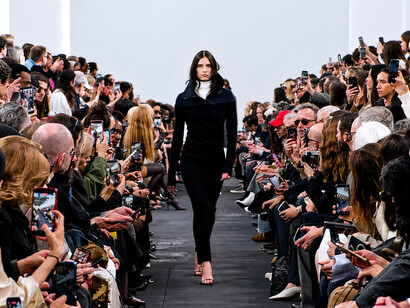
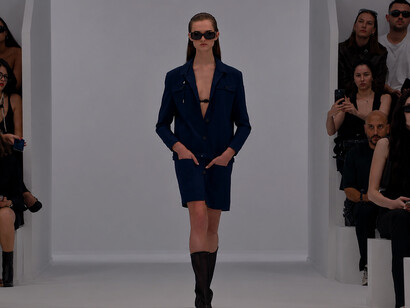
The rhythm of the music establishes a temporal grid, against which the garments are measured. Each look appears almost calibrated to the beat—hems align with rhythmic cycles, seams repeat like loops, and silhouettes advance with mechanical clarity. The result is not choreography in the theatrical sense, but precision in movement, where the body becomes an instrument activating the garment.
This approach recalls the modernist belief—central to André Courrèges’ original vision—that fashion should align with the tempo of contemporary life. SS26 reinterprets this idea through a contemporary lens, where digital rhythms and urban soundscapes replace the Space Age optimism of the 1960s. Music becomes an invisible pattern, guiding how garments are structured rather than how they are emotionally read.
Cutting techniques as rhythmic architecture
At the core of SS26 lies a mastery of cutting techniques that privilege clarity over complexity. The garments are not minimal because they lack construction; rather, they are minimal because construction has been reduced to its most efficient expression.
Key cutting strategies dominate the collection:
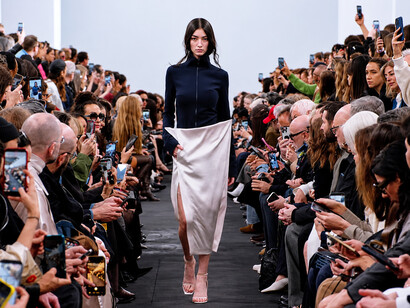
Geometric panelling, often symmetrical, creating visual beats across the body.
Sharp vertical and horizontal seams, echoing musical bars and measures.
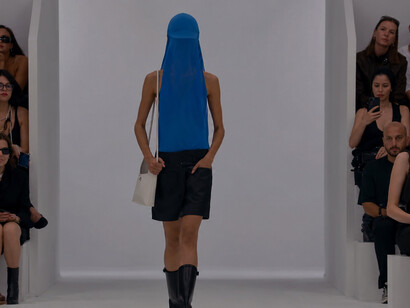
Controlled volume, achieved through precise insertion rather than draping.
Repetition of shapes, suggesting loops and refrains.
These techniques function much like musical motifs—reintroduced across different garments, slightly altered in proportion or placement, but always recognisable. A cropped jacket and a sleeveless dress may share the same seam logic, just as different tracks in an album share a rhythmic signature.
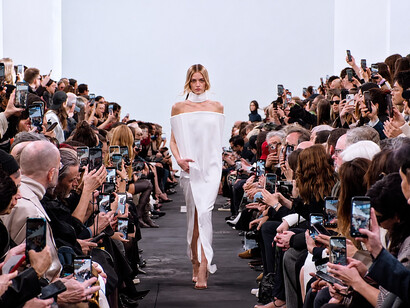
Notably, Courrèges avoids romantic fluidity. There is little in the way of soft drape or organic collapse. Instead, the cut maintains structural tension, holding the body in a state of poised readiness. This tension is crucial: it creates a visual hum, a sense that the garment is always on the verge of movement, even when static.
The body as a moving metronome
SS26 positions the wearer not as a passive figure but as an active participant in the garment’s rhythm. As models walk, the clothes do not flutter dramatically; they respond with measured precision. Panels shift, hems lift slightly, surfaces catch light momentarily—micro-movements that register like subtle changes in sound frequency.
This relationship between body and garment suggests a future-orientated vision of wearability. Courrèges does not design for spectacle alone but for daily urban motion—walking, turning, commuting, and inhabiting space. The clothes appear engineered for repetition, for being worn again and again, much like a favourite track replayed endlessly without losing relevance.
In this sense, Courrèges offers an alternative to both hyper-theatrical runway fashion and nostalgic romanticism. Its modernity is not loud; it is calibrated.
Material choices and sonic texture
Just as music relies on texture as much as melody, SS26 uses materiality to deepen its rhythmic logic. Smooth technical fabrics, structured cottons, and lightly reflective surfaces dominate the collection. These materials do not absorb sound metaphorically; they reflect it, visually reinforcing the idea of clarity and precision.
There is a notable absence of heavy embellishment or tactile excess. Instead, texture is controlled, almost muted—allowing cut and construction to remain the primary communicators. This restraint suggests a brand confident enough to let structure speak louder than surface.
Such material discipline hints strongly at FW26, where we can expect Courrèges to further explore hybrid textiles—materials that balance rigidity and flexibility, possibly incorporating technical innovations while maintaining visual austerity.
SS26 as a blueprint for FW26
While SS26 stands firmly on its own, it also functions as a conceptual rehearsal for what Courrèges may unveil in FW26. Several trajectories emerge clearly from this collection:
Increased modularity: the repeated seam structures and interchangeable proportions suggest a future emphasis on modular garments—pieces designed to layer, detach, or reconfigure. FW26 may explore garments that adapt across climates and contexts, reinforcing Courrèges’ functional modernism.
Sharper architectural silhouettes: SS26 already leans toward controlled geometry. FW26 is likely to push this further, introducing more pronounced volumes, sharper shoulders, and sculptural outerwear that amplifies the brand’s architectural DNA.
Darker, more concentrated palette: while SS26 remains light and precise, FW26 may deepen its chromatic focus—introducing blacks, charcoals, metallic greys, and muted tones that enhance structural visibility and align with winter’s density.
Sound-inspired detailing: music’s influence may evolve from rhythm to frequency and vibration, expressed through ribbing, repeated fastenings, or surface patterning that visually suggests sound waves or oscillation.
Courrèges and the future of fashion modernism
What makes Courrèges particularly promising today is its refusal to confuse futurism with novelty. Instead of chasing trend cycles, the brand commits to a coherent modernist language—one that evolves incrementally but decisively.
In a fashion landscape saturated with archival recycling, Courrèges demonstrates that heritage can be a launchpad rather than a limitation. By focusing on cut, proportion, and movement, the house avoids nostalgia while remaining recognisably itself.
SS26 exemplifies this balance. It neither abandons the brand’s Space Age legacy nor reenacts it literally. Instead, it translates its founding principles into a contemporary grammar—one shaped by electronic music, urban mobility, and post-digital sensibilities.
Why Courrèges is a brand to watch
Courrèges’ strength lies in its intellectual consistency. Each collection builds upon the last, refining a language rather than reinventing it. This long-view approach is increasingly rare in an industry driven by immediate impact.
By aligning music, cutting techniques, and future projection into a unified vision, SS26 positions Courrèges as a house capable of sustained relevance. It appeals to a wearer who values clarity over chaos, structure over spectacle, and futurity grounded in discipline.
As FW26 approaches, Courrèges appears poised not for radical rupture but for architectural intensification—a deepening of its core values through sharper cuts, denser materials, and even more refined rhythmic logic.
Fashion in tempo
Courrèges SS26 reminds us that fashion, at its most powerful, operates like music: structured yet expressive, repetitive yet evolving, and precise yet alive. By cutting garments to the beat—literally and metaphorically—the brand reasserts the importance of discipline as a creative force.
In doing so, Courrèges does not merely present clothes; it proposes a way of moving through the world. One step at a time, in rhythm, with intention.
And if SS26 is any indication, FW26 will not shout its arrival. It will arrive exactly on time.