English
 Español
 Français
 Deutsch
 Italiano
 Português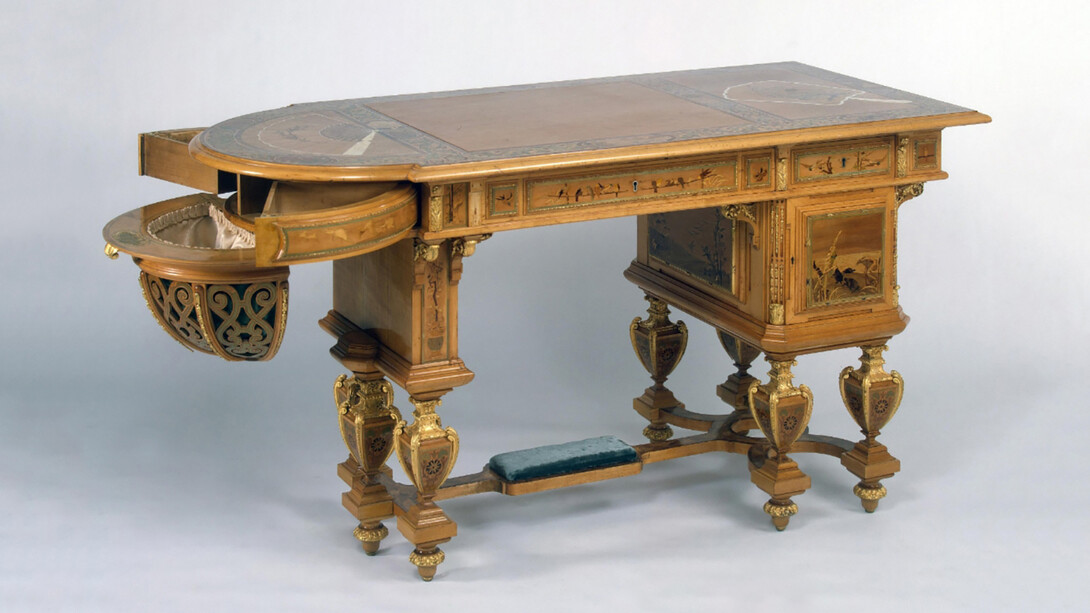
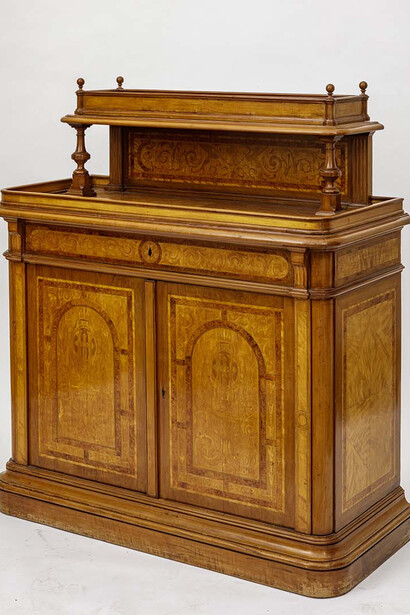
The Hermitage possesses the largest collection of furniture (more than 60 items) produced by Nikolay Svirsky's enterprise: among them are both "revival" pieces made in imitation of various historical styles and objects decorated using the marquetry technique. Almost all of these items are memorial pieces, connected with the history of the imperial family, primarily with Alexander III, who patronized this talented entrepreneur.
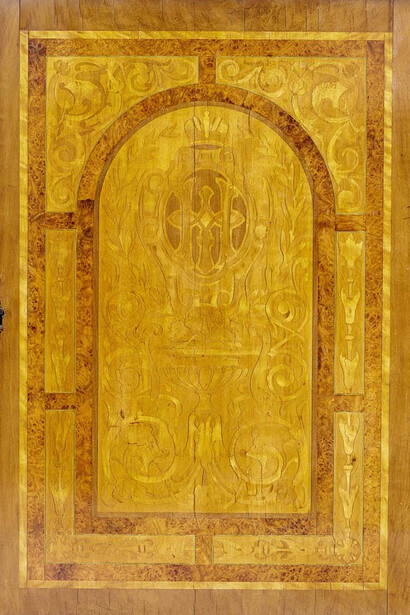
The main merit of Svirsky's products lay in his mosaic woodwork, executed using his "own method". Their distinctive feature is the intricate, jewellery-fine detailing of the assembled pattern, which, like works of painting, permitted the subtlest shades of colour to be conveyed. It is worth noting that it was craftsmen from his enterprise who participated in the decoration of the Gothic Library of Nicholas II, which survives to this day.
Visitors to the exhibition in the General Staff building can see furniture made for the apartments of Nicholas II’s family in the Winter Palace – a bureau from Empress Alexandra Feodorovna’s study, a display table from the bedroom, a bench and a lectern from the Gothic Library. The exhibition also includes a lady's writing desk that was displayed at the 1889 Paris World's Fair, pieces from the palace of Baron Pavel von Derviz on the English Embankment in Saint Petersburg, as well as a wooden scraper plane bearing the mark of Svirsky's workshop at 21 Kazanskaya Street and a file of French journals from his personal library.
A special section of the exhibition is devoted to the furniture from the yacht Polyarnaya Zvezda (“Pole Star”) – the principal seaborne residence of Emperor Alexander III’s family. In 1894, the yacht played an important role in the dynasty's history: it arrived in London carrying the Tsesarevich (soon to be Nicholas II), who sailed there to meet his future bride – Princess Alix of Hesse-Darmstadt, a granddaughter of Queen Victoria. During the First World War, the vessel lay up in Petrograd. During the revolution, it became the headquarters of Tsentrobalt (the Central Committee of the Baltic Fleet), and in 1918, it was part of the Baltic Fleet’s legendary Ice Cruise from Helsinki to Kronstadt. In the 1930s, the yacht was converted into a submarine tender.
During the Great Patriotic War, the yacht, frozen into the ice of the Neva opposite the Winter Palace, found a new, heroic mission. The crew of the Polyarnaya Zvezda laid electric cables to the basements and halls of the Hermitage, literally giving the museum light. The Polyarnaya Zvezda made its final voyage in 1961. Serving as a target for cruise missile tests, it sank in the Gulf of Riga.
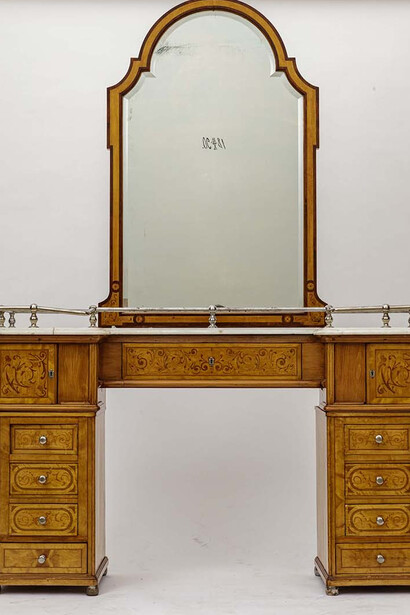
The objects that, together with the yacht, survived the era of empire, revolution, the siege and then its tragic demise have today found an eternal haven in the museum. They hold a special value for the Hermitage – artistic, historical and memorial. Thanks to the generous gift of the patron Mikhail Yuryevich Karisalov, the museum's collection was enriched in 2024 by unique pieces from the yacht's furnishings, which adorned the boudoir of Maria Feodorovna, the Emperor's study and the library. The exhibition features a mirror in a frame, two tables, an armchair, a dressing mirror, a half-cabinet bearing the elegant marquetry monogram MF and a cartonnier (ornamental container for papers).
In 1891, a correspondent for the Pravitelstvenny Vestnik [Government Messenger] wrote admiringly: "Regarding the interior decoration of the yacht, it must be said that it is something truly exceptional and perfect in its elegance; there is not gaudy, eye-catching splendour here, but there is artistic splendour...". One can see the truth of this judgement for oneself by visiting the exhibition in the General Staff building.