English
 Español
 Français
 Deutsch
 Italiano
 Português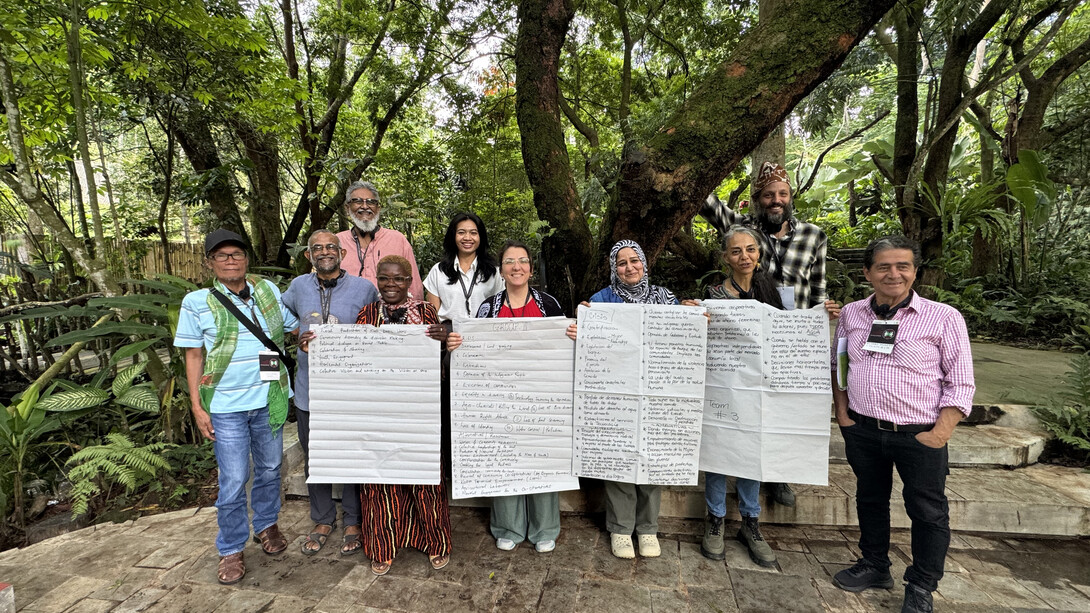
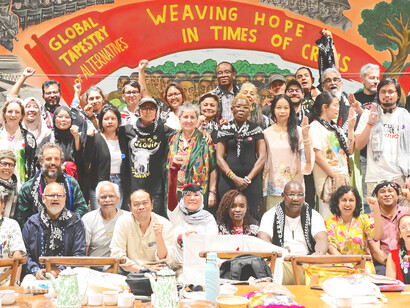
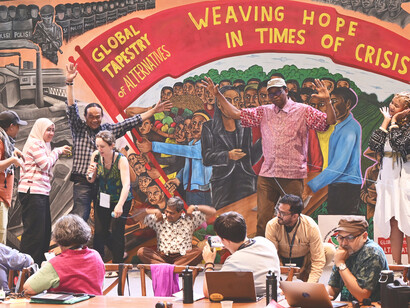
Hope. Esperanza. Harapan. These words were frequently invoked by the 70 participants of a 6-day gathering near the historic town of Bandung in Indonesia, in early April 2026. Hailing from about 25 countries primarily across Asia, Africa, and Latin America, we were at the 2nd physical Assembly of the Global Tapestry of Alternatives. Our purpose was to share, collaborate on, and promote radical solutions to the multiple crises the world is currently gripped in – war and genocide, gross inequality, ecological and climate collapse, ethnic and religious conflicts, a widespread slide towards authoritarian governments, and land-grabbing for both conventional industrial expansion and for the new ‘green colonialism’ (mining for critical minerals, mega-energy projects, etc). The stories that participants recounted were of despair, but also of hope and inspiration from remarkable initiatives of resistance and alternatives, led by Indigenous people and other local communities, women, marginalized genders and youth, farmers and fishers and workers, civil society groups, and – not to forget – nature itself.
Bandung was a deliberate choice for the gathering. It was here that, 71 years ago, heads of state of newly independent countries and those still struggling against colonialism met at the invitation of Indonesia’s first President, Sukarno. The ‘Bandung Spirit’ proclaimed at this ‘Asian-African Conference’ contains ten principles, including respect for human rights, peace and non-violence, national sovereignty and territorial integrity, equality of all races, justice, and a commitment to the United Nations Charter. While this conference had several positive impacts, including a series of UN instruments and the global Non-aligned Movement, it is today only a distant memory since even in its founding countries, most of these principles are openly being violated1. This context was important for the people who gathered in April this year, and I will come back to it below.
A global platform for alternatives
The Global Tapestry of Alternatives (GTA)2 is a platform that attempts to weave together movements that resist the dominant forces of exploitation (including capitalism, statism, patriarchy, and human-centredness) as well as build alternatives to these. These include, to quote from GTA’s background note: “sustainable and holistic agriculture, community led water/energy/food sovereignty, solidarity and sharing economies, worker control of production facilities, resource/knowledge commons, respect for and rights of nature, and inter-ethnic peace and harmony … the revival of ancient traditions and the emergence of new worldviews that re-establish humanity’s place within nature, as a basis for human dignity and equality. There is no one alternative, but a pluriverse of them, each unique, yet all aiming for a just world.”
While the idea of the GTA was mooted in 2016, it was formally launched only in 2019 after a lot of discussion with existing global networks. Its constituents are ‘weavers’3, i.e. networks and platforms that bring together radical alternatives across many sectors and themes, at a national or regional level; ‘endorsers’4, which are global or regional networks and organisations that are broadly aligned with GTA’s principles and objectives; and a Facilitation Team of about 20 individuals spread across the world that loosely holds the process. Its assembly is the space for all constituents to come together, meeting online every three months and physically every three years.
The Bandung Assembly was its 2nd physical one - an important space for reviewing and reflecting on six years of activity, consolidating the governance structure with the Assembly as the main decision-making body, welcoming new members, providing an opportunity for intergenerational learning, and reaffirming the principle of non-hierarchical functioning. GTA has a relatively flat structure with distributed power. It is not registered as a formal organization, and has no formal positions of power like a president or executive secretary.
Since 2019, GTA has attempted to weave the worldwide tapestry through inter-regional dialogues (physical and online), documentation and mapping of radical alternatives, production of relevant material (including a bi-monthly periodical ‘Weaving Alternatives’), thematic work on democracy, education, economy and energy, physical and online gatherings for sharing and collaboration, an evolving Dictionary of Radical Alternatives5, and advocacy at global events. Most of the work is done through voluntary labour, which has been an important principle, while also being mindful that, where necessary, some honoraria must be provided to avoid invisible exploitation. There is a conscious attempt to bring all forms of knowledge and experience on an equal plane, and honour the pluriverse of the academic and the activist, the researcher and the artist, the Indigenous and the urban, the community and the civil society organization, the ‘local’ and the ‘global’, and other such categories that we often treat as contrasting dualisms or as having irreconcilable differences.
GTA has also striven to create or join collaborative platforms with other global networks, realizing that no single network can transform the mega-crises we face. Indeed, one of the first questions its founders had asked in the early years before 2019 was whether a process like GTA was even needed, given that there were others, notably the World Social Forum (WSF). It was only when we got an overwhelming ‘yes’ and that such a process could work as complementary to those like WSF, that the GTA was launched. Several of the partner networks were present in the Bandung Assembly and spoke in a session dedicated to such partnerships: Women Weaving the Future, Global Alliance for the Rights of Nature, ICCA Consortium, WoMIN, African Biodiversity Network, Well-being Economy Alliance, Alliance for Food Sovereignty in Africa, and others. As Necibe Qeredaxi of the Jineoloji Academy said, “GTA has been a crucial space for us to build bridges with movements across the world."
The Bandung Assembly
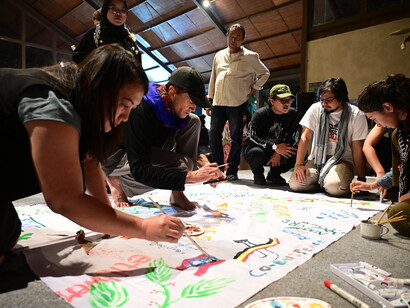
The six days of the assembly were a mix of discussions and dialogue, visits to relevant local initiatives, ceremonies and celebration, art and dance, exhibitions, storytelling, local cuisines, and more. This goes with GTA’s attempt to make such spaces a seamless integration of serious deliberation with creativity and enjoyment. Local host Konfederasi Pergerakan Rakyat Indonesia (KPRI, or Confederation of Indonesia People’s Movements), along with Serikat Petani Pasundan (SPP, a farmers’ movement in Java), organized trips to Indigenous communities, student and worker unions, and historical and other sites to give those coming from outside a tangible, tactile experience. One of these was to the Cigugur Indigenous community in West Java, where participants were briefly immersed in their long history of autonomous governance and living that combines humans, the rest of nature, and the divine, and learnt about their struggle for recognition from the Indonesian state. In another, we heard from students and workers of Padjadjaran University about their movement to obtain decent wages and working conditions for the institution’s workers.
Four morning ceremonies, reminding us of our ties with each other and the rest of nature, the sacredness of life, and the diversity yet oneness of cultures we belong to, were conducted by local Indigenous and community people and people from Africa, Asia, and Latin America. An impromptu storytelling session witnessed narratives and poetry on weaving, relationality, and ethical learning from the plant and animal world, with wonderful contributions from Simon Mitambo of the Tharaka community in Kenya and the GTA Facilitation Team, long-time anti-oil activist Nnimmo Bassey of Health of Mother Earth Foundation, Nigeria, and others.
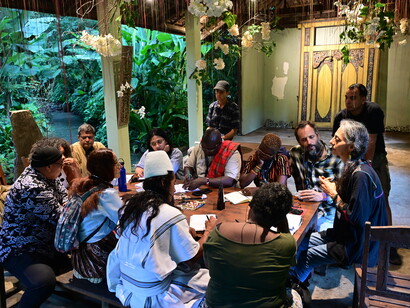
The venue itself, the lushly vegetated Imah Seniman artists’ village, provided a peaceful and calm atmosphere, and was fully used in outdoor breakout group sessions. Though I was disappointed by the near-complete absence of birdlife (one possible and depressing reason being Indonesia’s thriving trade in cagebirds), a diversity of plants, insects, the occasional squirrels, a gurgling stream, and plentiful rainfall made sure that we were always mindful of the rest of nature. And the comfort and needs of participants were also ensured by the incredible logistical work that went into the assembly's organizing, anchored by the GTA Facilitation Team’s Madhuresh Kumar and KPRI’s Anwar ‘Sastro’ Ma’ruf, Firdaus, and team of volunteers. The smiling hospitality and efficiency of the resort staff were crucial ingredients as well, as was some tasty local cuisine (though individually plastic-wrapped snacks were a jarring eye-sore).
Other than the full sessions, there were also two parallel assemblies: one dedicated to women and other genders, and the other to youth and inter-generational dialogue. The former was a continuation of a process started in 2023 in Kenya, in which marginalized genders have a safe space to express their perspectives, struggles, rights, and visions. On the latter, more below.
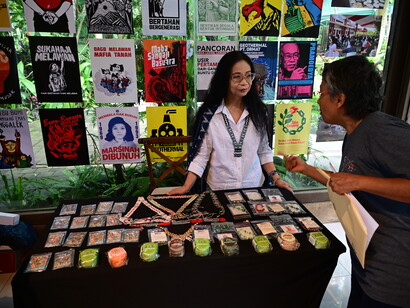
Not all, of course, went well. With people from several cultures, translation is always a challenge. Simultaneous translation into English, Spanish, and Bahasa Indonesia was arranged, but was not always smooth; it was due to an atmosphere of solidarity that people tolerated the occasional breakdown, or even stepped in to do voluntary and whisper translation. The pace and intensity of the programme were also uncomfortable to some; in particular, a lack of free time to absorb and digest all that was being spoken and heard. And yet, due as much to the diversity of methods and the atmosphere of the venue, frequent availability of beverages, and the commitment of the participants themselves, virtually all participants attended from 8.30 am to 6 pm for five days in a row. Most even attended the optional evening programmes (film screenings, presentations of alternatives from various organisations, theatre, book releases6, etc), stretching into dinner-time!
Challenges of global networking
Over the six years of working in the GTA, many of its constituents have been aware of the challenges facing any such effort. As it has grown, it has needed greater clarity regarding the structures that have organically evolved, clearer guidelines and norms, more funds, and a greater ability to manage activities and expectations. Inevitably, there is a tension between the explicit desire to maintain levels of informality, voluntarism, passion, and horizontality and the need for some structure and rules. Many international initiatives have faced an erosion of the original principles they started with, such as equity and distributed power, when they have not been able to maintain this balance.
This is especially the case if large amounts of funding have had to be handled or if growth has been too fast. In many networks, founders have held on to power for too long, reluctant to hand over to new generations, or intergenerational knowledge transfers have been weak. Then there is the politics of representation: can we be sure that whoever attends the Assembly is truly representing their community or movement, and when a new representative takes over, is there adequate transfer of institutional memory? And while we may agree that decisions should be based on consensus rather than voting (which sets up an unhealthy majority vs. minority dynamic), there is also the danger of invisible hierarchies silencing some people, or of the erasure of diversity and differences in the name of reaching common positions.
How does GTA not fall into such traps, or minimize their dangers? Participants of the Assembly were sharp in asking for processes of accountability, e.g., regarding the funds that GTA receives, or the processes by which the facilitation team composition is decided. Everyone recognized the need for spelling out governance structures and processes more clearly, for which a small working group was formed. Many more participants were also incorporated into the Thematic Groups and Working Groups that GTA has, and new ones (on food and agriculture, water, healing Mother Earth, and urban settlements) were proposed to be set up.
Also noted was the danger of ‘gatekeeping’ by some sections of the movements that consider themselves ‘radical’ or ‘left’ or 'progressive' but define these in a somewhat narrow way. For instance, some have (quite justifiably) condemned the American attack on Iran, but refused to nuance this with a criticism of the despotic regime within Iran itself. Or those who view China only through rose-tinted glasses for its role in standing up to the USA’s imperialism (certainly worth appreciating), deliberately blind to the ecological and social devastation by Chinese enterprises in many parts of the world, or its internal repression of Indigenous peoples, rights activists, labour organisers, and political dissidents. For GTA, it would be crucial to sustain a comprehensive commitment to justice, even when it means taking complex positions or facing the danger of flak from more narrowly focused movements.
Going beyond the nation-state
One of the recurrent themes in GTA has been the need, as one participant put it, to act ‘within, against, and beyond the state’. Its commitment to radical alternatives implies that it seeks pathways that are not only anti-capitalist and anti-patriarchal, but also challenging the nation-state itself. A key focus of its Thematic Group on Radical Democracy and Autonomy has been the search for practices and concepts of genuine, grounded governance by Indigenous peoples and local communities, and collectives even in urban areas7. So even as many of its constituents do advocacy with governments and intergovernmental bodies for policy shifts towards radical solutions, and others resist and oppose state actions, many are also trying to go ‘beyond’ the nation-state through forms of democracy that centre people and nature.
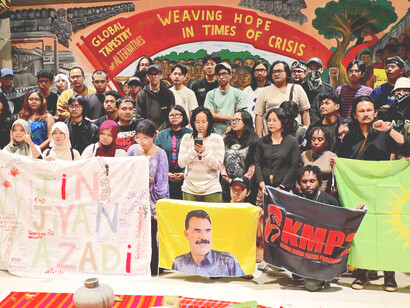
At the Assembly, several participants spoke of their experiences in this. Alim Bandara of the Teduray tribe in Mindanao, the Philippines, mentioned their customary self-governance processes and the attempt to gain recognition of these through the country’s Ancestral Domain law. Mauricio del Villar Zamacona of Crianza Mutua Mexico described how over 400 of the 570 municipalities in the Oaxaca region use Indigenous and community principles of self-governance. Necibe Qeredaxi, Halwest Karim, Camilo Torres, and Bedia Ertürk from the Kurdish movement showed a film and told us about the experience of radical democracy based on the principles of ‘jineoloji’ (women’s revolution) in Rojava and elsewhere in the proposed Kurdistan; but also how these were constantly threatened by armed aggression of the nation-states they were located in (Iran, Iraq, Syria, and Turkey). Maria Campo of Casa Cultural el Chontaduro and other members of collectives that are part of Crianzas Mutuas Colombia spoke of their mapping and mobilization in the Cauca River basin as a movement towards more autonomous self-governance.
Grounded, radical political democracy cannot succeed without transformations in the economy and society, too. GTA’s thematic Groups on Solidarity Economy, Energy Alternatives, and Alternative Education focus on some of these aspects. Bablu Ganguly of Timbaktu Collective in India mentioned its work in about 300 villages, towards greater economic self-reliance, while also struggling for gender justice and the rights of children. Jane Kinya described the promotion of ecologically regenerative practices across several countries, including in agriculture and food sovereignty, through the Alliance for Food Sovereignty in Africa and the African Biodiversity Network.
Others spoke of initiatives of community-based learning (such as Unitierras or Universities of the Earth in Mexico and Colombia) as alternatives to mainstream education, health and healing, locally appropriate technologies, and more. Sizaltina Cutaia of WoMIN African Alliance, Liepollo Lebohang Pheko of the Well-Being Economy Alliance and the GTA Facilitation Team, Pup Kornkanok Khamta of the feminist care group Baan Phu Tuk Lai (Cracked but Unbroken) in Thailand, and Yuli Rustinawati of the national coordinator of Forum LGBTIQ of Indonesia, amongst others, stressed the centrality of feminist and gender-diverse ways of thinking, acting, caring, and being.
Participants also stressed that none of the above will succeed unless the regenerative and life-sustaining properties of Earth itself are sustained. Natalia Greene of GARN reiterated the principles of respect for all life, of the ‘rights of nature’ (not only in a legalistic sense, but ethical and customary), while Cindy Julianty of the ICCA Consortium mentioned how the concept and practice of ‘territories of life’ harmonise community well-being and autonomy with the conservation of nature.
All of this pointed to how the GTA Assembly in Bandung, while honouring the spirit of the 1955 Asia-Africa conference, recognized its failure in being truly transformative because it remained focused on nation-states (ruled by political and economic elites) and on neo-liberal forms of ‘development’. In contrast, the GTA Assembly was explicitly focused on fundamental transformations towards grounded communities and collectives taking political and economic control, while striving for social justice and respecting the regenerative power and limits of the earth. A ‘Bandung Declaration’ to this effect is under preparation.
The South-East Asian and Indonesian flavour
At its first physical Assembly in Kenya in 2023, GTA had enabled a proportionally larger representation from the African continent and from Kenya itself. This included a full-day dialogue with Kenyan civil society, which resulted in an ongoing process to form a national ‘weaver’ that brings together groups from diverse sectors. This time, too, the formula was used. There was significant participation from across South-East Asia, consisting of representatives of the Movement for Alternatives and Solidarity in South-East Asia (MASSA), one of the hosts of the Assembly.
On one of the days, nearly 100 representatives of youth groups joined us for an intergenerational dialogue. For many of us this was an important space to learn about their struggles against authoritarianism and repression – this includes the significant youth mobilisations in 2025, the attempt to bring youth voices into mainstream discourse, and many quiet initiatives at alternatives for basic needs, e.g. agroecology for food, cooperatives, worker and student rights, alternative media, legal awareness, ecological conservation, inter-ethnic harmony, and rights of women and LGBTIQ+. In turn, it was an opportunity for some of us to give a glimpse of resistance and alternatives from other parts of the world.
This led to a discussion on the need for youth and other movements that aim to bring down corrupt and exploitative regimes to have some idea of the kind of systemic alternatives they want (what some call ‘prefiguration’). This is especially so that whatever replaces the old does not simply reproduce the same political and economic patterns in a new garb. Mark Raquino of the Global Youth Biodiversity Network (GYBN) offered to anchor an ongoing Youth Assembly process in the GTA, to focus on such issues. Meanwhile, the Indonesian Youth Assembly carried on independently for two more days and decided to form a nationwide federation of youth organisations.
The Intergenerational Dialogue also led to consideration by the Indonesian participants of a national forum or network that could bring together various kinds of movements and groups, and possibly become a weaver of GTA. As KPRI’s Sastro and SSP’s Erni Kartini said, organizing the GTA Assembly in Bandung was an important boost to the movements for justice in Indonesia.
Conclusion: the way ahead
‘Asking, we walk’, say the Zapatista, one of the world’s most exciting attempts at creating processes and structures of political autonomy, ecological regenerative economy, and social justice. The GTA hopes to use the same principle, while starting with a set of principles and ethics, to keep asking what practices are working and what are not, where we may be heading into traps of the kind described above, where we need to unlearn and learn. Unfortunately, the packed agenda at the assembly did not leave time for a 3-year visioning process that could have guided us towards the next physical assembly. But there were enough earthy pointers and a set of exciting action points that GTA’s constituents could use to guide them.
There was also an indication that while the global crises are urgent, some catastrophically so, GTA’s vision needed to encompass both immediate responses as well as slower, more carefully worked-out pathways that are based on trust, care, and relationality. This also had to ensure intergenerational learning, combining the experience of elders with the innovation and enthusiasm of newer generations. If it can achieve these balances, within itself as well as in partnership with other global networks of resistance and alternatives, it could play an important part in humanity’s search for a future more in harmony with the wonders and beauties of our planet.
References
1 Tricontinental Institute, ‘The Bandung Spirit’, 2025.
2 The Global Tapestry of Alternatives.
3 The four current weavers are Vikalp Sangam (India), Crianza Mutua (Mexico), Crianzas Mutuas (Colombia), and Movement for Alternatives and Solidarity in South-East Asia (MASSA).
4 For a full list of current endorsers.
5 Global Tapestry of Alternatives, Dictionary of Radical Alternatives.
6 For instance, Global Tapestry of Alternatives. Radical Democracy: recovering the roots of self-governance & autonomy, December 2025.
7 See ‘Global Confluence on Radical Democracy, Autonomy, and Self-Determination’, Feb 2025.