English
 Español
 Français
 Deutsch
 Italiano
 Português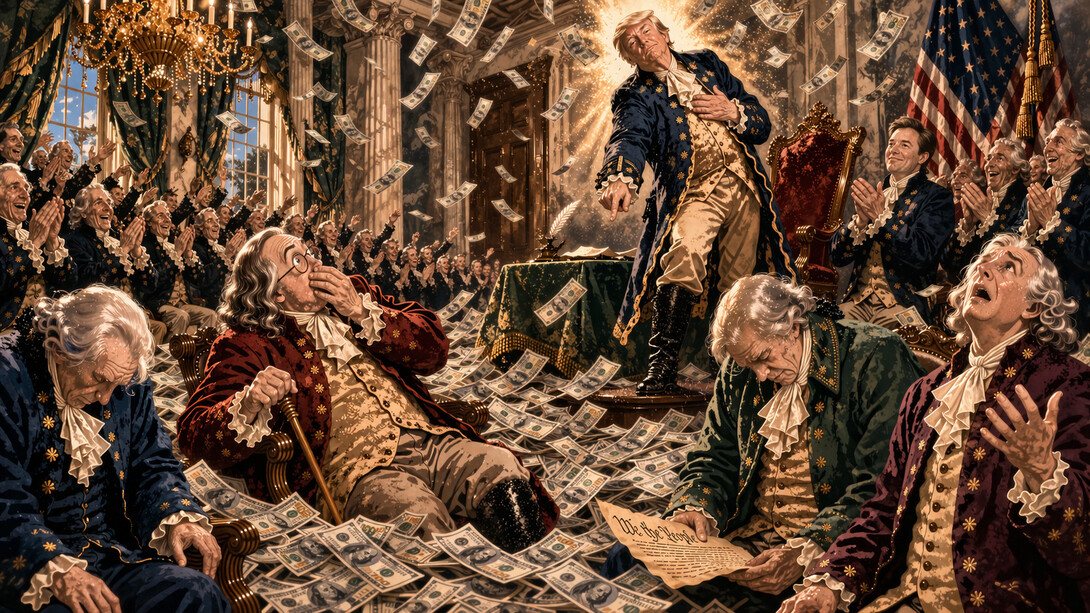
Moscow and Beijing are challenging Western democracies. Trump and Trumpism have put American democracy under existential pressure. Nationalistic populism has promoted illiberalism on both sides of the Atlantic. High walls against people and goods are drawn up. Authoritarian rule is gaining acceptance. Anti-democratic winds are blowing everywhere.
Populism is a democracy-destroying force. Why did Italy in 1947, Germany in 1949, and Spain in 1978 adopt new constitutions? Because a century ago, the strongmen Mussolini, Hitler, and Franco unleashed the destructive waves of fascism and National Socialism that peaked in World War II. Today, populist strongmen are again in power: Trump in the U.S., Putin in Russia, Xi in China, Modi in India, and quite a few more in less powerful countries. Now we must ask: How could the U.S. walk into the quagmire of populism?1 Why is America not pulling the world out of this morass but deeper into it? To have no good answer to this question is not hard; to have one good answer is great; and having eight answers is my answer.
Among the countless influences that brought Trump to the helm, eight played a major role and taken together proved decisive. These include an older and a newer American peculiarity, namely unlimited freedom of speech for big money and brilliant far-right intellectuals. I claim therefore: the symbiosis of aggressive rightwing minds with vast financial resources has made a significant contribution to the rise of Trump and Trumpism.
Freedom of speech for big money
For a long time, the Constitution of the United States has been the country’s ultimate political benchmark. In the two hundred thirty-eight years since its ratification (1788), approximately 12,000 constitutional amendments were proposed but only 27 added, the first ten of which immediately (U.S. Bill of Rights, 1789–91). Compared to the Magna Carta of 1215, which has served for eight hundred years as Great Britain’s guide, the supreme law of the U.S. appears young; nevertheless, its longevity is impressive, especially when viewed against the backdrop of the so-called “Old World” and its much younger constitutions.
Freedom of speech is guaranteed in the First Amendment to the American Bill of Rights:
Congress shall make no law respecting an establishment of religion, or prohibiting the free exercise thereof; or abridging the freedom of speech, or of the press; or the right of the people peaceably to assemble, and to petition the Government for a redress of grievances.2
So far, Congress has adhered to this rule. The legislature has not passed any laws that restrict or curtail the right to free speech and freedom of the press. Even President Trump has not (yet) changed this and has limited himself to regularly denouncing journalists, print media, and television stations he dislikes as “enemies of the people.” Trump’s verbal discrimination against the fourth estate, despite his legal restraint, is ominous. Yet it is not always the restriction of rights that leads to negative outcomes; the expansion of a right can also be harmful.
And that is what happened to the American freedom of speech. In 2010, the U.S. Supreme Court extended the exercise of free speech to campaign spending in the case Citizens United against the Federal Election Commission. The court ruled:
Political spending is a form of protected speech under the First Amendment, and the government may not keep corporations or unions from spending money to support or denounce individual candidates in elections. While corporations or unions may not give money directly to campaigns, they may seek to persuade the voting public through other means, including ads, especially where these ads were not broadcast.3
The ruling that corporations and labor unions speak with money in election campaigns (if they operate with campaign-independent personnel) gave rise to well-funded lobbying groups known as Political Action Committees (PACs). After that the Supreme Court went even further and decreed that “aggregate limits” on political contributions are unconstitutional.4 The result was the birth of Super PACs, organizations legally permitted to ‘speak’ with unlimited amounts of money for or against political campaigns. They are the “loudspeakers” in the title of this article.
The loudspeakers’ limit
Money talks. While the dollars of most Americans whisper, the money speaking for American billionaires – of whom there are ever more5 – is loud and clear. One percent of a billion is 10 million and one percent of 100,000 is 1,000. The difference between campaign donations of one thousand dollars and ten million dollars is this: the thousand-dollar speech gets lost in the citizens’ murmur, while the ten-million-dollar speech is impossible to ignore.
The voice of big money has grown louder with every election since 2010, and the distinction between political campaigns and Super PACs has become a legal fiction. On top of that, the influx of dark money – funds from ‘nonprofit’ organizations that are allowed to keep their donors secret – has kept pace with Super PAC spending.
Enormously wealthy Americans are known for their seemingly exorbitant political campaign donations. For example, Elon Musk spent over a quarter billion dollars for Trump’s 2024 campaign. That was a great deal of money, but less than one percent of Musk’s net worth, which exceeded $500 billion for the first time in October 2025. One could say, therefore, Musk bought his way into Trump’s administration for four months as a “special government employee” and director of the Department of Government Efficiency (DOGE, never formally established and disbanded quickly). More accurate and important, however, would be the observation that Musk’s unchecked influence during the first months of Trump’s second term was an exception.
As a rule of thumb, big money buys ‘nothing more’ than access to the U.S. president and his closest advisors. It makes it possible to get put through to the Oval Office. For many donors this is a phone call worth a few million dollars. Yet one should also keep in mind that there are Republican and Democratic billionaires whose money benefits both parties in roughly equal measure, especially in presidential elections.
The astronomical sums at stake in U.S. campaigns undoubtedly open many avenues for bribery. But the top prize is not attainable with big money alone. The view that the office of U.S. president can be bought is largely false. If it were so simple, campaign donations from the superrich would surely be an order of magnitude higher and fluctuate around ten percent of their wealth. The (im)modest amounts that Musk and his class spend show that billionaire donors are aware of the gamble of American elections; they know they are not making a safe bet.
To make presidential history big money needs exceptionally strong intellectual support. It is not enough for it to be deployed strategically – many try to do that – but to secure the presidency, something more is needed: the talent of superb political slayers. That is the lesson of Trump’s first election. The key players in this success story were Robert and Rebekah Mercer on the financial side as well as two unmatched matadors on the right wing of aggressive political intelligence, Kellyanne Conway and Stephen Bannon.
The Robert and Rebekah Mercer duo
Big money and terrific fighters paved Trump’s path to the White House. This does not mean that American voters had no other choice or that Trump’s personality played no role, but only – and this with certainty – that the combination of money with intelligence was just as necessary a contribution to the breakthrough of Trumpian populism as the media revolution in the technology field that I have discussed earlier.6
The Mercer money streamed from a money-making machine (Renaissance Technologies), a hedge fund created in 1982 by a Stony Brook University mathematician, James Simons, which generated phenomenal returns via high-frequency trading. Mercer joined Renaissance from IBM together with a colleague (Peter Brown) in 1993. In 2009, when Simons stepped down, Mercer and Brown became co-leaders of the firm. But unlike Simons, who had as regularly as unconditionally donated millions to the Democratic Party, Mercer used his money for a radical transformation of the Republican Party.
Mercer shuns the public. He is taciturn, lives a reclusive life, holds a Ph.D. in computer science, developed early artificial intelligence systems for text recognition and automatic translation, plays competitive poker,7 and collects machine guns. He is a true Citizens United man who speaks about politics mainly if not only through his investments and donations.
Mercer set to work with a long-term perspective. He ruthlessly pursued his goal of moving the conservative party to the far right in close collaboration with his middle daughter Rebekah. Bringing his extensive experience with data-driven methods (first for machine translation and then identification of financial opportunities) into the political arena, he systematically financed unconventional pollsters, alternative media, right-leaning think tanks and Super PACs. He fanned the rising winds of anti-democratic sentiments without hesitation and with the most capable fighters.8
In search of a suitable front-runner for president, Robert and Rebekah Mercer joined a group of prominent loudspeaker families in April 2015 who ‘spoke’ for the candidacy of Senator Ted Cruz with more than $43 million from their individually controlled Super PACs. Mercer funded his big money vehicle, Keep the Promise I, with $11 million. To lead his PAC, he hired the Republican pollster Kellyanne Conway. And to provide optimal guidance for the Cruz campaign’s data operations he commissioned the unorthodox political consulting firm Cambridge Analytica, in which he held a controlling stake of about 90 percent beginning in 2013-14.
Since 2013, independent polls indicated a general turn against the established parties, elites, and institutions. Mercer tracked this trend through election day 2016 and ensured the data was repeatedly updated. He recognized the electoral prospects of a “Trump-like” political outsider and learned from his non-conformist pollster, Patrick Caddell, what virtually nobody thought possible: “Americans were increasingly yearning for a ‘strong man’ to fix the country.”
Although Cruz was no strongman, he possessed both insider and outsider qualities as a universally unpopular senator. His quick and unexpected rise to serious contender was attributed to Cambridge Analytica’s “psychographic” voter profiling (probably not entirely without reason), but then he lost the Indiana primary to Trump in May 2016. This ended Cruz’s bid for the Republican nomination. Trump was now the only (and true) outsider still in the race.
Mercer instantly switched his support from Cruz to Trump. He changed the name of his Super PAC to Make America Number I and redirected Conway as well as Cambridge Analytica to advance the Trump campaign. Conway recruited her friend David Bossie, the Citizens United president and die-hard Clinton opponent to manage the refocused PAC. She herself began advising Paul Manafort, Trump’s then-campaign manager.
In July 2016, Trump won the nomination for president of the Republican National Convention. A month later, CNN reported that Trump had met Rebekah Mercer at a donor’s party in the exclusive Hamptons on Long Island where she shared “her concerns about the direction of the campaign” with him. Shortly thereafter, Manafort was asked to step down. Trump appointed Conway as campaign manager and Bannon as its executive director. Trump thus entered the final stretch of his campaign with the two most formidable political operatives around.
The Mercers’ game was working perfectly. Their matadors had taken the reins of the underdog campaign. As an insider remarked, “The Mercers basically own this campaign. They have installed their people. And now they’ve got their data firm in there.” After Trump’s victory in November 2016, Rebekah Mercer became a member of the executive committee of Trump’s transition team. She ensured that the operatives of her family moved into the White House with Trump.
The fact that Trump knew Bannon and Conway for years facilitated the Mercers’ success. In 2010, when Trump was once again floating the idea of running for president (he had toyed with it since 1987), Bossie introduced Bannon to Trump as an “expert on new media” and “very action-oriented.” Trump also knew Conway for quite some time. Since 2006, Kellyanne and her husband George resided in Trump World Tower in Manhattan, and for a time she served on the board of directors of Trump’s residential complex.
The Mercers’ resolve
Mega-donor spending in American presidential elections is mostly driven by the billionaires’ calculation that their political investments will somehow pay off for their private ventures, such as Tesla, SpaceX, and Starlink in the case of Musk. Not so in the case of the Mercers. Their material support was purely ideological. This became clear in the wake of the Access Hollywood tape scandal.
Over 100,000 people immediately watched the video of Trump’s sexual bragging after it was released by the Washington Post. It instantly became a viral sensation across all social media and cable news. Leading Republicans like John McCain and Paul Ryan distanced themselves, and Hillary Clinton tweeted: “We cannot allow this man to become president.”
The scandal prompted the Mercers to break their usual reticence for a rare public comment. The day after the tape’s release and one day before the second presidential debate, Robert and Rebekah Mercer proclaimed, also in the Washington Post, that they were “completely indifferent to Mr. Trump’s locker-room braggadocio” and standing “steadfastly behind Donald J. Trump.”9 Against the surging tide of moral outrage the Mercer duo declared with unwavering resolve what and whom they considered unacceptable:
They would rethink their support for Trump had he said, “that he was for open borders, open trade, and executive actions in pursuit of gun control.”
They would also rethink their support had he admitted “that he had profited privately by allowing the sale to Russia of 20 percent of U.S. uranium deposits or that he had amassed his personal fortune not by hard work in the private sector but by selling favors to foreigners on the American taxpayers’ dime,” and equally, “if he had argued that he needed both a public and a private position on issues facing the American public.”
Finally, they would “most definitely” rethink their support for him had he “serially terrorized and silenced the victims of violent sexual assaults whom he feared could damage his political career.”
All these counterpoints targeted Bill and Hillary Clinton as well as the Clinton Foundation. The Mercers were primarily interested in defeating the Clintons; they could not stand their politics nor their personalities. The upcoming presidential election was a make-or-break moment for them. They thought nobody but Trump, the Washington outsider, could save the United States from impending doom:
America is finally fed up and disgusted with its political elite. Trump is channeling this disgust and those among the political elite who quake before the boombox of media blather do not appreciate the apocalyptic choice that America faces on November 8th. We have a country to save and there is only one person who can save it.
I wonder if Robert and Rebekah Mercer have rethought their faith in Trump. What are they making of his personal profiteering as U.S. president, the combination of public office with private business, the brazen enrichment of his family and friends? Do they have a problem with Trump accepting the “flying palace” from Qatar or filing a $10 billion lawsuit against the U.S. treasury and Internal Revenue Service? How are they squaring his attempts to withhold the Epstein files? Would they conclude on the record that they had been mistaken about the savior of America who fancies himself as king, pope, and Christ? That would be clarifying.
Bannon’s temptation
A great loudspeaker-success like that of the Mercers is instructive. It shows that big money needs outstanding fighters to successfully launch its candidates and win the presidency. Conway and Bannon were master warriors. Both possessed the matador’s “killer instinct” Trump had always admired; however, they were also different.
Conway, who stood in the spotlight day in and day out, was in a class of her own in deflecting criticisms of Trump. Always totally unfazed and telegenic, she was unbeatable at devising stunning counterattacks. Her retort that Trump’s press secretary had not lied but quite rightly referred to “alternative facts” is unforgettable.10 In contrast, the greatest strength of Bannon was not lightning-fast defense but overwhelming offense.
Bannon was 58 years old when the founder of Breitbart News Network, Andrew Breitbart, introduced him to Robert and Rebekah Mercer at a donor conference. Bannon, who had already tried his hand at several careers,11 including Navy officer, investment banker at Goldman Sachs, and Hollywood film producer, seized the opportunity. He subsequently drafted a business plan for the Mercers proposing a strategic investment in Breitbart News.
Breitbart News was a small, right-leaning media company founded in 2007 that promised to move the world further in that direction. Bannon’s plan fit the duo’s political goal, and the outlet was added with $10 million to the Mercers’ political portfolio (around 2011). The sudden death of Breitbart’s founder in March 2012 propelled Bannon forward; he became CEO and assumed editorial control of the opinion and news portal.
Under Bannon, Breitbart News shifted further to the right and expanded internationally. Bannon sharpened the website’s nationalist profile, opened the platform to provocative influencers from new social media, amplified anti-establishment rhetoric against both Democrats and Republicans, and connected Breitbart with anti-immigrant Euroskeptics such as Nigel Farage in the UK and Marine Le Pen in France. He established ties with the religious right in Europe and the ultra-conservative opposition to Pope Francis (notably Cardinal Raymond Burke).
Bannon was a Catholic with an Irish working-class background (his father had worked his entire life for AT&T and lost nearly all his savings in 2008). He was a “voracious reader” with the autodidact’s burning interest in historical theories. The trauma of the 2001 al-Qaeda terrorist attacks and the 2008 financial crisis politicized him. He adopted anti-globalist, nationalist, and anti-liberal Christian positions, emulated the partisanship of Leni Riefenstahl and Michael Moore in his film productions, and advocated “outright war” against Islam.
In 2014, Bannon delivered the keynote (via Skype) in a conference on “Poverty and the Common Good” convened at the Vatican by the Dignitatis Humanae Institute, a “Judeo-Christian” think tank. He distinguished two dangerous versions of capitalism, the “state-sponsored” Russian and Chinese models and the “libertarian capitalism” of the U.S. According to Bannon, the former creates prosperity “for a very small subset of people,” yet the latter is “almost as disturbing” because it “looks to make people commodities, and to objectify people.” His preference – an “enlightened capitalism of the Judeo-Christian West” – remained unarticulated. Instead, Bannon affirmed that he and Breitbart firmly supported the “entrepreneurial capitalist spirit of the United States” as “free-enterprise capitalists.”
Bannon’s fortune was insignificant in the billion-dollar context of the loudspeakers; however, it was not negligible. When Bannon joined the White House as Trump’s Chief Strategist, it was officially estimated to be in the range of $9.5 million to $48 million. That wealth and the fact that Bannon was craving access to big money was probably enough for the libertarian Mercers to assure them that their matador’s desire for a capitalism for the people would remain mute.
Bannon had kept his moral ambitions in his Rome “manifesto” in check. But it was clear that he could develop and set far-reaching political goals on his own initiative, as well as devising plans to achieve them. That is not a temptation all matadors face, but it was the inner urge Bannon struggled with. In his case, the self-control lasted one year, from August 2016 to August 2017.
In August 2016, Bannon was appointed CEO of Trump’s campaign. Three months later, after winning the election in November, Trump announced Bannon’s next position: “Trump for President CEO Stephen K. Bannon will serve as Chief Strategist and Senior Counselor to the President.” Looking forward, Bannon revealed his dream to unleash capitalism for the American working class. Condemning the betrayal of the workers by the establishments of both parties, he told Michael Wolff:
It’s everything related to jobs. The conservatives are going to go crazy. I’m the guy pushing a trillion-dollar infrastructure plan. With negative interest rates throughout the world, it’s the greatest opportunity to rebuild everything. Shipyards, ironworks, get them all jacked up. We’re just going to throw it up against the wall and see if it sticks. It will be as exciting as the 1930s, greater than the Reagan revolution – conservatives, plus populists, in an economic nationalist movement.12
Trump’s inaugural speech “American Carnage” was conceived by Bannon and drafted by Stephen Miller in January 2017. Its dark tone, populist rupture, emphasis on America’s decline, and confrontational stance broke with the traditionally optimistic rhetoric of inaugural addresses. The blunt points of the speech included:
“The forgotten men and women of our country will be forgotten no longer.”
“For too long, a small group in our nation’s Capital has reaped the rewards of government while the people have borne the cost.”
“And spent trillions of dollars overseas while America’s infrastructure has fallen into disrepair and decay.”
“Every decision on trade, on taxes, on immigration, on foreign affairs, will be made to benefit American workers and American families.”
“We will reinforce old alliances and form new ones – and unite the civilized world against Radical Islamic Terrorism, which we will eradicate completely from the face of the Earth.”13
Bannon’s bellicose worldview was unmistakable. But that was not (yet) a problem, because everyone involved – from Trump to Bannon and Miller to the Mercers – was jointly fighting at that point for a populist, nationalist, libertarian, anti-immigration, anti-Islamist turn of America. Shortly after Trump took office, Bannon gained even more influence when he got a permanent seat on the Principals Committee of the National Security Council. With that he had reached the highest levels of the U.S. government. Discovered by the deliberate Mercers, propelled by Trump’s flamboyant leadership style, and driven by his own ambition, Bannon had risen in record time from disruptive outsider to powerful insider.
Bannon’s meteoric rise ended with the reassertion of conventional power structures during Trump’s first presidency. The shift began in March 2017 with the appointment of a new National Security Advisor, H. R. McMaster, who in April removed Bannon from his “permanent” seat on the Principals Committee. Further course corrections followed in July with the appointment of a new White House Chief of Staff, John F. Kelly, who dismissed Trump’s Chief Strategist and Senior Counselor on August 18.
Bannon’s dismissal was a victory for the more globally and cosmopolitan oriented anti-Bannon faction around Jared Kushner, Ivanka Trump, Treasury Secretary Steven Mnuchin, and economic adviser Gary Cohn. Friends of the traditional order like the New York Times hailed Bannon’s removal as “a welcome course correction” and overdue restoration of “actual expertise.”14 Bannon, by contrast, interpreted his forced exit as a reactionary turning point, stating:
The Trump presidency that we fought for, and won, is over... We still have a huge movement, and we will make something of this Trump presidency. But that presidency is over.15
In making this claim, the wounded matador overreached. He attributed to himself a decisive role in a political victory that ultimately belonged to the president. Thus, Bannon, not Trump, was finished; the matador had to go. For Robert and Rebekah Mercer, the loss of Bannon represented a temporary setback. And, as the turbulent developments since Trump’s second inauguration show, the circumstances of Bannon’s ouster constrained Trump only in his first term.
Notes
1 See Wolf Schäfer, “Populism as a wishmachine: the Trump brand.” Meer, 25 February 2026.
2 See Constitution Annotated, First Amendment, Fundamental Freedoms.
3 See Citizens United v. Federal Election Commission at SCOTUSblog.
4 See McCutcheon v. Federal Election Commission at SCOTUSblog: “Because aggregate limits restricting how much money a donor may contribute to candidates for federal office, political parties, and political action committees do not further the government’s interest in preventing quid pro quo corruption or the appearance of such corruption, while at the same time seriously restricting participation in the democratic process, they are invalid under the First Amendment.” The requirement that Super PACs must be separate from campaign organizations remained in place but was easy to bypass.
5 See Beth Reinhard, Naftali Bendavid, Clara Ence Morse, and Aaron Schaffer: “How billionaires took over American politics. The concentration of wealth among the richest Americans is unlike anything in history – and so is billionaires’ influence in politics.” Washington Post, 21 November 2025.
6 See Wolf Schäfer, “Media upheaval in the technology field.” Meer, 25 March 2026.
7 A rare photo shows Mercer at the 2012 World Poker Tour.
8 See Jane Mayer, “The Reclusive Hedge-Fund Tycoon Behind the Trump Presidency.” The New Yorker, 17 March 2017 (behind a paywall). For the brothers Charles and David Koch as well as other important predecessors of Mercer, see Jane Mayer, Dark Money: The Hidden History of the Billionaires Behind the Rise of the Radical Right. New York: Anchor Books, 2017.
9 Matea Gold, “GOP mega-donors Robert and Rebekah Mercer stand by Trump.” Washington Post, 8 October 2016.
10 See John Swaine, “Donald Trump’s team defends ‘alternative facts’ after widespread protests.” The Guardian, 23 January 2017.
11 See “Steve Bannon” in Wikipedia for Bannon’s eventful life and career.
12 Michael Wolff, “Ringside with Steve Bannon at Trump Tower as the President-Elect’s Strategist Plots ‘An Entirely New Political Movement’ (Exclusive).” The Hollywood Reporter, 18 November 2016.
13 Donald Trump, “The Inaugural Address.” 20 January 2017.
14 The Editorial Board, “Downsizing Mr. Bannon.” New York Times, 6 April 2017.
15 Christiano Lima, “Bannon: ‘Trump presidency that we fought for, and won, is over’.” Politico, 18 August 2017.