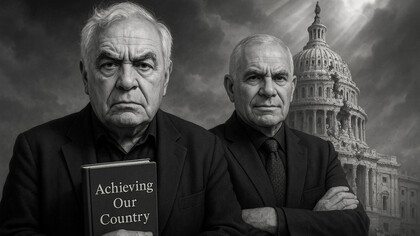
I was born in World War II in Germany and grew up in the ruins of Frankfurt am Main. The handcart I used there to collect and sell scrap metal and paper has accompanied me everywhere for eight decades. Initially, I wanted to become a painter. An artist. But my parents didn’t want that. And after a few years – working as an artist in the evenings and a house painter during the day (to pay for food and my basement apartment) – I gave up hope and set my sights on an academic career.
That worked out. Studying was, and still is, inexpensive in Germany. In addition, scholarships for gifted students helped, such as the Evangelische Studienwerk Villigst and the Studienstiftung des deutschen Volkes.
I studied history, philosophy, and international politics in the second half of the 1960s in Marburg, Bonn, London, and Munich, where I completed my studies with a master’s degree (1970). After that, I became a research assistant at a social science institute, which was in Starnberg, Bavaria, and had a long name: Max Planck Institute for the Study of Living Conditions in the Scientific-Technical World. It was headed by Carl Friedrich von Weizsäcker and Jürgen Habermas. The institute was divided into interdisciplinary working groups and existed from the early 1970s to the early 1980s. The learning experiences in the context of these two scholars and my colleagues were extraordinary. They had a lasting impact on my academic value system.
Most of the scientific staff at the Starnberg Institute came out of the student movement of the 1960s, which was politically inconvenient. So, the Max Planck Society closed our institute in 1984 following von Weizsäcker’s retirement and Habermas’ departure to the University of Frankfurt (1981). Around thirty research assistants had to look for new jobs.
In 1983, I earned a doctorate in social history and the history of science and technology, and in 1985, I accepted a professorship at the University of Applied Sciences in Darmstadt, Hesse. It was a stopgap solution. The title of professor was all well and good, but the working conditions were anything but. Especially the teaching load. Compared to a university professor, a professor at a university of applied sciences had more than twice the teaching load (18 hours per week). That was hard for anyone who wanted to do research. For me, having spent years doing research without any teaching obligation, it was ironic: a repeat of my artist/house painter problem on the academic level.
What to do? I began to make contacts in the US. At the end of the 1980s, I received an offer from the State University of New York at Stony Brook. Stony Brook University was an up-and-coming research university, beautifully located on Long Island and not far from Manhattan. The position was advertised for a historian of science; the teaching load was eight hours per week. Accepting the job was a no-brainer.
So it came to pass that my academic career in West Germany ended before the fall of the Berlin Wall, and my American career began with the reunification of Germany. Looking back, I see that I spent about 40 years of my life in Germany and then another 40 in the US. Furthermore, I became bilingual and familiar with the academic worlds on both sides of the Atlantic. Now, after my retirement at the end of 2025, I’m again working as a part-time artist.
What the young Marx dreamed of in 1846 in The German Ideology – “to do one thing today and another tomorrow, to hunt in the morning, fish in the afternoon, rear cattle in the evening, criticize after dinner, just as I have a mind, without ever becoming hunter, fisherman, herdsman or critic” – is what I am doing now: reading the New York Times today, the Wall Street Journal tomorrow, sculpting in the barn in the morning, working in the garden in the afternoon, and writing an article for Meer in the evening, just as I please.





 English
 Español
 Français
 Deutsch
 Italiano
 Português
 Deutsch