English
 Español
 Français
 Deutsch
 Italiano
 Português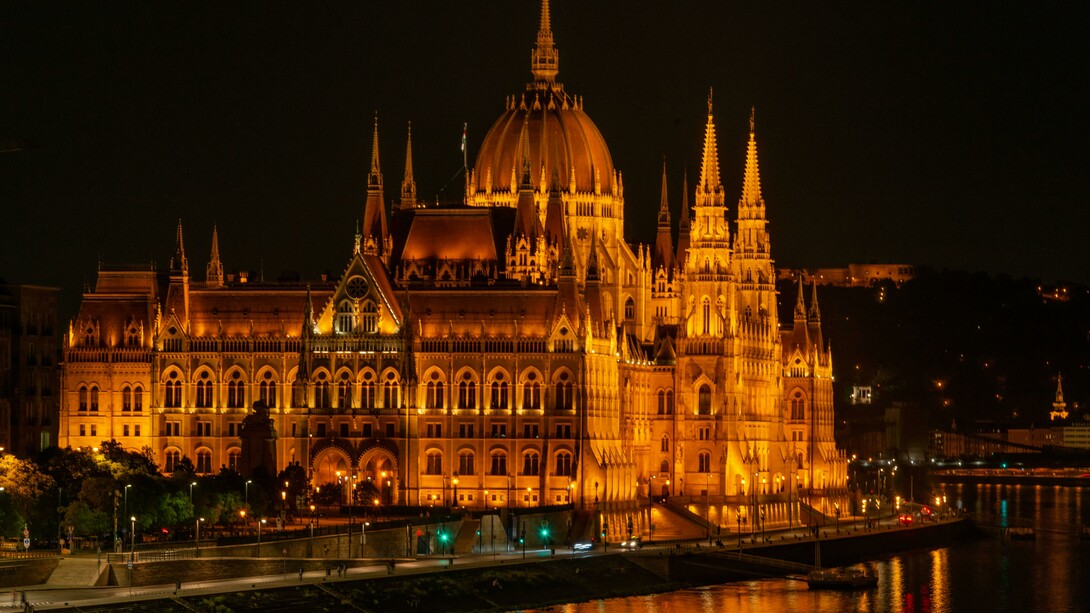
I keep coming back to the Danube.
I call it “Danis” sometimes, like a friend, like something alive that knows me already even when I’m not paying attention. Every time I’m in Budapest I end up walking its edges as if I’m trying to understand something it still hasn’t fully told me. Something it keeps holding back or maybe something I’m only ready to hear in fragments.
And then I reach the shoes.
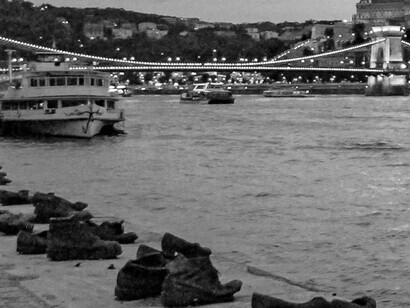
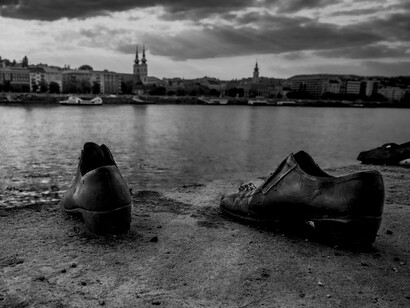
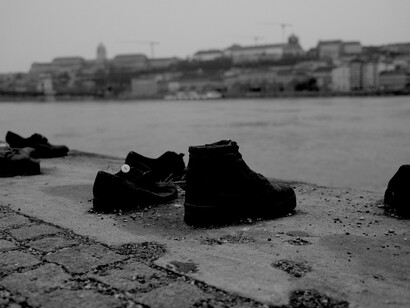
They are just there. Quiet. Sitting in a long, careful line along the stone embankment. Sixty pairs of iron shoes placed directly on the edge of the river. Boots, men’s work shoes, women’s heels, children’s pairs. Some are worn down, some still sharp, some almost delicate. They are not abstract sculptures. They are exact. Specific. Human-sized.
At first they almost look forgotten, like someone left them behind by accident and will come back for them any minute. Like a scene interrupted mid-step.
But of course no one comes back.
This is Shoes on the Danube Bank (Cipők a Duna-parton), a memorial created in 2005 by filmmaker Can Togay and sculptor Gyula Pauer. It stands in memory of the Jewish victims murdered in Budapest during World War II, mainly between 1944 and 1945, when members of the Arrow Cross militia carried out mass executions along the river.
The method was brutally simple. People were brought to the edge of the Danube and ordered to remove their shoes because shoes were valuable during wartime, something that could be reused or sold. Only after that were they shot so their bodies fell directly into the river and were carried away by the current.
The shoes remained on the shore.
Now they are cast in iron and fixed permanently into the stone. Behind them a low stone wall carries a plaque in Hungarian, English and Hebrew that reads:
To the memory of the victims shot into the Danube by Arrow Cross militiamen in 1944–45. Erected 16 April 2005.
There is nothing else explaining it. No figures. No reconstruction. No dramatisation.
Just shoes.
I always feel something strange when I stand there. The city is still alive around it. People walking, talking, laughing, trams passing, boats sliding through the water, the Parliament glowing across the river like it has nothing to do with any of this.
But the shoes don’t move with the city.
They interrupt it.
Not loudly. Not dramatically. Just by existing exactly where they are.
And somehow that is enough to change the air.
What strikes me most is how the memorial refuses spectacle. It doesn’t reconstruct violence. It doesn’t try to simulate suffering. It doesn’t give you bodies or faces or answers. It gives you absence shaped into something physical enough to be seen but not resolved.
The shoes are not symbolic in an abstract way. They are literal enough to feel uncomfortable. They are empty, but they still carry presence. You can almost imagine the weight of a foot inside each one, the pressure of walking, stopping, and standing at the edge of something without knowing it is the edge of everything.
And then nothing.
The Danube runs right beside them, completely indifferent and completely involved at the same time. It reflects light, carries boats, and absorbs sound. It behaves like a river that has seen everything and therefore refuses to explain anything.
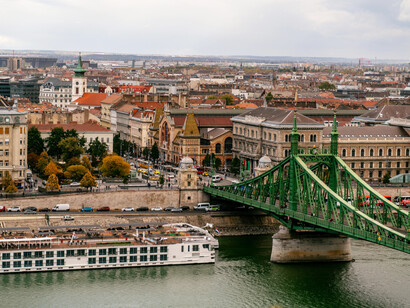
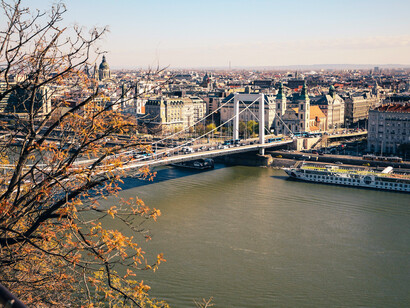
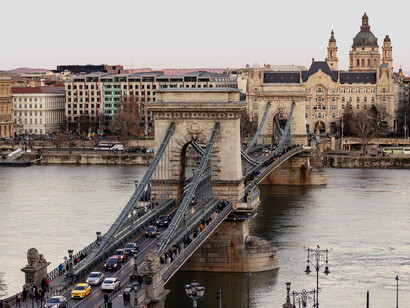
The Danube is beautiful in a way that almost feels unfair. Bridges are like drawings stretched between two worlds: light breaking into fragments on the surface, music drifting in summer air, and reflections of buildings that look almost unreal at night. It feels like a place made for stories, for cinema, for longing for arrival and departure at the same time.
But it is also a place that holds everything we don’t want to look at too closely.
I think about that often: how water carries history without explaining it. It doesn’t pause. It doesn’t annotate. It doesn’t give context. It just moves forward endlessly, rearranging memory into reflection.
Except here somehow it does stop me.
The shoes change the river for me. They don’t scream. They don’t perform grief. They don’t try to explain history in a way that makes it easier to digest.
They just stay.
And staying is its own form of speech.
What makes them unbearable in a quiet way is their ordinariness. Shoes are one of the most basic human objects. They carry us through days without attention. They remember our weight, our direction, our habits of movement. They are personal in a way we rarely think about until we see them without the body they belong to.
Here that absence becomes visible.
A child’s shoe next to an adult one collapses everything at once. Time. Family. Future. It removes narrative and leaves only interruption. It is not a story that can be completed. It is a sentence cut in the middle and left that way on purpose.
And I think that’s what stays with me most. Not the violence itself, but the way memory refuses closure here. The way the city holds it in the present tense, without turning it into something safely distant.
People pass it constantly. Some stop. Some don’t notice. Some notice and continue anyway because life does not pause for memory in the way memory asks life to pause.
That tension is what makes the place feel unstable in a very quiet way. Nothing is exaggerated, yet everything is amplified.
Sometimes I stand there longer than I expect. Sometimes I just walk past and feel it behind me like a shift in temperature. Either way it doesn’t leave me where it found me.
Many cities I go to, not just the ones I’ve lived in, have had a river or something like it, a place I go when I need to think without language, when words feel too direct, too fixed, or too small for what I’m trying to process.
But the Danube is different.
Maybe because it refuses comfort. Maybe because it refuses distance. Maybe because it refuses to let the past behave like the past.
It carries too much at once. Empire and music, borders and migration, war and beauty, tourism and silence, celebration and disappearance. It does not separate these layers. It holds them together without explanation.
And now, these shoes.
I think that’s why I keep coming back. Not for answers. Not for resolution. Just for contact. For proximity to something that resists being simplified.
The river keeps moving.
The shoes don’t. And in that difference something becomes visible that I still don’t know how to fully name.
But maybe this is what remains when history is not allowed to disappear into comfort.
Memory that does not turn into decoration. Absence that does not become silence. And a fragile form of freedom that depends on remembering, not forgetting.
Because democracy and freedom are not only what a city celebrates in its present. They are what it chooses to protect in its memory.
And here, by the river, the shoes stay as a reminder that neither is guaranteed. They depend on attention. On presence. On the decision not to look away.
The river keeps moving.
The shoes don’t.