English
 Español
 Français
 Deutsch
 Italiano
 Português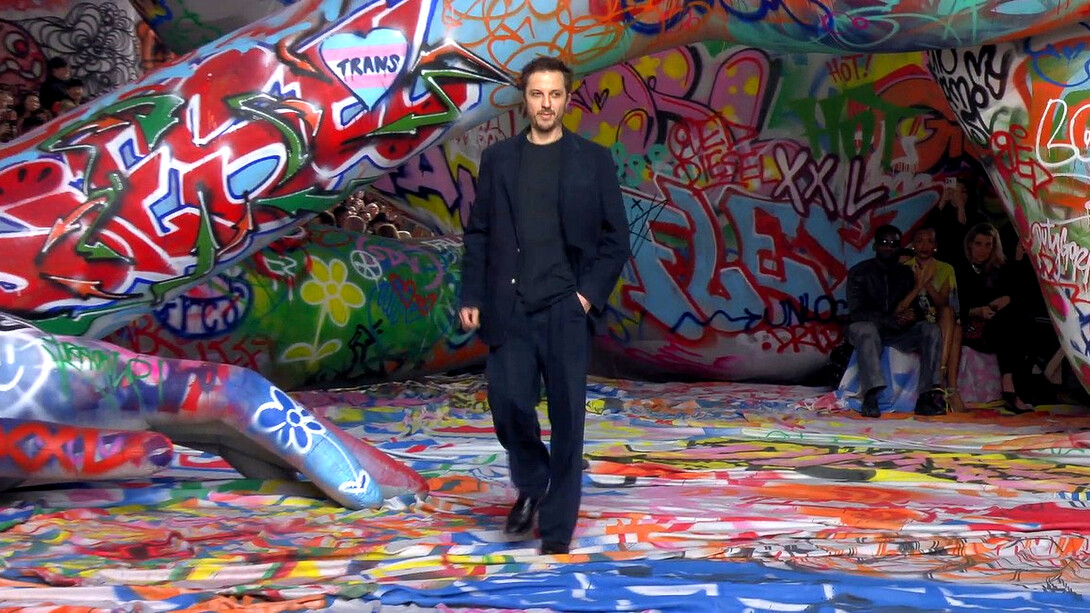
Diesel’s Paris flagship window for fall/winter 2025 greets passersby not with glossy perfection but with a raw and tactile disarray. Piles of distressed denim, shredded seams, and frayed cotton blocks serve as the pedestals for black leather boots and sculptural handbags. The background itself—a patchwork of flattened jeans, pockets, and fabric ghosts—evokes an archaeological layer of the brand’s own heritage. This mise-en-scène feels like walking through the ruins of Diesel’s industrial empire: a visual sediment of decades of denim production compressed into an abstract textile wall.
Beneath the glowing red “Diesel — For Successful Living” logo, the phrase takes on new irony. What does “successful living” mean when the very material that once symbolised labour, rebellion, and youth has been torn apart, disassembled, and displayed as waste? The installation answers with a paradox: success today is found in reinvention, in turning leftovers into luxury. The piles of denim scraps become altars of resilience—monuments to the cyclical destruction that defines contemporary fashion.
The composition is strikingly architectural. Each pedestal is built from dense layers of shredded denim, dyed in gradients of grey and highlighted by pinkish-red lighting that bleeds into the texture. The result is both sculptural and emotional—an evocation of raw matter in flux. Against this ruinous stage, the mannequins dressed in sleek black silhouettes and dark tailored coordinates create a confrontation between chaos and precision and material decay and design control.
The store window becomes more than visual merchandising; it’s a condensed philosophy of the Diesel brand under Glenn Martens. It embodies the tension between industrial identity and digital-era sensuality—between the rough tactility of denim and the futuristic ambition of Diesel’s global vision.
Glenn Martens’ Diesel: from workwear to post-apocalyptic couture
Since his appointment, Glenn Martens has transformed Diesel from a fading denim powerhouse into one of fashion’s most conceptually daring brands. His approach fuses post-industrial aesthetics with high-fashion construction, creating a new visual vocabulary for denim that’s both dystopian and sensual. FW2025 marks a continuation of this evolution, translating the chaotic energy of the real world—economic uncertainty, ecological anxiety, and digital overload—into a language of beauty and resilience.
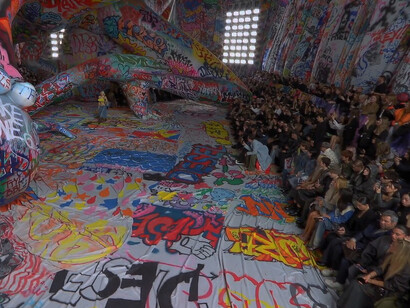
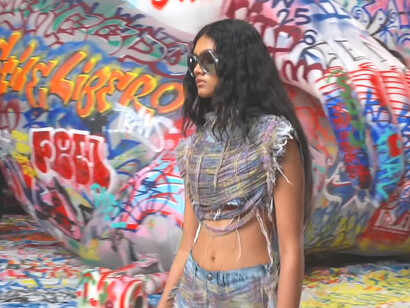
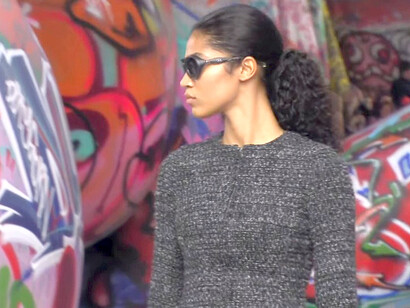
On the runway, Martens presented a hybrid world: bodies wrapped in manipulated denim, translucent latex dresses moulded like armour, and outerwear that looked burnt, scraped, or reconstituted from debris. The show opened with exaggerated silhouettes and frayed hems, echoing the textures seen in the Paris window display. The shredded pedestals in the store, in this sense, mirror the garments’ own material rebellion—each piece an artefact of reconstruction.
What distinguishes Martens’ Diesel is his refusal to polish away imperfection. The beauty lies in friction: between softness and hardness, precision and ruin, desire and decay. His denim isn’t a nostalgic nod to Americana but an experimental fabric, stretched to its limits—literally and conceptually. The runway’s dark palette—charcoals, blacks, and oil-slick blues—extends directly into the visual atmosphere of the store windows. Both environments celebrate rawness as luxury and imperfection as identity.
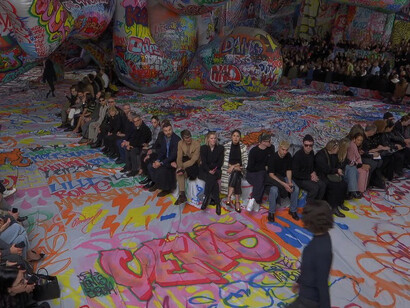
In this context, the Diesel store display functions as an extension of the runway set, an architectural continuation of Martens’ world-building. Instead of a commercial adaptation, it’s a spatial translation—where the chaos of the runway’s energy is distilled into a static, sculptural tableau for the urban passerby.
Material metaphors: denim as memory and waste
The choice to use denim debris as both background and podium in the Paris display is not merely aesthetic. It’s a statement about memory, sustainability, and the life cycle of fashion. Each fabric scrap suggests a ghost of a past collection, a consumer moment, or a discarded garment. Together, they form a topography of excess—a silent commentary on the environmental footprint of fashion production.
But Diesel’s approach is less moralising and more poetic. The installation doesn’t sermonise; it aestheticises destruction. It reclaims waste as texture, giving the illusion that these fragments have been fossilised into the brand’s very architecture. The walls look like denim geological strata, compressing time and history into visual sediment. In the context of FW2025, where Martens explored the tension between mechanical repetition and human touch, this display becomes a metaphor for the persistence of material memory—how fashion, like denim, never fully disappears but mutates endlessly.
The frayed pedestals, painted with faint red highlights, recall industrial ruins bathed in artificial light, suggesting an afterimage of the factory era. They stand like postmodern monuments to the labour that birthed Diesel’s empire. The juxtaposition of shredded denim with sleek black dresses and polished accessories dramatises the transformation of humble material into aspirational product—a dynamic that lies at the core of Diesel’s DNA.
The semiotics of “For Successful Living”
Diesel’s long-time slogan—For Successful Living—appears in the Paris window as a bright red beacon, glowing above a landscape of decay. The juxtaposition is deliberate and subversive. Once a declaration of youthful optimism, the phrase now reads as an ironic reflection on consumer culture itself. Success, in the Diesel universe of 2025, is no longer about perfection or luxury in the traditional sense—it’s about authenticity, resilience, and the ability to reconfigure the ruins of the past into something new.
The store’s visual language functions like a sociological mirror. The shredded denim suggests the fragility of material culture, while the minimalist black ensembles represent survival and adaptation. The glow of red light, refracted across the frayed textures, evokes both danger and vitality—life pulsing through decay. The installation becomes a meditation on what it means to live successfully amid the collapse of systems, values, and aesthetics.
For Diesel, the concept of success has always been anti-establishment. Glenn Martens amplifies that message by aestheticising failure itself—by showing that destruction, chaos, and imperfection can also be forms of success in a post-industrial age. The Paris window thus reads as both critique and celebration, both apocalypse and rebirth.
From runway to retail: translating the Diesel narrative
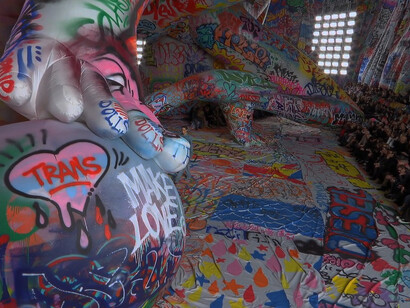
One of Martens’s greatest achievements is how seamlessly the Diesel aesthetic transitions from the runway to the retail environment. The FW2025 show, staged in a space that resembled a post-digital factory, set the tone with its sculpted silhouettes and distressed surfaces. The collection balanced sensual minimalism with raw materiality—knit dresses that clung to the body like armour, tailored sets that suggested utilitarian discipline, and accessories crafted from inflated or wrinkled leather.
The Paris window mirrors this aesthetic language in miniature. The mannequins’ minimalist postures echo the runway’s discipline, while the chaotic pedestals recall the runway’s material experimentation. The lighting—icy blue with streaks of red—evokes the same emotional temperature as the show’s industrial soundtrack. Everything functions as a coded ecosystem: the store becomes a gallery, the street becomes an extension of the runway, and the pedestrian becomes a viewer inside Diesel’s universe of controlled disarray.
Importantly, this continuity between runway and window challenges the conventional hierarchy of fashion presentation. Diesel’s retail space doesn’t simply commercialise the runway vision; it continues it. The brand blurs boundaries between art installation, product display, and conceptual storytelling, demonstrating how fashion communication can exist across different mediums without losing its coherence.
The politics of fabric: gender, identity, and rebellion
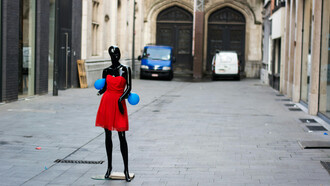
Diesel’s FW2025 also continues Martens’s exploration of gender fluidity through material experimentation. The Paris window shows both masculine and feminine silhouettes—two mannequins in dark utilitarian coordinates and a singular feminine figure in a minimal black dress. Yet, the difference feels more stylistic than essential. Both figures embody the same aesthetic ideology: a tough sensuality that rejects ornamentation in favour of texture and attitude.
In this sense, the window display becomes a tableau of contemporary identity politics. The shredded denim backdrops symbolise the tearing apart of old binaries and hierarchies, while the cohesive colour palette suggests unity through chaos. Diesel’s rebellion has matured—it’s no longer the youthful defiance of the 1990s but an intellectual resistance to conformity itself.
The handbags—soft, crushed, and amorphous—contrast with the structured garments, suggesting a new form of mobility and softness within strength. The boots and shoes, displayed like relics on their textured pedestals, recall the brand’s early connection to subcultures—punk, rave, and industrial streetwear—but reinterpret those references through a refined, contemporary lens.
Martens’s Diesel speaks to a generation that sees rebellion not as spectacle but as authenticity, not as noise but as texture.
Light, colour, and atmosphere: the theatre of contradiction
The play of lighting in the Diesel Paris display is as crucial as the objects themselves. The alternating glow of red and blue casts the denim textures into states of transformation—neither warm nor cold, neither alive nor dead. It gives the impression that the store is breathing, that the material is pulsing beneath the surface. This lighting echoes the FW2025 runway, which used flickering strobe effects to simulate a world in flux—one caught between collapse and rebirth.
The red light carries symbolic weight: passion, danger, and the industrial glow of machinery. The blue tones evoke the coolness of denim and digital screens. Together they form a chromatic dialectic—analogue and digital, human and machine, emotion and detachment. This visual contradiction defines Diesel’s visual politics: beauty born from conflict, luxury carved from residue.
Even the mannequins’ poses contribute to the installation’s emotional rhythm. They stand motionless yet expressive, their lack of heads emphasising anonymity and universality. The display refuses traditional glamour in favour of existential realism—it is about material, not fantasy; about process, not perfection.
Diesel and the aesthetics of ruin
At its core, Diesel FW2025 can be read as a study in the aesthetics of ruin. Both the runway and the store window find beauty in decay, using destruction as a creative tool. This approach situates Diesel within a broader cultural movement that romanticises the remnants of industrial civilisation—the factories, the waste, the glitches—as metaphors for resilience in the digital age.
But Martens’s interpretation is distinct in its sensuality. His ruins are not cold or sterile; they are tactile, intimate, and charged with emotion. The shredded denim, when viewed closely, resembles skin—torn, repaired, vulnerable. The black dress on the mannequin, simple yet assertive, becomes a counterpoint to the chaos surrounding it: the human figure re-emerging from the rubble.
In a world obsessed with newness, Diesel’s decision to celebrate remnants feels radical. It invites viewers to confront the material consequences of consumption while finding poetry in what remains. The store window thus becomes a kind of shrine—not to perfection, but to endurance.
A post-industrial future: redefining “successful living”
Through its Paris display and FW2025 runway, Diesel proposes a redefinition of success. No longer tied to wealth, polish, or permanence, success is instead linked to adaptability—to the capacity to reimagine, reconfigure, and reinvent. “For Successful Living” becomes a manifesto of survival in a fractured world.
The denim ruins remind us that the old systems—of production, of consumption, and of glamour—are collapsing. Yet, amid this collapse, Diesel offers an alternative vision: one where fragments become foundations, and imperfection becomes the new ideal. The brand’s visual universe feels almost philosophical—an invitation to find grace within the wreckage.
This ethos resonates strongly with Martens’s own design philosophy: an architecture of impermanence, where every garment carries the memory of what it once was. The Paris window, with its fossilised denim and ghostly textures, crystallises that vision in spatial form.
From matter to meaning
Diesel’s FW2025 visual world—both on the runway and in its Paris store—embodies a compelling synthesis of material experimentation and conceptual depth. The use of shredded denim, dark minimalism, and industrial light transforms the brand’s heritage into a living metaphor for the contemporary condition.
The window display is not simply a marketing tool; it is an act of storytelling. It tells of a world built from ruins, of beauty born from debris, of fashion’s power to make meaning out of matter. The dialogue between the tactile chaos of denim and the sleek control of modern tailoring becomes the very essence of Diesel’s identity today.
Glenn Martens has achieved what few creative directors manage: to turn a mass-market denim label into a philosophical brand, capable of addressing the anxieties and desires of the present through design. His diesel speaks of destruction not as an end but as a beginning—of fashion as a continuous act of re-creation.
And as the red logo glows above the shredded landscape in the Paris night, one thing becomes clear: Diesel’s idea of “successful living” in 2025 is not about comfort or perfection—it is about survival, transformation, and the courage to find elegance amid ruins.