English
 Español
 Français
 Deutsch
 Italiano
 Português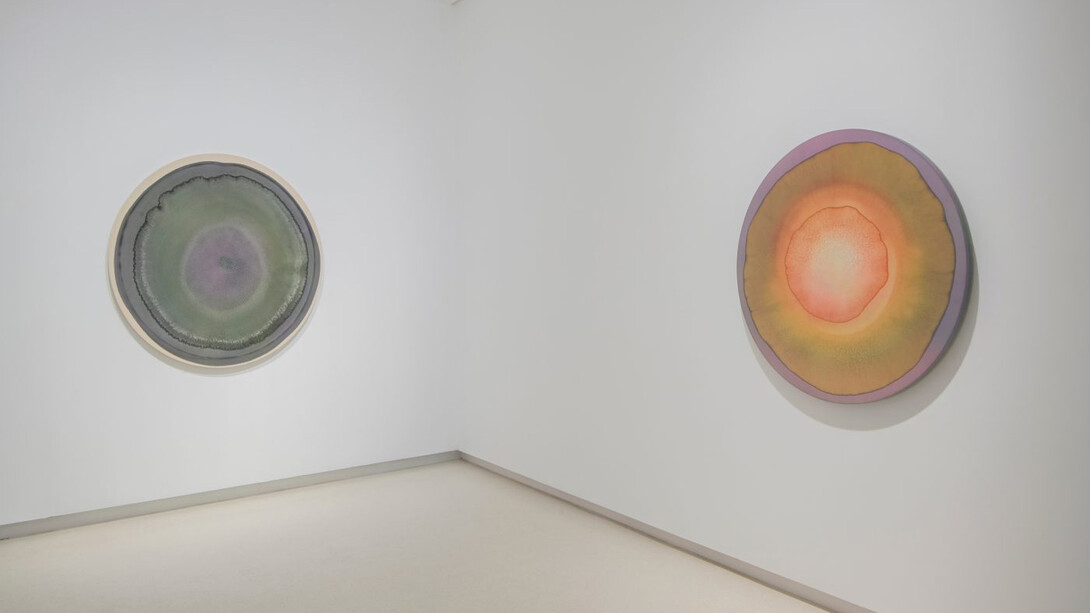
These works reveal everything that is not evident to the eye: gravity, heat, light, wind — elements that are only perceived and acquire meaning when we observe them closely.
(O. Eliasson)
Galería Elvira González presents Your immeasurable expanse of flares, Olafur Eliasson’s fifth solo exhibition at the gallery, bringing together 19 paintings and 2 light installations. The exhibition will open to the public on Wednesday, February 25.
In his ongoing investigation into light, color, perception, and various optical phenomena, Eliasson explores the relationship between chance, matter, and sensory experience. The works presented in this exhibition span different lines of inquiry, yet all share the common denominator of the experimental process that takes on a central role.
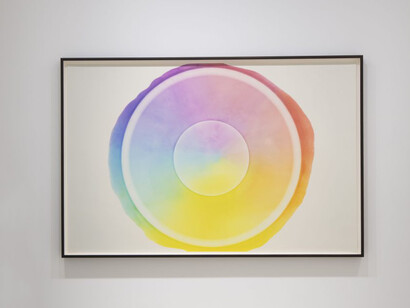
Some of the paintings in the show such as Seven days of sunlight (Monday–Sunday) (2026), The self-led energy nebula (2026) or Dark lichen for brighter days (2026) are created by pouring highly diluted inks mixed with isopropyl alcohol onto unprimed circular canvases. The pigment slowly expands outward, forming vibrant halos.
“In the circular paintings, intention and accident coexist — a tension between natural forces and the controlling power exerted by the act of creation.” As Eliasson notes, a subtle intervention through heat and directed air currents guides or restrains the movement of the paint. The resulting composition emerges from the convergence of chance, the material’s viscosity, the qualities of the support, and the atmospheric conditions of the moment.
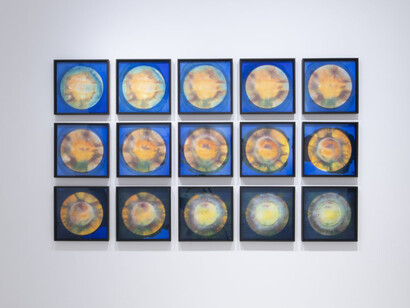
The exhibition also includes works such as Transformative self-led colours (2026). This installation consists of fifteen works made from a single block of watercolor paper, where each sheet absorbs the excess ink from the previous one, generating an organic sequence of interconnected compositions. In this piece, a translucent blue blown-glass panel with a large circular opening acts as a passe-partout, emphasizing the central explosion of color.
Another key focus of the exhibition is the “flares” series, inspired by the optical phenomenon of lens flare—those rings and circles of light that appear when a camera is pointed toward an intense light source. Eliasson understands these phenomena as “mysterious accidents,” which, although traditionally considered errors in photography, he transforms into the main subject of the composition.
In works such as The attention flare (2026), through the use of circular stencils and the pouring of ink and black paint, the artist creates undulating dark fields that reveal the luminous contrast of ellipses and chromatic circles, evoking the illusion of light in space. These deep black backgrounds, in Eliasson’s words, “could be understood as voids,” achieving “an apparently indeterminable depth”.
Within this series, some works such as The rare flare (2025) and The subconscious flare (2025) display the reverse side of the painted surfaces, presenting paler, more spectral images. In these pieces, the black pigment has not fully penetrated the paper, simulating a kind of afterimage that echoes the “positive” works.
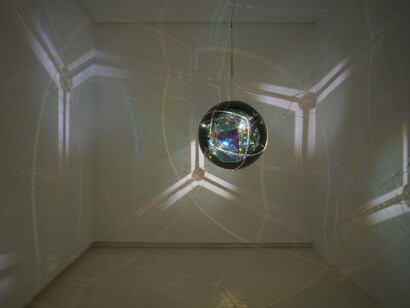
Positioned along the exhibition route and as a spatial counterpoint we find Fireflybiosphere twilighting (2022) a suspended sculpture from a series of sixteen polyhedra developed after decades of research in the artist’s studio.
The work is composed of three concentric polyhedra: two internal structures that interlace and rotate via a motor, LED lights that illuminate the core, and a segmented bubble made of twelve rhombi with eight visible faces that encloses all the elements. The sphere combines blown glass with chromatic-effect filters that reflect a single wavelength while allowing others to pass through, multiplying the projections of the elements and intervening throughout the surrounding space.
With Your immeasurable expanse of flares, Olafur Eliasson proposes an immersive experience in which painting and light enter into dialogue, inviting viewers to become aware of the physical processes that construct the visible and to reconsider the role of chance and accidental transformation in the formation of visible reality.