English
 Español
 Français
 Deutsch
 Italiano
 Português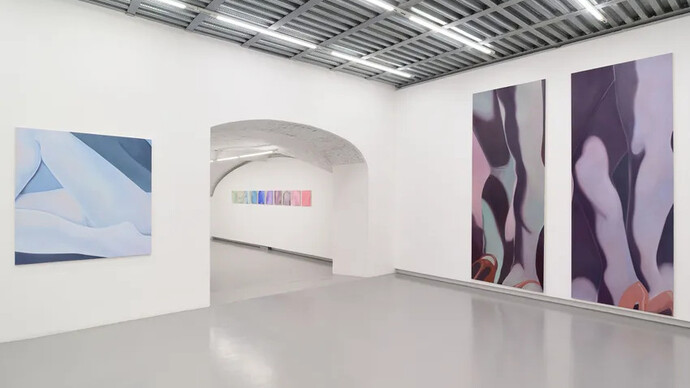
Several years ago, The Box had just opened on New York’s Lower East Side. The artists’ dressing rooms—where performers in drag were getting ready to take the stage—were open. No hierarchy, no artificial distance was created, just bodies in transformation, irony, shared joy, and the sense of belonging in their eyes. More than a mere show, there was an understanding: you can be yourself here. “Club culture was never only about music. It was about the possibility of another life.” 1
If club culture had created temporary spaces of freedom in otherwise often hostile contexts—from the AIDS crisis to the day’s resurgence of conservatives—what does the dance floor really mean? For those who have experienced it, a dancefloor is much more than the name it goes by: it’s a political and emotional arena. The floor can become a space built by bodies exposing themselves without judgement, where complicit gazes can be exchanged with no thoughts of possessing. The floor is a place of both spontaneous movement and deep connection. Paradoxically, however, it’s a fertile circle of solitude; there are moments when you know you’re completely alone with yourself even while being totally immersed in the collective.
Adelisa Selimbasic’s works possess the same power: they are austere, essential, unexpectedly severe and focus exclusively on the human body. Although no specific scenography may be discerned in this new exhibition, the paintings evoke distinct possibilities. In queer history, nightclubs have provided both refuge and social infrastructure. From Afro-American ballrooms to radical nights at Paradise Garage and post-Wall European clubs like Berghain, dancefloors have functioned as workshops in identity and resistance, as places where bodies—especially female, queer, non-conforming bodies—have been able to elude strict regulatory surveillance and reinvent themselves.
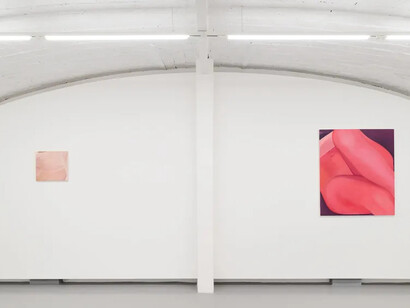
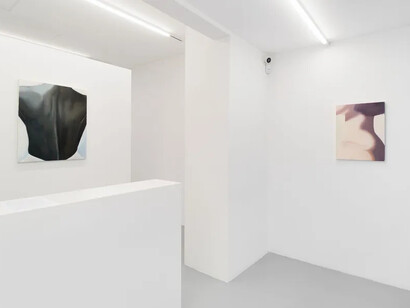
Here’s a story that can’t be told, one you must absorb. In composing The dancefloor, Selimbasic looks nearly exclusively at legs—fleshly uprights, three-dimensional segments that throb with tension. Poses are not relaxed; there’s always energy under restraint, gestures verging toward expression. Knees bend. Muscles wrapped in tights tense visibly. Lines become sculpture. It’s the body, that unstable structure as temporary and fleeting as the architecture of the nightcrawler community. “Virginia Slims” comes to mind, the monumental advertising diptych in which the shapely legs and curling smoke from the iconically slim cigarette are hard to miss.
Tights are a form of political skin historically linked to the construction of femininity, seduction, and gender performance. In The dancefloor, they become an act of transformation. Stretched over skin, they create landscapes of ever-changing intensity: transparencies, vibrations and fields of subtle chromatic variation interacting with nearly monochromatic backgrounds.
These backdrops are minimal, reduced to textures that muffle sound to bring back silence. They define and enable space, dancefloor space, an independent, provisory, fragile place.
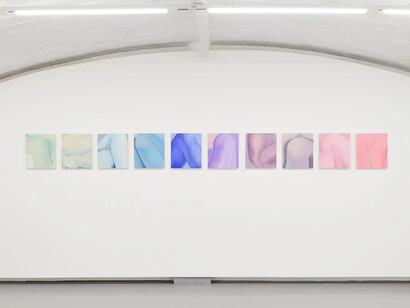
The titles of the works are not accidental, they’re parts of Selimbasic’s personal world, her own “guilty pleasures”: Purple sponge cake with mirror glaze, Raspberry coulis, Meringue, Bright green matcha mousse, are just a few from her personal pastry repertoire. There’s no lack of carnality or more descriptive allusions. Boiling ice gives us legs with even more sensuality, if not explicit eroticism.
In this series of paintings, color plays a decisive role; tights act as filters that transform skin and strip it of its original identity; bodies are no longer defined by natural colors but by new chromatic surfaces that redefine them. In this way, legs create scales of intensity, a sequence of shades ranging from reds to purples and greens, from deep grays to lighter, almost inexistent hues. Color creates unexpected landscapes and emotional perspectives, as if each body were suffused with its own luminous atmosphere. At the same time, color evens out and erases differences in both skin tone and gender. Veiled in tights, each body comes into the same visual field. Contrasting with these intense chromatic presences, backgrounds remain neutral—they are suspended surfaces that do not compete with the body but embrace it, and let legs build the space and mark the composition’s visual rhythm.
A precise dialectic emerges between the sculptural tension of the legs and the ethereal quality of the background—individual and collective, exposing and protecting. Above all, a moment of intimacy in the middle of the crowd is created. This ambivalence is central to the subjects of the paintings: the body is offered to the gaze but remains fragmented without surrendering itself entirely. It’s free, but its freedom arises from the awareness of its vulnerability, and the tension between exposure and protection is, in all probability, the fulcrum of artistic production.
(Text by Michele Spinelli)
Notes
1 A quote attributed to Mark Fisher, a British philosopher and cultural theorist known for his work on pop culture, electronic music, and contemporary capitalism (author of Capitalist realism, among other works). The phrase is often cited in discussions about club culture and the political and social legacy of electronic music.