English
 Español
 Français
 Deutsch
 Italiano
 Português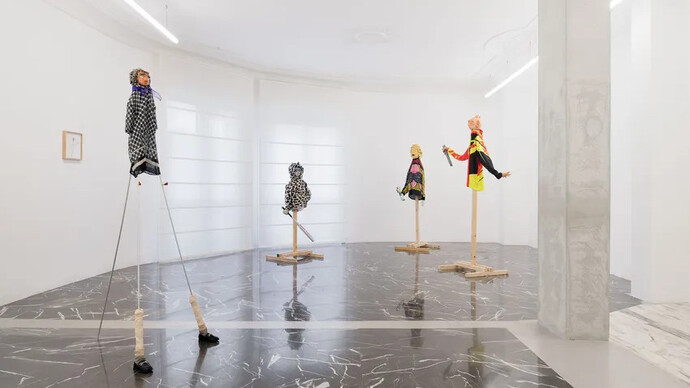
z2o Project is pleased to present Surface, friends, fantasy, the first solo exhibition by Luca Parise (Paris, 1991) in Rome, at the gallery space on Via Baccio Pontelli 16, curated by Enrico Camprini.
The three words that give this exhibition its title, placed side by side almost as an unordered list, began to surface with a certain frequency in the conversations that Luca Parise and I have been carrying on since our first and, all things considered, chance encounter about a year ago, between Versilia and the Apuan Alps. Their recurrence does not turn them into key concepts for framing a practice or, as if that were of any use, into guidelines for explaining what the artist does. Rather, I see in them a sincere and meaningful catalytic value: a trigger for the relationship between each individual work and its viewer, and for the sketch of a narrative toward which the exhibition gravitates, without ever confirming or denying it. Surface, Friends, Fantasy will recur throughout this brief text as well – words that one hopes might activate imaginaries and open up perspectives, rather than articulate a fully-fledged argument. What might appear to be a problem – an undulating, perhaps unsystematic practice – is in fact the most compelling element of Parise’s work. Whether through an installation-based approach or, as in this case, a more distinctly sculptural one, the artist moves according to a kind of felicitous improvisation. This improvisation translates into the work as a sum of material, formal, and compositional decisions that largely resist any predefined script – one that only later, and only in our eyes, seems to emerge.
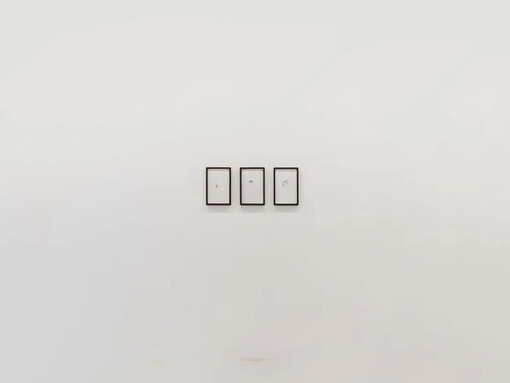
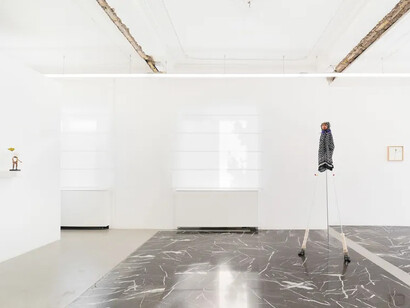
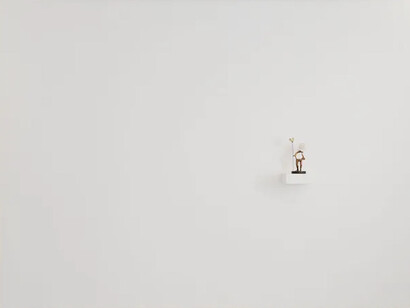
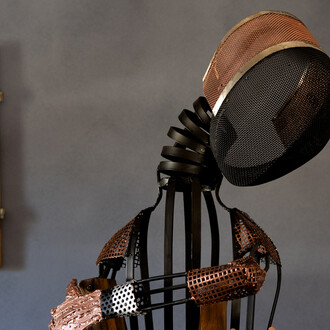
Thus the exhibition itself takes shape: a group of sculptures and a group of drawings, clearly interrelated, to the point of suggesting an intention to evoke a narrative that encompasses them – the humanoid figures tower in space, bearing proper names and assigned genders, forming a cast of characters seemingly in dialogue – yet at the same time the exhibition withholds the coordinates that might orient such a story. It is up to us, should we feel the need, to imagine the reasons and meanings behind this curious sculptural assembly, whose members in fact each stand on their own; each endowed with peculiarities and details that, rather than functioning as elements of a hypothetical plot, are quite concretely the outcome of a compositional exercise carried out by the artist through trial and error. Within these variations on the human figure, the drawings do not play an ancillary or preparatory role, but rather a complementary one to the sculptures – constituting a parallel offshoot of that same felicitous improvisation that characterizes Parise’s current practice. Among the numerous and at times markedly different drawings, there is a small series in which the figure, always solitary, seems to come into being almost through a single stroke: a linear annotation that delicately suggests the essential traits of a body, with a distinct predilection for the careful rendering of small faces. The name given to this fragile figurative synthesis, in its variations, is Nefelibata – literally “cloud-walker” – a poetic term of Portuguese origin and Greek derivation referring to a dreamer, or more generally to someone who stands outside conventional frameworks.
On further reflection, “walking among the clouds” is a curious expression. Its meaning, of course, does not stray far from the more common “having one’s head in the clouds,” yet I find that its suggestion of a certain movement – an activity that is, par excellence, a matter of surface – produces an oxymoron capable of leading us, lightly, to the heart of the matter. Parise’s attitude – sufficient to account for the works we see – stems from a balance between the need to find an anchorage in the things of the world and the desire to reimagine them, between surface and fantasy. Indeed, any artistic practice can only situate itself between these two poles, especially for a generation such as ours; and equally true is the difficulty of finding that balance. A fantasy that does not lapse into escapism and derealization; an adherence to the world that does not reduce it to normative didacticism.
In any case, what interests the artist in things is what is quite literally superficial – commonplace, to borrow a term from Arthur Danto – that is, banal, trivial, and certainly lacking in depth from the standpoint of a thematically and intellectually “engaged” practice. If some years ago he created bizarre installations of a double nature (an exhibition space shaped like a sauna, a semi-automatic “drawing machine”), and if we now find ourselves before works that recall both mannequins and theatrical props, yet present themselves as autonomous sculptures, it is because, for Parise, the dimension of fantasy acts directly upon that flat and modest surface – activating it so as to produce images that are unexpected and, in some way, persuasive.
Fantasy recombines the surface; it rearranges it. In this sense, retrospectively, we might think of the sculptures in the exhibition as a hypothetical group of friends. Born as individual experiments in composing the human figure, I first encountered them gathered for purely practical reasons of space in the artist’s bedroom. Yet he also said he wanted them all there with him, as though their mutual existence required validation by his own gaze. Conceived in solitude, they become not a series but a group, insofar as they share not only formal traits but, above all, a peculiar emotional consistency – a disquieting sense of “humor”. Manuela, a comical and lugubrious giantess wearing dainty ladies’ shoes and little red hands modeled with the wax that coats Babybel cheeses; Cacciatore celeste (Parise is fond of the books of Roberto Calasso), with his sly smile, a flashy motocross jersey, and a menacing – if hardly convincing – large knife, paired with Marco, who instead brandishes a flower, clutching it as though it were the last thing left to him, his face – absurd as it may sound – relaxed into a lament. The group is completed by Charlotte, a scowling humanoid who seems to have stepped out of a cyberpunk video game, wielding a baseball bat – this one genuinely threatening – onto which a large sticker bearing the name of Mark Fisher has been affixed, as if she were ready to strike us all down with blows of “theory”.
What remains, finally, to be examined in this exhibition is the attention devoted to faces. A common denominator of both drawings and sculptures, they appear to be the element from which Parise’s practice – whether in the modeling of matter or in graphic line – takes its departure; or perhaps the opposite is true, and we might imagine them instead as the point of arrival of an entire compositional process. I am reminded of a well-known text by Antonin Artaud on the inexhaustible and tragic multiformity of the face, which “has not yet found its own visage […] has never corresponded to its own body but has from the very beginning been something other.”
I cannot help but think that, within this play of assemblages and juxtapositions, the faces of the artist’s sculptures can only be provisional – masks whose names serve merely as a pretext, each time, for ensnaring the viewer’s gaze.
(Text by Enrico Camprini)